Uk politics

Mali is a British concern because it is a European concern

Aaron Ellis makes a good point: the comparison between Mali and Afghanistan is flawed. But I disagree with him as to why. Afghanistan was a failed state long before al-Qaeda settled there (as a last resort). The pattern is slightly different in Mali: Islamists have further destabilised an already weak country in a strategically sensitive area. Mali has been wracked by unrest, both ethnic and religious, for some time. The country is so poor (as a glance at the CIA World Fact Book’s approximations demonstrates) that is precarious politically; so precarious that it threatened to undermine some of its delicate neighbours along the Sahel (the massive and growing strip where

Mali is not another Afghanistan

Why should we worry if jihadists control a poor, landlocked country thousands of miles away? As the French push on with the ‘reconquest’ of Mali, there’s a feeling here that Britain must play its part in preventing a terrorist safe haven on Europe’s southern border. Some compare the situation to pre-9/11 Afghanistan. Back in May, Ian Birrell warned that we ‘have seen the damage caused by a broken, chaotic country – and how Islamist terror groups promising stability can fill the void.’ The ‘shockwaves’ from Mali ‘could be felt far beyond its own borders’ just as the ones from Afghanistan were felt in New York and Washington. Bob Carr, Australia’s

David Cameron tells porkies about Britain’s national debt

And then David Cameron has to go and spoil it all by telling porkies about what his government is doing to our national debt. The party election broadcast the Conservatives have just released is so astonishingly dishonest that it really would have disgraced Gordon Brown. In it, the Prime Minister tells an outright – how to put it? – untruth. He says:- “So though this government has had to make some difficult decisions, we are making progress. We’re paying down Britain’s debts.” listen to ‘David Cameron: “We’re paying down Britain’s debts” 23 Jan 13’ on Audioboo David Cameron’s policy is to increase Britain’s debt by 60 per cent, more than

The EU renegotiation pantomime

Today’s midday press briefing at the European Commission was of course dominated by questions about the Cameron speech. This was despite efforts by Pia Ahrenkilde Hansen, Barroso’s spokesman-in-chief. First she tried to downplay the implications of the speech by making an anodyne statement welcoming democratic debate in member states. Then she announced that questions on Cameron’s speech would be limited to three. A growl came up from the press corps that indicated she should think again. So she took more questions. She just didn’t much answer them. I asked Pia if she could describe for me any existing mechanism under present treaties by which Britain could claw back powers which

Tory MP: The public will struggle to believe Cameron’s EU pledge

Six months ago, the word ‘referendum’ had not even passed David Cameron’s lips. The issue was not on the table. I would, therefore, like to thank the 100 Conservative Parliamentary colleagues who co-signed my letter in June, urging the Prime Minister to commit to a referendum. In a small way, I like to think our efforts helped to change his mind. We can now have a vigorous debate. However, whilst not doubting the Prime Minister’s sincerity, I am concerned his pledge will not be believed by the public. Far too many promises have been broken in the past, such as Blair’s promise on the EU Constitution and the Liberal Democrats’

The Spectator: One step ahead of David Cameron’s EU manoeuvres

While David Cameron’s EU speech today made all the front pages, it is far from fresh news. Two weeks ago, James Forsyth revealed to Spectator readers what the Prime Minister would say in his speech. But as far back as last May, we revealed that a referendum on EU membership was almost certain: A referendum on Europe is the obvious answer. It is one the leadership seems set to embrace. The popularity of Cameron’s EU veto made his circle realise how much of a political asset Euroscepticism could be, if used in the right way. There is also concern in No. 10 that if the Tories don’t offer the public a

The private rented sector is blocking aspiration and isolating families

The private rented sector is no longer fit for the people it now serves. Almost half of those renting are over 35, and the proportion of privately rented homes has rocketed by 69 per cent. As MPs debate standards in the sector this afternoon, we’ll have to recognise that it isn’t just Neil and the Young Ones, but families who typify this part of the market, and it needs to change to recognise that. The default tenancy is the Assured Shorthold Tenancy, which allows landlords and tenants to enter into short-term agreements with regular rent reviews and the ability for either party to break after six months with one month’s

Labour’s ‘for now’ policy on an EU referendum

The Tory spinners were in an exceptionally good mood after PMQs today. The general feeling was that Ed Miliband had messed up, and this wasn’t helped by his aides having to clarify that when he told the Prime Minister that ‘my position is no – we don’t want an In/Out referendum’, he actually meant that currently they don’t want an In/Out referendum now. ‘The position has not changed,’ said one party source. ‘We do not think that an In/Out referendum is a good idea. We will not do anything which damages the UK economy.’ But they added that they were not ruling one out forever. And they were not ruling out

Why meddling with A-levels won’t work

Conservatives will, no doubt, welcome the government’s announcement about A-levels today. Modules will be abolished. We will return to one tough exam at the end of the two years of study. Life will go back to the golden era of the 1970s when the top people got As and Bs and everybody else got a random selection of C-F because they struggled to understand the questions. It is true that the old system had some merits. It was especially good for selecting the brilliant from the very good. However, in its latter days, for the vast majority of people taking A-levels, the system did not work. The current modular system

PMQs: It’s Cameron’s turn to have some fun

Last week at PMQs, Ed Miliband had great fun, mocking the wait for David Cameron’s Europe speech. He lampooned the Prime Minister as the weak leader of a divided party. It was a performance that disturbed even some normally calm Number 10 aides. But this week, it was Cameron who was relishing PMQs. By the end of the session, he was even telling Dennis Skinner — who normally brings out the Prime Minister’s irritable side — that he might agree with the speech Cameron is  giving in Davos tomorrow. Now that Cameron has set out his position, Miliband is under pressure to follow suit. Miliband appeared to rule out a

Cameron’s EU referendum pledge makes winning the Battle for Britain more difficult

At the risk of seeming parochial, I’d suggest that David Cameron’s long-awaited Europe speech and his endorsement of an In or Out referendum has implications and consequences for another referendum campaign closer to home. I suspect he has bought himself some time on the Europe question but this comes at a price. He has made winning the Battle for Britain – to be decided in 2014 – more difficult. The SNP should be very pleased today. Cameron has demolished a couple of core Unionist arguments. He can no longer credibly point to the unknown uncertainties of Scottish independence. Not when he has embraced, even made a point of celebrating, uncertainty

Sketch: Cameron’s EU climax

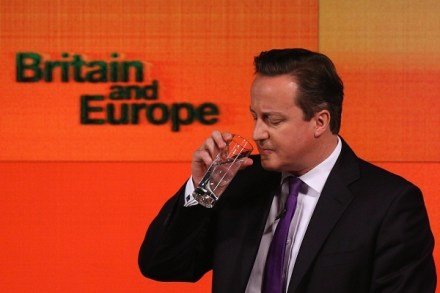
This was no tantric anti-climax. This was a seismic moment in British politics. David Cameron breezed into a London press conference this morning and proceeded to reshape Europe. The wooden lectern he stood at was pale and municipal. He wore a dark suit and a nice purple tie, and his affable pink chops glowed with moderation and good sense. He looked like a council negotiator arriving to settle a hedge dispute between warring neighbours. The Euro-crisis will lead to the restructuring of Europe, he said. He called for a new design that would incorporate more openness, flexibility and competitiveness. And the single market, not the single currency, should lie at

‘Mrs Bone was singing in the shower’: PM’s EU speech delights Tory MPs

David Cameron should savour today as the moment he finally satisfied Mrs Bone. I’ve been calling round Tory MPs, and Peter Bone, often a thorn in the flesh of the Prime Minister with his probing questions that his wife wants clearing up, is happy with the speech. He says: ‘I could hear Mrs Bone singing in the shower room and it included the words “for he’s a jolly good fellow”.’ Bone explains why his household is filled with such joy this morning: ‘I am in a very good mood. A year ago, if I had said to you the Prime Minister is going to renegotiate the terms of the EU

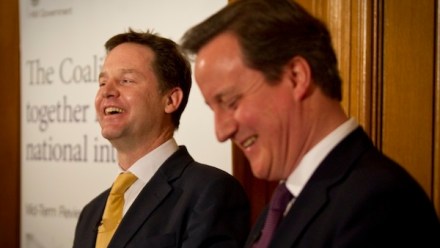
David Cameron puts Nick Clegg on the spot

Downing Street always hoped that once David Cameron had given his Europe speech, the pressure would shift on to the other party leaders. They believed that once Cameron had committed himself to a referendum, Ed Miliband and Nick Clegg would be required to say whether or not they’ll match this pledge. But Cameron has put particular pressure on the Deputy Prime Minister by making clear that renegotiation and a referendum will happen if he is Prime Minister after the next election. In other words, this is not up for debate in any 2015 coalition negotiation. Every interviewer can now ask Nick Clegg if he and the Liberal Democrats could be

Cameron’s red meat EU speech: five key points

Cameron has finished delivering his ‘red meat’ speech on the European Union and answering questions from journalists. You can read the full text here, but here are five key points to take away: 1. The Prime Minister is a pro-European sceptical about the current EU settlement It actually took Cameron a long time to reach his vision of a new Europe because he was so busy praising its history. We had a whistle-stop tour through the EU’s creation, dotted with praise for its peacekeeping mission first. He was clearly keen to emphasis his pro-European credentials as much as he was to criticise, saying: ‘I am not a British isolationist’ and

David Cameron’s EU speech: full text

This morning I want to talk about the future of Europe. But first, let us remember the past. Seventy years ago, Europe was being torn apart by its second catastrophic conflict in a generation. A war which saw the streets of European cities strewn with rubble. The skies of London lit by flames night after night. And millions dead across the world in the battle for peace and liberty. As we remember their sacrifice, so we should also remember how the shift in Europe from war to sustained peace came about. It did not happen like a change in the weather. It happened because of determined work over generations. A

David Cameron’s EU speech: the Coffee House guide

Downing Street has tonight released the following extracts from David Cameron’s speech on the European Union, which he will deliver tomorrow at 8am. Here’s your guide to what we know so far: 1. An unwilling EU could sleepwalk Britain out of the union ‘I speak as British Prime Minister with a positive vision for the future of the European Union. A future in which Britain wants, and should want, to play a committed and active part. ‘If we don’t address these challenges, the danger is that Europe will fail and the British people will drift towards the exit. ‘I do not want that to happen. I want the European Union

Schools can teach good character and the 3 Rs

Education debates are riddled with false choices, as Michael Barber notes in his recently published essay Oceans of Innovation. It’s academic or vocational; it’s best practice or innovation; it’s the three Rs or character development. These are the choices, we are told, that must be made. It plays well for those in pursuit of the politics of dividing lines but it is detrimental in policy terms. I want to see rigorous academic and vocational routes for young people in 14- 19 education. That is why Labour will bring forward a Technical Baccalaureate, with a strong focus on technical education and with Maths and English to 18 for all. If we