Uk politics

Tim Loughton vs the Department for Education, round 2

The battle between Tim Loughton and the Education department rumbles on, with new foot soldiers joining the fray. The latest shot fired in the war comes from Labour’s Stephen Twigg, who has demanded an investigation into the quotes we ran on Coffee House last week from a senior DfE source which described the former minister as a ‘lazy incompetent narcissist obsessed only with self-promotion’. Twigg has written to the department’s Permanent Secretary Chris Wormald, saying the following: ‘You will be aware that both special advisers and civil servants are bound by a code of conduct, which precludes them from making personal attacks.’ In the letter, which you can read in

Austerity latest: spending up, deficit up.

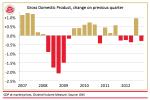
We can all overdo it a little at Christmas, but the government’s monthly overdraft statement — which came in this morning — is of a different order. In December, HM Treasury spent £15.4 billion more than it received in tax, a worse result than December last year where the monthly deficit was £14.8 billion. And why? Well, growth has been sluggish (we may learn on Friday that the UK economy is shrinking again) so tax revenues have fallen. But, more worryingly, state spending seems to be running out of control too. The below graph, from Citi, sums it up. The blue is what is expected (from those fiscal Mystic Megs at

Talk of a leadership challenge to David Cameron is reckless self-indulgence – Spectator Blogs

For reasons I do not wholly understand, Labour partisans appear reasonably pleased with Ed Miliband. Liberal Democrats may not be especially gruntled with Nicholas Clegg but they do appear to appreciate that there’s little point in changing leader now. Which brings us to the Conservative party. And there we discover madness aplenty. Again. For it seems as though more than 50 Tory MPs are sufficiently dissatisfied with David Cameron’s leadership that they think a change of leader something worth considering before the next election. This, for all the reasons Robert Colvile suggests and many more he doesn’t, would be folly. Madness. Lunacy. Proof that the party is unfit for office.

Restoring the 10p tax rate would be fair and simple

MPs will today debate taxes and the living wage – in particular, my campaign to restore the 10p rate of income tax. For Conservatives, a ‘starter’ rate of 10p would help us to counter the Labour war-cry that the Coalition is only interested cutting taxes for millionaires. It would prove to the electorate, that this Government is on a moral mission to help the poor, by boosting the cash income of a worker on minimum wage by more than £250 a year. As Tim Montgomerie puts it: ‘We must declare very loudly and clearly that tax cuts for the working poor will be our priority as the economy picks up.’ As

The Succession to the Crown Bill is a constitutional can of worms

Today, the Succession to the Crown Bill will receive its second reading in the House of Commons. If one had to think of one person who would welcome this plan to ‘modernise’ the Monarchy, it would have to be that arch-Blairite, Baroness Jay of Paddington. But she popped up yesterday in her capacity as chair of the Lords’ Constitution Committee, to warn of the potential ‘unintended consequences’ of the Bill and to decry the use of the emergency fast track procedure to rush it through. Surely some mistake? Actually, no. Baroness Jay arguably knows more than anybody about tinkering with the constitution, having made it her life’s work. Despite the

Labour opposes benefit cuts: for now, anyway

Last night’s debate on the bill capping benefit rises at 1 per cent was far more revelatory than it might first have appeared. It wasn’t Labour’s conclusion that the Tories were evil and the Lib Dems (those that turned up, at least: there were nine rebels, but a further 11 Lib Dem MPs were mysteriously absent) just as bad. But the most interesting revelation was the way the party handled this exchange: Charlie Elphicke: Is it therefore the right hon. Gentleman’s and the Opposition’s policy that uprating should be not by 1%, but by inflation? Is that a commitment? Stephen Timms: Uprating should indeed be in line with inflation, as

Tory MPs to press Theresa May on Bulgarian and Romanian migrants

Tory backbenchers will raise concerns about the government’s preparations for the lifting of controls on Bulgarian and Romanian migrants at a meeting with the Home Secretary in the next few weeks, I understand. Conservative MPs are becoming increasingly nervous about the situation, fearing that if handled poorly, it could have a particularly bad impact on the party’s performance in the 2014 European elections, as the transitional controls end on 31 December 2013. One of those worried backbenchers is former ministerial aide Stewart Jackson, who tells me he is considering introducing a modified version of the 10-Minute Rule Bill that he brought before the House in October. The European Union Free

David Cameron redoubles his commitment to interventionism

David Cameron’s Commons statement on Algeria just now was the most interventionist speech he has made since the one he delivered at the Foreign Policy Centre during his 2005 leadership bid. But this speech is far more important than that one because it is what he actually believes; the 2005 speech was written by Michael Gove and was given more to tick the leadership contest’s foreign policy box than anything else. Listening to Cameron today, it is clear that the events of recent days have led him to redouble his commitment to interventionism. Indeed, in his talk of the ‘generational challenge’ and the need to ‘beat them [the terrorists] militarily’

Boosting the private sector in Wales

Wales, sadly is one of the poorest regions of the United Kingdom. GVA stands at 75 per cent that of the UK average. Just 1 in 16 people earn more than £35,000. There is an over reliance on the public sector, and we must boost growth in our private sector. Too often the approach seems to be to sit back and expect an outside investor to come in and provide our future success, but we need to harness the talent and the enterprise we have here already. Today, the Welsh Conservatives launched a new policy aimed at helping our striving small business owners to access finance – imperative for the

The Labour MPs who could make trouble for Ed Miliband on Europe

So the Prime Minister’s speech is, as James hinted yesterday, going to be on Wednesday, and in London to avoid any further strikes of the Curse of Tutancameron’s Europe speech. His official spokesman confirmed the date this morning. Thanks to briefed extracts and further briefings over the weekend, we now have a rough outline of what’s going to be in it, which will mean it’s impressive if anything the David Cameron says causes anyone in the audience to gasp with surprise. What is more exciting is what the response will be from the other benches in the Commons. Labour spokesmen on the broadcast rounds yesterday were squirming rather when asked

Big Brother (and HMRC) is watching you

It’s the anniversary of George Orwell’s death today – and HMRC seem to be marking the occasion with adverts in cashpoints celebrating their emerging status as the Big Brother of Britain. The above picture, which I took the other day from a cashpoint, shows a pair of female eyes staring and blinking at you as you take our you money, with the clear message from the taxman: be warned, we have the power to pry. Not yet they don’t: the Snooping Bill has been attacked in parliament and looks like it may not survive. The disingenuous rationale for the Bill was that it would help MI5 crack down on terrorists who

Correction of the Year – Spectator Blogs

Courtesy of Time magazine: This article has been changed. An earlier version stated that Oxford University accepted “only one black Caribbean student” in 2009, when in fact the university accepted one British black Caribbean undergraduate who declared his or her ethnicity when applying to Oxford. The article has also been amended to reflect the context for comments made by British Prime Minister David Cameron on the number of black students at Oxford. It has also been changed to reflect the fact that in 2009 Oxford “held” rather than “targeted” 21% of its outreach events at private schools, and that it draws the majority of its non-private students from public schools

Hague fleshes out Britain’s role in the decades-long response to terrorism

The Prime Minister’s two statements on the Algerian hostage crisis on Friday and Sunday set some tongues wagging about what sort of a role he saw Britain playing in the ‘global response’ that was ‘about years, even decades’ to the terror threat in North Africa. William Hague fleshed that out a little bit more in his Today programme interview, arguing that the West couldn’t resolve all the world’s problems: ‘It is a complete illusion to think that we are omnipotent in all of these respects. Of course there are many, many factors at play. I’m describing to you what the United Nations have been doing, what Western countries have been

Why the Tory leadership thinks it can push gay marriage and boost its support among ethnic minority voters

If the Tory party doesn’t improve its performance with ethnic minority voters, it’ll be nigh-on-impossible for it to win a general election in a generation’s time. The single biggest driver of not voting Tory is not being white and more than one in four under fives in Britain are non-white. This is the background to the Tories’ big push to increase their support among ethnic minority voters and David Cameron’s decision to devote Wednesday’s political Cabinet to the subject. Now, I’m always wary of parties talking about appealing to specific groups rather than individuals. But there is something complex going on here in that even those ethnic minority voters who

The Curse of Tutancameron’s Europe speech

David Cameron’s Europe speech already had a Tutankhamun-style curse on it before events forced him to postpone it, with the much longer delay from its original date of mid-autumn causing a feeding frenzy in the media, in his own party, his coalition partners, and in the opposition. By the end of last week, it was difficult to find an opposition MP or columnist who hadn’t written a whimsical piece imagining they were Cameron giving the speech (or indeed twisting readers into an even greater willing suspension of disbelief by imagining they were John Major talking to Cameron about the as-yet undelivered speech as David Miliband managed to do). James reports

David Cameron: Terrorism in North Africa requires global response

In his latest statement on the Algerian hostage crisis this morning, the Prime Minister built on the interventionist language that James spotted in his Commons address on Friday. Cameron said: ‘This is a global threat and it will require a global response; it will require a response that is about years, even decades, rather than months, and it requires a response that is patient, that is painstaking, that is tough but also intelligent, but above all has an absolutely iron resolve and that is what we deliver over these coming years.’ listen to ‘David Cameron on the Algerian hostage crisis’ on Audioboo

Revealed: the most expensive government services

Anyone mulling how the government can save a tidy sum of money could do a lot worse than to sift through the slew of data released this week by the Cabinet Office on how much government services cost. It sounds a bit techy, but the breakdown of costs underlines how important the  ‘Digital by Default’ approach to public services pioneered by Martha Lane Fox really is. Currently non-digital government transactions cost £4 billion a year. The Government Digital Service believes between £1.7 billion and £1.8 billion worth of annual savings could be made by making transactional services digital. The Cabinet Office data shows that the most expensive Government transaction is the Rural

War in Whitehall or plumbing problems?

Is there really war in Whitehall? Tensions between ministers and civil servants have certainly spilled over at some departments, but there has, as you might expect, been a backlash over the past few days to the Times investigation into the civil service. Former civil service head Lord O’Donnell and Telegraph columnist Sue Cameron have both, unsurprisingly, defended the service. Yesterday Cameron attacked the idea of a ‘war’. She reported that Number 10 had rejected this, with a source saying ‘we don’t have a massive crisis. We don’t have government paralysis’. Reforms in key policy areas such as welfare, health and education were, she said, a sign that the civil service