Uk politics

David Cameron and Michael Gove to abstain on key Recall Bill vote – to keep Lib Dems happy

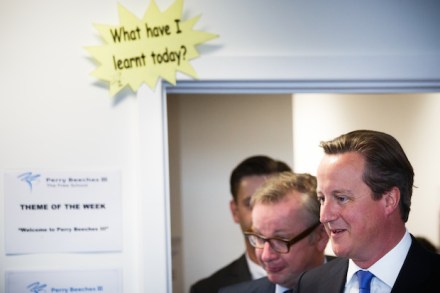
MPs have a free vote tonight on Zac Goldsmith's amendment to the Recall Bill. But I have learned that instead of voting with their Tory colleague, the Prime Minister and chief whip are to abstain in the vote. Michael Gove and David Cameron have agreed to do so, not because they oppose Goldsmith's proposals, which will, he claims, ensure a powerful form of recall rather than that endorsed by Nick Clegg. Instead, they will not walk through the lobbies because the Lib Dems have asked them not to. Clegg and co were apparently wary of an ambush by the Tories whereby the party would officially hold a free vote, but backbenchers would in practice follow their party leader and whip through the lobbies. And so to avoid this, they asked for the abstention.
Jim Murphy is Scottish Labour’s only hope

At the risk of intruding into someone else's calamity, if you can't enjoy this what can you enjoy? By this I mean, of course, Scottish Labour's meltdown. (Suggestions the party is not actually an iced lollipop should not be taken too seriously.) The thing to remember about Labour in Scotland is they've never been as popular as they like to think. They've only ever been the largest minority. A large and zombified minority, to be sure, but a minority nonetheless. They never - ever - spoke for a majority of Scots. They only claimed to. They still do. That's the astonishing thing. They are the people's army, the political will of the Scottish people made flesh. And how dare anyone else suggest otherwise. Inconveniently, a fair few folk have dared make just that suggestion. The bastards.

Never mind the Baghdad politics, Iraqi Kurds need help to fight Islamic State

The threat from Daish, the Arabic acronym for the so-called Islamic State in Iraq and Syria, has gone from a side issue to a central imperative, judging by discussions with Kurdish leaders on my four fact-finding trips to the Kurdistan region in the last year. Last November, I was told how Daish operatives were assiduously measuring building sites in Mosul in an extortion racket. In February, I learned of their external funding and their continuing growth. In June, they captured Mosul with a small force that immediately acquired thousands of adherents, and established a 650-mile border with the Iraqi Kurds. The major shock, though, was how quickly the Iraqi Army had 'disappeared in a puff', as the governor of Kirkuk put it to me in his office in the city.

Tricky Commons session looms for Cameron on EU bill

It's been a while since David Cameron had to give such a difficult feedback statement to the House of Commons after a European summit. Even his last tricky address, on his failure to block Jean-Claude Juncker as president of the European Commission, could at least be spun as the Prime Minister valiantly standing up for the right principle. But at this afternoon's session in the Commons, the Prime Minister will face complaints from MPs not just about how impossible Europe is but about how some parts of the Westminster machine knew about the so-called unexpected bill but others did not. So the questions Cameron will face will be: can you avoid paying this bill? Who can we blame, not just for the original situation, but the fact that officials apparently failed to pass the information on?

David Cameron has no choice but to defy Brussels

If the European Commission had come to Britain demanding another £90 million because this country’s economy had performed better than expected, it would have been a political headache for David Cameron. The money would have been handed over and Ukip would have slapped it on to its election leaflets. But the Commission’s demand for £1.7 billion extra from Britain is so outrageous that it provides Cameron with a political opportunity. He can refuse to pay and hold up all other European business until the demand is dropped, rallying the country to his side as Margaret Thatcher did over the British rebate. One Cabinet Minister says excitedly of the row with the Commission, ‘This provides us with an opportunity to tell them where to get off’.

Alas, poor Johann Lamont: a symptom, not the cause, of Labour’s decline in Scotland

It was the wee things that did it. Things like vision, inspiration, confidence and all the other details that coalesce into that strange something called leadership. There are many types of leader and leadership is another of those things easier to see than define but all successful leaders share one essential quality: they can choose a hill and persuade their followers that's the place they must die. Johann Lamont never had a hill. By the end she didn't have much of an army either. Scottish Labour is a party suffering from some kind of political dementia right now. It kind of remembers being a contender and it still stands before a mirror shadowboxing but the moves are slower now and less convincing all the time.

A federal UK? Home Rule all round? We have been here before.

There are fewer truly new things in politics than you think. The present constitutional uncertainty - which, it should be said, could scarcely have been avoided - is no exception. We have been here before, all of us, even if we choose to forget our previous gallops around this track. A century ago - on September 18th, to be precise - a bill for Irish Home Rule was finally passed. It had taken three attempts and nearly 30 years but it was passed at last. There would, once again, be an Irish parliament. Or there would have been had it not been for the Kaiser's War. The guns of August delayed Home Rule; Easter 1916 (and, especially, the response to Padraig Pearse's mad provocation) killed it. Nothing would recover; nothing would be quite the same again.

The NHS Wales disaster vindicates Tony Blair, not David Cameron

[audioplayer src="http://traffic.libsyn.com/spectator/TheViewFrom22_23_January_2014_v4.mp3" title="Charlotte Leslie and James Forsyth join Sebastian Payne to discuss the NHS." startat=1410] Listen [/audioplayer] As someone who believes that a Labour government would be a calamity for Britain, I ought not to mind the recent fuss about NHS Wales. Yes, it is a disaster – as the Daily Mail has been cleverly highlighting. And it has been run by Labour for 15 years, so they're guilty as charged. Jeremy Hunt, the Health Secretary, makes this point powerfully today. But if the English NHS is much better by comparison to Wales, it’s not because of him, nor because of David Cameron. It’s because of Tony Blair.

The EU’s gift to Nigel Farage – Brussels demands £1.7 billion more from Britain

With truly dreadful timing, the European Commission has sprung David Cameron with a demand for £1.7 billion in extra British budget payments to the EU. The commission says this amount is due because the British economy has performed better than forecast. But this unexpected demand is for serious money, an almost 20 per cent increase in the British contribution. If Britain pays up, Christmas will have come early for Nigel Farage and Ukip. This explains why all three Westminster parties have been so quick to denounce the demand as unacceptable. There are mutterings of legal challenges and the like. The money is due by December 1. But politically, I don’t think the government can afford to pay.

Westminster’s gone barking

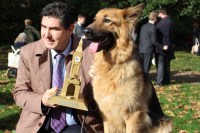
It’s that time of year again – sandwiched between conference season and the Autumn statement – when the nation’s political pooches (and their owners) descend on Westminster. Yes, yesterday saw the Westminster Dog of the Year show, 2014. [caption id="attachment_8903972" align="alignleft" width="250"] Noodle and Alan Duncan announce the winners[/caption] Last year’s winner, Noodle the cockerpoo (and her owner, Alan Duncan) had been promoted to the judging panel after her success, and seemed keen to be back on the podium. She wasn’t the only one, either. David Burrowes’ Cholmeley (who came third last year, and second in 2012), also seemed very attached to the winner’s platform, and posed nicely alongside it.

Russell Brand and Nigel Farage remind me of myself five years ago

I’m often asked by other free school proposers what lessons I’ve learnt over the past five years. Any pearls of wisdom I can pass on so they don’t make the same mistakes? My standard response is to reel off a checklist of things I would have done differently if I’d known then what I know now. To take just one example, we probably wouldn’t have introduced a ‘no packed lunch’ rule if we’d known that we’d have to provide all our four-to-seven-year-olds with free school meals. But the biggest lesson is one I daren’t share, which is that trying to give children a better education than the neighbouring local authority schools, with no additional funding, is really, really difficult.

Kelly Tolhurst wins Rochester primary on turnout of 5,688

Kelly Tolhurst has won the open primary to be Conservative candidate for Rochester and Strood, I understand. The result is not due to be announced until this evening, but I hear that Tolhurst won by fewer than 50 votes on a turnout of 4,000. The turnout is the key in this as it will give some indication as to the level of interest in the constituency in the Conservative candidate. It is worth bearing in mind that the turnout in Sarah Wollaston's open primary in Totnes was 16,497. That much lower turnout in a more high-profile contest following a defection will add to party worries following yet another poll showing Ukip ahead in the constituency. UPDATE, 20.10: Tolhurst has been confirmed as the candidate.

NHS ambulance trouble is more complex than miserly Tories and NHS privatisation

English NHS ambulance services are spending twice as much on private ambulances than they were in 2012, according to Labour, while response-times have lengthened and ambulance staff appear increasingly disgruntled.[audioplayer src="http://traffic.libsyn.com/spectator/TheViewFrom22_28_August_2014_v4.mp3" title="Julia Manning joins Mary Wakefield and Fraser Nelson to discuss the 999 crisis." startat=50] Listen [/audioplayer] So there's something else to blame on the Tory government, lest anyone feared a shortage. Shadow Health Secretary Andy Burnham lost no time in charging that 'these figures show just how quickly the NHS is changing under David Cameron.' Perhaps.

Breitbart’s loss is Nigel Farage’s gain – or is it?

It’s no great surprise that Raheem Kassam, the troublesome managing editor of Breitbart London, has left his job. Kassam is a wildly self-important figure who flits about on the internet Right. Mr Kassam is famed for his inflated sense of self-importance, and Mr S particularly enjoyed the write up of the new job, mysteriously under an anonymous by-line on Breitbart: 'Breitbart London understands from senior UKIP sources that Kassam was picked specifically for his political nous and campaigning prowess.' What’s intriguing, though, is Kassam's new job: he has been taken on as a ‘senior adviser’ by Nigel Farage.

‘Hang ’em high!’ – leftists for the death penalty, re Pistorius et al

O, the fury of my Sisters over the risible punishment (I’ve seen longer sentences in Ulysses) handed out to Oscar Pistorius! I’m with them all the way on this one. On hearing that India had issued the death penalty to the four men convicted of raping and murdering a student in Delhi last year, my first reaction was, ‘Ooo, good ­I hope it’s televised!’ I have long been a supporter of the death ­penalty for any type of killing except the most self-defensive kind - and I see this as an important part of my identity as a feminist, especially. Two women a week are killed by partners or ex-partners, and in my opinion, the more woman-murderers who are forced to meet their Maker, the better.

The UKIP effect: killing the thing you love

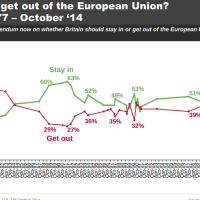
This chart, courtesy of Mike Smithson, shows Ipsos-Mori's polling on British membership of the European Union. It shows support for leaving the EU is no higher now than it was 20 years ago. I'll wager this surprises you. As you can see, there has always been a constituency for leaving the EU. Public enthusiasm for the european project has always been conditional. Despite that, the unhappiness of a known known has generally proved more attractive than the uncertainty of a known unknown. (This, ahem, is also true of certain other constitutional questions with which we have wrestled recently.) But how can this be? How can UKIP be soaring in the polls even as public support for their greatest proposal sags?