Uk politics

How Ukip plans to boost its national campaign

From our UK edition

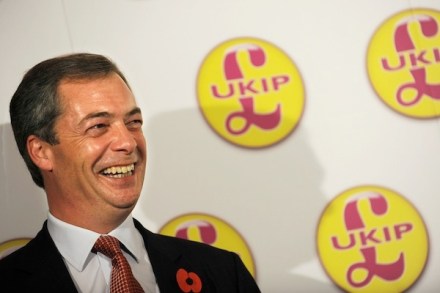
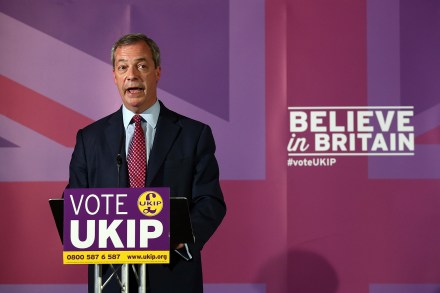
What will Ukip do with the £1.3 million donated by Express chief Richard Desmond? The party cannot plough the money directly into its fight in South Thanet because strict spending limits apply on fights in seats during the short campaign. But it can spend it in other ways to promote the party, and of course to promote Nigel Farage. The plan, sources tell me, is to buy more billboard posters and other national advertising slots, as well as being up Ukip’s social media presence. The Tories have been spending hundreds of thousands of pounds each month on this, so Ukip will never match them - but the party benefits not from money online but a strong grassroots presence of supporters who spread Ukip’s message.

The Tories have fallen for their own spin on Miliband

From our UK edition

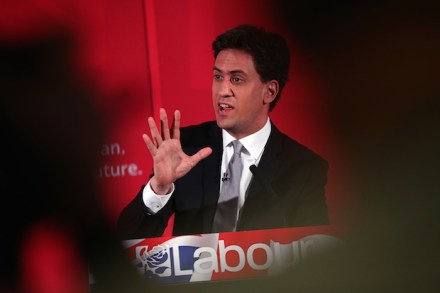
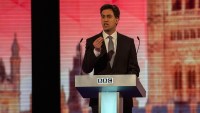
Believing your own hype is a dangerous thing in politics (and elsewhere). So is falling for your own spin. Spin is a message you craft that bears a tenuous link to the truth but is the line you want others to believe. You say it because something else is true, but it doesn’t suit you. You hope that the people you’re directing your spin at pick up at least some of its thrust and start seeing things the way you want them to be seen. If the Tories fail to make it back into government after this general election, one of the things they will have to come to terms with is that they fell for their own spin about Ed Miliband, without realising that the public might not. The Labour leader is not so desperately awful that he cannot string a sentence together.

Passion | 16 April 2015

From our UK edition

‘I long for spontaneous passion but I will never get it with my husband because I think he has Asperger syndrome,’ wrote a reader of the Sun to Deidre last week. I noticed this because the leading article in The Spectator earlier this month said that David Cameron needs ‘more passion’. It was right, of course. Deidre’s reply suggested that ‘specific requests could help him, such as “Please give me a cuddle in bed”.’ I don’t know if a similar suggestion has been made to Mr Cameron. But Tony Blair said in his recent speech: ‘I believe passionately that leaving Europe would leave Britain diminished.’ Does believing passionately that something would happen count as having passion?

Mob rules

From our UK edition

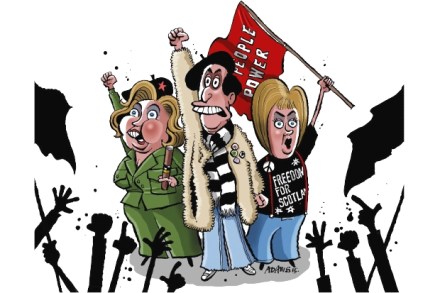
A spectre is haunting Europe — and knocking on the door of Downing Street. It has installed a president in France and a mayor in New York. It is causing mayhem in Spain and Greece and insurgency in Scotland and it may yet halt Hillary Clinton’s march to the White House. This idea — left-wing populism — is a radical, coherent and modern response to the financial crisis and the hardship suffered since. It is being effectively harnessed by Ed Miliband, taking him within touching distance of victory. And it may well become the creed that guides the next five years of British government. The Labour manifesto that was published this week is a response to the new populist mood.

The Ukip pledge that other parties may well adopt

From our UK edition

One of the Ukip manifesto pledges that's making certain types a bit grumpy today is a pledge to abolish the Department for Energy and Climate Change. Unite has said that this ‘beyond barmy and would create chaos’. Unite is a union and is naturally keen to support the jobs of those who work for DECC and in industries covered by the department. But this particular Ukip policy might be one that a party of government ends up adopting. Nigel Farage’s party’s manifesto said today that DECC should be abolished because its ‘essential powers and functions can be merged into other departments’.

Coffee shots: The best (silliest) manifesto photos

From our UK edition

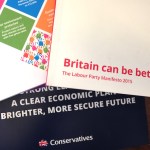
If voters pick up party manifestos, chances are they might not make it all the way through the 80-150 page tomes the people pitching for government have produced. But they might leaf through and look at some of the bullet points, graphics and the pictures. Here are some of the best (or perhaps the oddest) manifesto pictures from the three main parties: This woman is just so thrilled to be buying some sweets, which were only made thanks to the Tories' long-term economic plan. This kid is definitely hiding something behind his back, and it's not the detail of George Osborne's £12bn welfare cuts. This student is hoping the Tory photographer will leave her alone to understand the clotting cascade in peace.

Are the Conservatives being honest about their new minimum wage policy?

From our UK edition

The Conservatives have sent out a campaign email from David Cameron this evening promoting their key manifesto pledges. You'd expect that: now's the time to galvanise activists' support. But there is one line in there that jars: 'Everyone earning the Minimum Wage lifted out of income tax altogether.' This isn't true. Cameron was quite careful in his speech today to say that the Tories will make sure 'no-one on the Minimum Wage who works 30 hours a week pays any income tax on their wages'. If you're working 40 hours a week on minimum wage pay, you will continue to pay income tax. So when the email says ‘no one’, it only means those who work part-time on the minimum wage (which the government defines as 30 or fewer hours per week).

Cameron declares that the Tories are the ‘party of working people’ as he pledges to extend right to buy

From our UK edition

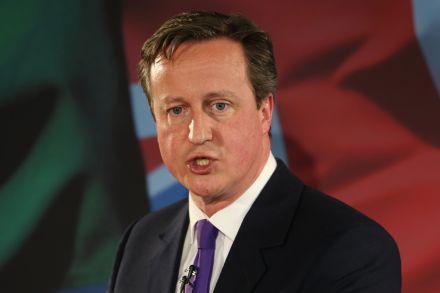
Tomorrow’s Tory manifesto will contain the boldest policy proposal of this campaign so far. The party will promise to extend the right to buy to 1.3 million families living in housing association properties. This policy has the potential to create a new group of homeowners and to start the reversal of the decline in home ownership; even critics of the plan think that more than 150,000 families might take advantage of it. It helps to keep alive the idea of a property owning democracy which has been so crucial to the success of the centre-right in this country.

Nick Clegg sets out red lines for coalition negotiations with Labour and the Tories

From our UK edition

Nick Clegg produced Lib Dem red lines for any coalition with either Labour or the Tories in an interview with Evan Davis this evening. Clegg said that he wouldn’t go into Coalition with the Tories if they insisted on making £12 billion of cuts to welfare in the next two years. But he said that he also couldn’t recommend going into coalition with Labour until they were clearer about how they planned to deal with the deficit, making clear that what Labour said today was not sufficient. As Fraser says, this was an assured performance from Clegg who offered a robust defence of the government’s record. The Liberal Democrats would be in a better position to claim credit for the recovery if they had always been this unequivocal.

Labour tries to confound expectations with tough-sounding manifesto front page

From our UK edition

Labour’s manifesto launch today sees the party seeking to confound expectations. Even though the party would prefer to fight a comfortable election campaign on the NHS, the fact remains that no party has won when behind in the polls on both the ratings of its leader and on the economy. And so the first page of the party’s manifesto, which was released last night, says this: ‘Our manifesto begins with the Budget Responsibility Lock we offer the British people. It is the basis for all our plans in this manifesto because it is by securing our national finances that we are able to secure the family finances of the working people of Britain.’ That last in particular sounds like the kind of thing the Tories have been saying for a little while.

Tories on £8bn NHS commitment: Trust in me

From our UK edition

Towards the end of last week, the Tories were looking a bit miserable. Their slow response to Labour’s non-coms announcement, coupled with a ‘dead cat’ response from Michael Fallon which made the party look rattled and unpleasant had left the Conservative campaign looking unusually disorganised and slow-witted. But ministers have tried to pick things up, and some of their announcements in particular have left Labour in a similar mess. The story that David Cameron’s party will meet the £8bn demand for health funding from NHS England chief executive Simon Stevens has left Labour hopping around looking a bit cross and awkward.

This week, the Tories must seize the initiative

From our UK edition

Even Tory insiders admit that while they broadly had the better of the first week of the campaign, Labour had the better of the week just gone.  This makes it imperative for their hopes of re-election that the Tories wrest back the initiative this week. As I say in the Mail on Sunday, if they don’t, Tory discipline—which is already beginning to fray a bit—will crack, and Ed Miliband will have the keys to Number 10 within his grasp. The Tories have made a decent start to this task. Labour has been unsure of how to respond to the Tories’ commitment to give £8 billion more to the NHS.

Tories try to use their lead on the economy to bolster their position on the NHS

From our UK edition

The Tories believe that their record in government and their lead on economic competence means that they can set out spending commitments without having to set out precisely how they would pay for them. George Osborne’s interview on Marr this morning was a demonstration of this strategy. Challenged repeatedly over where the £8 billion for the NHS that he and Cameron pledged yesterday would come from, Osborne simply pointed out that they have managed to increase the amount of money going into the health service every year over the last five years despite having to make significant spending cuts. However much it infuriates their opponents, I suspect that this Tory tactic is quite effective.

What’s going on in Scotland

From our UK edition

If the election in England is the political equivalent of trench warfare with Labour and the Tories inching forwards and then back, what’s going on in Scotland is a rout with the SNP driving all before it. What is remarkable is how the Nationalists are even in with a chance of winning seats such as Edinburgh South West that voted No by a more than twenty point margin. At the moment, everything their opponents throw at it seems to bounce off the SNP. The so-called Sturgeon memo, which claimed that she had told the French Ambassador that—contrary to all her public protestations—she would prefer Cameron to Miliband as Prime Minister, was the big story this time last week. But now, it is an irrelevance.

Three new polls put Labour ahead

From our UK edition

Three new polls out today have put Labour ahead of the Tories. At a time when the Conservatives are firing all guns at the opposition, Labour appear to be gaining some momentum. According to a new Survation/Daily Mirror poll, Labour is four points ahead on 35 per cent, compared to the Tories on 31 per cent, Ukip on 15, the Lib Dems on nine and the SNP and Greens both on four. Panelbase has conducted an online poll, which suggests Labour has a six-point lead at 37 per cent and the Conservatives are on 31 per cent. TNS has also released a poll which puts Labour ahead by three points on 33 per cent, compared to 30 per cent for the Tories.

Tony Blair rallies the troops at Labour HQ

From our UK edition

Tony Blair gave a speech at Labour HQ this afternoon, I understand, which rather puts paid to the claim that he was doing the very minimum required of the former Prime Minister to help his party. I hear from those present that it was a very upbeat address, in which Blair told Labourites he was optimistic about the party's chances in this election. He also reflected on his speech on Tuesday in which he warned of the dangers of a European referendum and described his party's outlook as a progressive internationalist one.

Is the Tory Trident row an example of a ‘dead cat’ strategy?

From our UK edition

Are the Tories throwing dead cats into the election debate? This question only makes sense if you recall Boris Johnson's 2013 description of a strategy deployed by an 'Australian friend' of his: 'To understand what has happened in Europe in the last week, we must borrow from the rich and fruity vocabulary of Australian political analysis. Let us suppose you are losing an argument. The facts are overwhelmingly against you, and the more people focus on the reality the worse it is for you and your case. Your best bet in these circumstances is to perform a manoeuvre that a great campaigner describes as “throwing a dead cat on the table, mate”.

Grand National Notebook

From our UK edition

‘How’s your shoulder?’ someone asked recently, and it was only then I realised, for the first time in a while, that my shoulder felt good again. In last year’s Grand National — you might recall if you watched it on television — I had a heavy fall when going well on Long Run, the wonderful horse on whom I won the Gold Cup. I landed on my shoulder and had to hobble off the course. Those famously intimidating Grand National fences may have been made a bit more forgiving in recent years — thank God! — but they are still huge, and when you fall going over one it hurts. Not that I’m put off. The Grand National continues to excite me as much as any horse-racing romantic. The National crams every human emotion into about eight minutes.

The referendum is still defining Scottish politics

From our UK edition

One of the most striking things about Scotland is how the referendum still dominates politics here. I’ve seen more Yes posters and stickers than I’ve seen posters for any political party. The referendum also goes a long way to explaining the SNP surge. In Edinburgh East, for instance, 17 thousand people voted Labour in 2010, giving the party a nine thousand majority. Considering that the seat has been Labour since 1935, you’d expect that to be enough for the party to hold on easily. But as the SNP candidate for the seat Tommy Sheppard pointed out to me, 27 thousand people in this seat voted Yes last autumn. If he can get two thirds of them to turn out and vote SNP, then he’ll win.

Three ways the Scottish leaders’ debate will affect the UK general election campaign ​

From our UK edition

Tonight’s Scottish debate isn’t going to fundamentally alter the dynamics of this general election campaign in Scotland. But it will reverberate through the UK-wide general election campaign. Both Ed Miliband and David Cameron have been left with questions to answer by their Scottish leaders while Nicola Sturgeon has made clear the price she intends to try and extract for supporting a Labour government. In heated exchanges with Sturgeon about the economy, Jim Murphy pointed out that the Institute for Fiscal Studies says that Labour would not need to cut further after 2016. Now, the Labour leadership in London has studiously avoided endorsing this idea. But Miliband and Ed Balls can now expect to be put on the spot about it after Murphy’s comments.