Uk politics

The Tory ‘rally’ that wasn’t: these photos reveal how modern campaigning works

From our UK edition

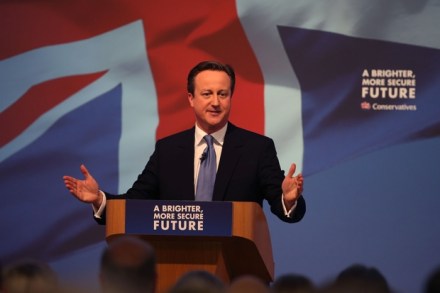
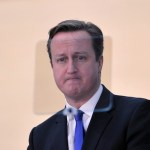
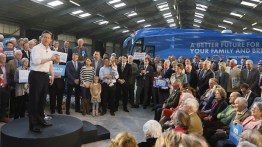
David Cameron took the stage at an election rally in Wadebridge, Cornwall this evening. He was surrounded by supporters waving placards. From the pictures, it seems there was a real sense of excitement about the Conservative party. But here are a couple of photos taken from a perspective that's a bit, er, different. The PM is currently holding a rally in Cornwall, in what appears to be a massive cow shed pic.twitter.com/eJh6RrnsQ6 — Niall Paterson (@skynewsniall) April 7, 2015 To give you a better idea of the size of this barn, and the size of the rally, the event is entirely behind this bus pic.twitter.

Is the general election campaign like watching paint dry?

From our UK edition

It is rather fashionable at the moment for those involved in politics to moan about what a boring election campaign this is shaping up to be, and how the only excitement will be once polls close and the results start rolling in. But interestingly fewer voters than you might think agree with this view. YouGov asked at the weekend ‘how interesting or boring have you found the general election campaign so far?’, and while a majority - 51 per cent - said it was boring, 42 per cent said it was interesting. The ‘interesting’ camp was made up of 33 per cent of voters who thought the campaign ‘fairly interesting’, while 9 per cent said it was ‘very interesting’.

Is ‘come home’ the best thing David Cameron can say to Ukip voters? 

From our UK edition

One of the things the Tories need to do in order to hold on to power is to convince those considering voting Ukip in the General Election that it is safer to back the Tories instead. To that end, David Cameron yesterday told a campaign event that he hoped such voters would return to the Tories so that Labour wouldn't have a chance of putting the recovery at risk. He said: 'Come with us, come back home to us rather than risk all of this good work being undone by Labour.' Labour said this was further evidence that the Tories and Ukip were preparing to work together. But Ukip's response gets it right, with Nigel Farage saying: 'Neither former Labour nor Conservative voters who have switched to UKIP are going back.

Why all this talk of a hung parliament could be a self-fulfilling prophecy

From our UK edition

In a close campaign, you would normally expect the smaller parties to get squeezed as voters decided that is really a choice between Labour and the Tories. But this time, thing might be different. Why, because the general expectation is that there will be another hung parliament and the coverage of the campaign is being reflected through that prism. This emphasis on the likelihood of a hung parliament could change how people actually vote. As I write in the current issue of the magazine, the British Election Study shows that among voters who expect another hung parliament support for both Labour and the Tories is radically lower with the minor parties doing that much better. Among those who expect one party to win outright, Labour and the Tories poll at 39 and 38 percent respectively.

The doom and gloom of the unions shows how out of touch they are with teachers

From our UK edition

From school places to behaviour to teacher training, the teaching unions have excelled themselves with their doom and gloom pronouncements at their conferences this weekend about the state of our schools.  We shouldn’t be surprised, there is, afterall, an election coming up and we all know where the union leaderships’ loyalty lies. But these conferences have simply served to highlight one thing - that the gulf between the leadership of the classroom unions and their members is wider than ever before. Because the unions' depressing portrait isn’t what I see when I look at England’s schools today. The first commitment I made as Education Secretary was to get out of Westminster and into classrooms.

Another Tory ‘defection’ to Ukip – in a safe Labour seat

From our UK edition

Nigel Farage has had a torrid few days - exactly as he'd planned. He had all six of his fellow contestants in the TV debate ganging up on him over immigration, just as he'd hoped. He's provoked the Liberal Metropolitan Elite into attacking him over his comments about health tourism and HIV, just as he'd hoped. And today, to cap it all, he's claiming a Tory defection. Mike Whitehead had been the Conservative candidate in Hull West and Hessle, standing against Alan Johnson in the Labour safe seat. The Tories came third here in 2010. Farage said this morning: 'I am delighted to be welcoming Mike to the party at this exciting time. His move to UKIP just underlines that today, the real party of opposition to Labour in the North is UKIP.

Parties launch tax attacks as Britain heads to the beach

From our UK edition

The three main parties are having a fight about tax today. It’s the day the rise in the personal allowance comes into effect, and David Cameron will give a speech describing what is to most people the Easter Bank Holiday as ‘Money-Back Monday’ (which sounds a bit like a gameshow in a pound shop) and claiming tat up to 94 per cent of households are better off under the tax and benefit changes that come into effect this year. Ed Balls is also working today while the rest of Britain heads to the beach and scratches its head about how to sort out the garden: the Shadow Chancellor is also giving a speech in which he will say that the Tory record on tax is ‘millions pay more, millionaires pay less’.

Tories convinced ‘moment of maximum danger’ has passed

From our UK edition

On Thursday night, David Cameron didn’t eviscerate the competition. But nor did he suffer any damage and that, to Tory high command, meant that it was job done. The Tory leadership didn’t want any debates at all, they’d rather not have taken the risk. So, to get through this one debate with the dynamics of the campaign unchanged was, to their mind, a result. As Cameron enjoyed a late night drink with Samantha Cameron, George Osborne and his key aides on Thursday, he reflected on how much better he felt than he did after the first debate five years ago when he knew that he had not only underperformed but that he had two more to get through. This time round he’d done fine and was done with debates.

Don’t let this election turn us into Little Britain

From our UK edition

If elections are job interviews, as party leaders like to say, then this interview has so far failed to assess applicants on the one part of the job description that most have no experience in - foreign policy and security. This absence was at its most conspicuous this week when the TV debate didn't spare even a cursory nod to global issues. Maybe the lack of contention on foreign policy is an implicit tribute to the Conservatives' steady hand on the tiller? If not, let's hear why. If so, the Conservatives have been surprisingly, some might argue laudably, reluctant to invoke global insecurity as an issue. Security concerns, global instability, and terrorism are important themes that normally mesh well with a serious, strong-headed, incumbent government.

Why the leaked Nicola Stugeon memo rings true 

From our UK edition

After 15 hours of fascinating and - let’s face it - fairly exciting developments in l’affaire Sturgeon, here’s where I think we are, and I’ll try to stick as much as possible to incontrovertible facts, not political bluster: If this was all a grand misunderstanding, I think the various parties would have come together by now to explain what they think has happened, e.g. perhaps Nicola Sturgeon used the word ‘expect’, that got turned into ‘espoir’ back in the French embassy, and then relayed to the FCO as ‘hope’. That’s pretty plausible, but we’ve heard no such explanation yet.

Labour’s business battle shows how small its circle of support is

From our UK edition

I have never been impressed by round robin letters, so if Ed Miliband had shrugged off the letter to the Daily Telegraph this week signed by 103 businessmen with the words: ‘if they have got something to say why can’t they speak for themselves rather than bleating like a flock of sheep’ he would have gained my respect. If Labour had to counter it with a round robin letter of its own it might at least have tried to find 100 businessmen of its own. Instead it rustled up a bizarre letter of its own. Complaining about zero hours contracts it declared:  'We come from all walks of life, this is what Britain looks like.' But when you read the signatories below you realise just how small Labour’s circle has become. All walks of North London, it ought to read.

Britain might want a holiday from history, but we’re not going to get one

From our UK edition

The more I think about the debate on Thursday night, the more I think it was a disgrace that there was no question on either defence or Britain’s role in the world. This country might want a holiday from history. But, sadly, we don’t look like getting one on. On Europe’s Eastern border, the Russians are behaving in an increasingly aggressive fashion. The Times' account of a recent meeting between ex-intelligence officials from Russia and the US shows just how bellicose Putin is and reveal that Britain might well soon have to decide whether to honour its Nato Article 5 obligations to the Baltic states. On Europe’s Southern border, Islamic State is a threat to the civilised order.

The media and political elite need to stop treating the electorate like dogs

From our UK edition

There are many grating phrases in modern British politics. ‘Best practice.’ ‘Fit for purpose.’ ‘Let me explain’ (just bloody well explain!). And that tendency of Labour politicians to preface pretty much everything they say with a schoolmarmish ‘Look’, as in ‘Look here’. As in: ‘You donuts know nothing, so I am going to put you straight.’ But even more grating than those, sat at the top of the pile of temperature-raising sayings, is ‘dog-whistle’. Everyone’s talking about ‘dog-whistle politics’.

Five things to watch for during tonight’s debate

From our UK edition

1) Can Natalie Bennett do enough to spark another Green surge? After Natalie Bennett’s infamous ‘brain fade’ the Green surge faded away. The media stopped giving the Greens the attention they had been and without the oxygen of publicity, support for the party fell away; this morning’s YouGov poll has the Greens on 4%, their lowest score since October. But tonight offers Bennett a chance to get her party back into the election frame. If she can deliver a few good answers and the odd zinger, that would be enough to get the media—and, then, the voters—to take a second look at her and the Greens. 2) Will Leanne Wood attack Miliband over the state of the NHS in Labour-run Wales?

The challenge for insurgents and ex-insurgents in tonight’s TV debate

From our UK edition

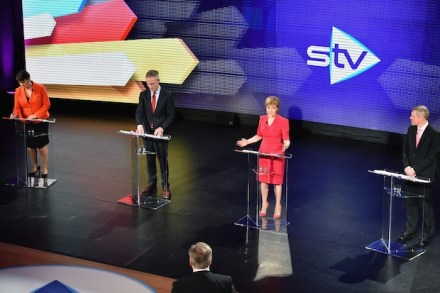
The party leaders have been reflecting on the challenges facing them ahead of tonight’s TV debates. Nigel Farage said this morning that he wished there weren’t so many of them taking part, something the audience may also feel by the end of tonight’s two-hour extravaganza. But the Ukip leader is probably peeved by the sheer number of party leaders because it makes it more difficult for him to appear to be the only exciting force disrupting British politics. His advantage is that he’s the only one on the Right. John Cleese or not, Nick Clegg does have one of the biggest challenges of any of the leaders participating. He needs to work out how to make his mark, now as a figure of government surrounded by new insurgents.

Nick Clegg’s picture caption election

From our UK edition

Mock Nick Clegg all you like, but he is taking an impressively pragmatic approach to this General Election. The Deputy Prime Minister knows that he might not get as much coverage as the main parties or the insurgent parties if he just says things (though already announcing a lot of your manifesto and charging hacks £750 a day for the pleasure of hanging out in your disturbingly Austin Powers-esque bus might make that a tad more difficult anyway). So to ensure that he does get a modicum of coverage each day, he’s having a picture caption election. On Monday, it was hedgehogs in Solihull. Yesterday he had that selfie with Joey Essex and a cookery class. Today he’s been at a soft play area, though sadly he didn’t dive into the ballpit.

A Cabinet of losers?

From our UK edition

Here’s an interesting factoid. We have gone the longest time since any serving Cabinet Minister has lost their seat… ever. Seven were booted out in 1997, most famously Defence Secretary Michael Portillo in Enfield Southgate – an experience shared by just 32 people since 1900. To some extent, MPs from marginals may be less likely to reach the Cabinet: they are by definition more likely to be newly elected and are forced to spend vast amounts of time and energy campaigning in their constituency, from which a Cabinet role can serve as a distraction. 2015 seems likely to end this streak, with five names around the current Cabinet table looking precarious.

Should Labour dismiss a letter from 100 business chiefs?

From our UK edition

The Labour reaction today to the Telegraph’s high-volume splash on 100 business leaders warning about the dangers of a Labour government has largely been along the lines of ‘how interesting, and tomorrow will you tell us about the Pope’s theology?’ The coverage of the letter, which has the mark of Tory co-chair Lord Feldman, has certainly created a rather stark contrast to the party’s own announcement that it will give workers on zero hours contracts a legal right to request proper hours after 12 weeks. Labour likes this contrast. The letter says: Dear Sirs, We run some of the leading businesses in the UK. We believe this Conservative-led Government has been good for business and has pursued policies which have supported investment and job creation.

Exclusive: Nick Clegg enlists Basil Fawlty to play Farage in TV debate rehearsals

From our UK edition

Tomorrow’s TV debate between the seven party leaders is the chance for the insurgent parties to muscle up to the mainstream leaders, make them look tired and old, and in doing so gain more supporters. But the leader with the biggest challenge is Nick Clegg, the insurgent in the 2010 debates, now coming to the end of five years in government. How does he fight Farage and boost the Lib Dem brand? The Lib Dem leader has been rehearsing with colleagues playing his rivals like all the other politicians, but I understand that his preparations for the debate have a rather more stellar quality to them than his opponents’ rehearsals. John Cleese, a Lib Dem supporter, recently suggested to the Deputy Prime Minister at a party event that he could play Nigel Farage in the rehearsals.