Uk politics

Which arguments about government legitimacy are legitimate?

From our UK edition

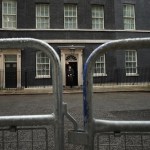
Well, Labour has started on its own mission of framing the post-election legitimacy debate. Responding to the Tory operation to prepare the public for what might happen from 8 May onwards, Ed Miliband’s party is now claiming that David Cameron is determined to stay in Downing Street even if his coalition loses its majority. A senior Labour official has told the Guardian: ‘All the noise coming out of the mouths of David Cameron and Nick Clegg is about how they can cling on to power even if their coalition loses its majority.’ Labour needs to set up a narrative of a desperate David Cameron holed up in Downing Street, refusing to relinquish the trappings of office.

Comedian Brand u-turns and urges people to vote

From our UK edition

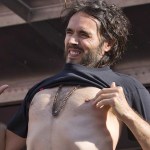
There’ll be satisfaction in the Labour leader’s office today as Russell Brand has done a reverse-ferret and urged his voters to vote and vote Labour. Or, to be more precise, to vote Labour in England—with the exception of Brighton where he wants them to vote Green. He seems to be implicitly urging a vote for the SNP in Scotland. To win Brand over, Miliband channelled his former US grassroots adviser Arnie Graf and talked about community politics and how the idea of a living wage came not from a policy seminar but activists in the US talking to low-paid workers. But Brand’s endorsement is of limited value given that it comes long after the deadline for registering to vote.

Parties turn attention to crafting post-election narrative

From our UK edition

Ed Miliband spent a lot of his Today programme interview refusing to answer questions about how a minority Labour government would work because he is focusing both on the ‘big issues’ and on ‘winning a majority’. Both are good things to focus on when the polling stations haven’t yet opened, though of course how a government would pass laws is generally a big issue too. But what’s interesting is that behind the scenes some Labour figures do still sincerely think they could win a majority. One senior Labour MP told me in the past few days to remember that in 1992 the polls didn’t move until the very last minute and produced a majority government.

Ed Miliband turns garden designer with scary new sculpture for Downing Street garden

From our UK edition

One of Britain’s great traditions is the open garden afternoon: an opportunity for folk revelling in being both middle-aged and nosy (like me) to wander around other people’s plots and peer at what they’ve planted while scoffing large slices of cake. The National Gardens Scheme and Open Squares are two of the most popular, and while they do allow people to see the true beauty of someone else’s well-maintained dahlia bed or snowdrop collection, they also help us indulge in that also very British tradition of pointing at the strange things people put in their back yards.

Will there be a late surge to the Tories?

From our UK edition

So, here we are. In 100 hours time, we’ll be half-way through election-day. But at the moment, the polls still remain deadlocked. Yet, there remains a sense that there’ll be some kind of late shift towards the Tories. Is there any grounds for this? Well, I argue in the Mail on Sunday that there are a few things that point towards this. David Cameron has finally hit his stride. His performances have improved markedly and the public appear to have concluded that he clearly won last Thursday’s Question Time, YouGov have the public giving it to him 42% to Miliband’s 26%. As Tim Shipman points out, Cameron’s lead as preferred Prime Minister has risen from 7% two weeks ago to 14% today. Ed Miliband had one on his weakest outings of the campaign on Thursday night.

Nicky Morgan’s market place fight to hold her marginal seat

From our UK edition

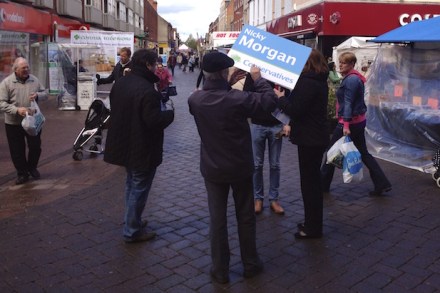
Nicky Morgan’s record as Education Secretary is coming under fierce attack in the Loughborough market place where she’s campaigning. A furious man is telling activists that he will never vote for the Tory candidate because of ‘what she’s done’. The campaigners brace themselves for a diatribe about Tory education policies. Instead, it turns out that his complaint is that ‘she’s kept all the kids in school for longer’. This has had a devastating effect, not on the kids themselves, but on the fish and chip shops in Yarmouth and Skegness, where this particular voter cannot now buy a delicious feast as he’d wish. ‘Rubbish!’ he bellows, as one Tory member tries to tell him that a better education is a good thing for children.

Exclusive: Senior Tories to plot election response on Friday

From our UK edition

Tory MPs will plot their party’s response to the election result and any likely coalition partnerships in a meeting next Friday, 8 May at 4pm, Coffee House has learned. The powerful executive of the 1922 Committee will meet that afternoon in order to prepare their demands for the Prime Minister and discuss any initial outlines of a coalition agreement between the Tories and the Lib Dems that have already been passed on to them. They will be preparing for a meeting of the full party on Monday, where they will set out their demands in full. We have known for some time what the demands of the Committee will be if the Tories are in a position to form a government.

Ed Miliband’s refusal to admit that Labour overspent could cost him dear

From our UK edition

Tonight’s Question Time special with Cameron, Miliband and Clegg provided the best television of this campaign so far. A well-informed audience relentlessly pressed the three leaders on their weakest points. At the end of the evening, an ICM poll for the Guardian gave the evening to Cameron by 44 per cent to Miliband’s 38 per cent with Clegg garnering 19 per cent support. Miliband’s didn’t have a great night and his most awkward moment came on the record of the last Labour government. The audience were audibly irritated by his repeated refusal to concede that the last Labour government had spent too much money. Under questioning from the audience, Miliband also went further than he previously has in ruling out a deal with the SNP.

A (partial) defence of the spin room

From our UK edition

Tonight’s ‘Question Time’-style TV debates will be followed by what has become probably the most hated aspect of this rather uninspiring general election campaign: the spin room. This spectacle of journalists interviewing journalists as they listen to frontbenchers from all the parties parroting lines about how their leader was the best (or, in the Tory case, how well Nicola Sturgeon has been doing) is odd enough inside the room, let alone for those watching at home. The way the politicians spinning talk is even less natural than usual: it’s like a Westminster version of Made In Chelsea, stuffed with people acting at being actors.

Douglas Carswell interview: Stop using my father to make cheap political points

From our UK edition

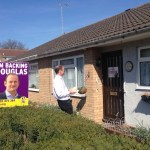
Douglas Carswell seems rather excited about the Spectator following him around as he campaigns in Clacton, but it’s not clear whether that’s just because our interview starts in McDonald’s. Tucking into a quarter pounder with cheese, the Ukip candidate seems on good form, expounding at length on the failure of mainstream politicians to connect with the electorate, and enthusing about his vision for the party in the future. But a little later, as we plod around the streets of the constituency, his mood changes. He’s getting a lot of messages and calls about a BBC foreign affairs debate that he has pulled out of at the last minute. With each message, the former Tory MP grows more rattled.

Can pavement politics save some Scottish Labour MPs?

From our UK edition

If some polls are to be believed, Labour won’t exist in Scotland after next week. All suggest it will be a considerably pruned branch of the party. Whatever happens, the campaign Scottish Labour has had to fight since the referendum shows a party coming to terms with the shocking realisation that safe seats cannot stay safe if you don’t bother to talk to voters in them. One Labour MP is notorious among colleagues for boasting in the years before this election that his canvassing involved walking around in the high street of his constituency and marking down people who greeted him as Labour voters. What a shock this election, where the party is having to go to those voters’ homes, knock on their doors and make an effort with them, must be.

Will Cameron’s ‘10 days to save the Union’ message work?

From our UK edition

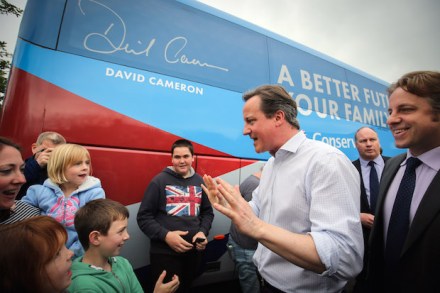
David Cameron continues his anti-SNP campaign today, launching what the Times calls his ‘strongest attack so far’ on a Labour-SNP government. The Prime Minister tells the paper that there are ‘ten days to save the United Kingdom’, which is an echo of Tony Blair’s ‘24 hours to save the NHS’ and William Hague’s less successful ‘last chance to save the pound’. The Conservatives are increasingly talking about the SNP and spending money on billboards featuring a thieving Alex Salmond because they say this message is cutting through in marginal constituencies. But the SNP’s retort is that even if people are bringing the SNP up on the doorstep, it may make little difference to how they vote.

PM pumps up the passion after porridge and panic

From our UK edition

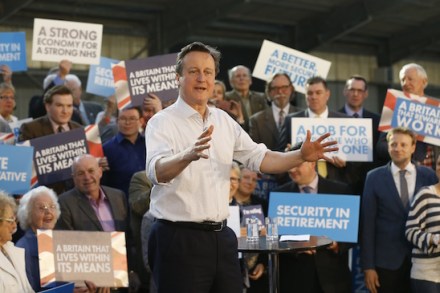
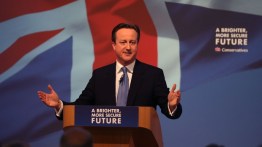
David Cameron is known as the ‘essay crisis’ Prime Minister, and today he did little to dispel that impression. With just 10 days to go until the election, Cameron produced a passionate, excited speech in which he insisted that he was ‘pumped’ about the election and about fighting Labour. Afterwards, when asked what he’d had for breakfast, he roared ‘PORRIDGE!’ with alarming fervour. This is the second furiously enthusiastic speech the Prime Minister has given in as many days, and it represents a significant shift in his tone after accusations of a boring and lacklustre campaign. Boring is, of course, the way Lynton Crosby would rather have it.

Cameron’s answer to the passion question

From our UK edition

David Cameron has been bugged in this campaign by the question of whether he’s passionate enough, of whether he really wants it. When Fraser and I asked him about why so many people aren’t sure of whether he has the passion for it a few days back, he replied, ‘I don’t know. There is something about me—I always manage to portray a calm smoothness or something.’ He then went on to explain why as a Conservative he wants to know what the plan is, not just what the passion is. As he quipped, ‘plan plus carrying out a plan equals dream. Dream plus rhetoric equals chaos.’ But in a speech in Yeovil today, Cameron gave his best answer yet to this passion question. listen to ‘'We can do it!

This election will be decided by the undecideds

From our UK edition

The polls could hardly be closer than they are at the moment and the parliamentary arithmetic looks like it is going to be remarkably tight, there’ll be only a few seats in it as to whether it’ll be Cameron or Miliband as Prime Minister. Yet, campaign aides on both sides have been struck by one thing: the large number of undecideds. One recent poll suggested that as many as one in five of those who intend to vote are still undecided. How this group breaks will determine the result. As one close Miliband ally put it to me, ‘The defining moment of this campaign hasn’t happened yet’. The Tory hope is that an unrelenting focus on the economy and the threat it that any Labour SNP arrangement would pose, will nudge these undecideds into their column.

David Cameron insists Tory campaign has ‘the most positive vision there could possibly be’

From our UK edition

There’s nothing wrong with negative campaigning in an election. If you think your opponents would damage the country, then you should point it out. What’s wrong with negative campaigning is when it’s the only sort of campaigning you’re doing, or when the balance appears to be tipping in its favour in terms of your key messages and big attention-seeking posters. The Tories are currently facing accusations that they are doing too much negative campaigning, and so today David Cameron tried to defend that campaign when he appeared on Sky's Murnaghan programme.

Miliband avoids the Scottish question

From our UK edition

On the Andrew Marr show this morning, Ed Miliband fended off questions about any post-election deal with the Scottish National Party. He had two lines of defence. First, he said he wasn’t going to pre-empt the election result and that he was fighting to win the election everywhere including Scotland. Second, he was adamant that ‘I’m not doing deals with the Scottish National Party’. But there was no explanation of how he would pilot legislation through the Commons without their support. listen to ‘Ed Miliband on the Andrew Marr Show’ on audioBoom When it came to the economy, Miliband refused to admit that the last Labour government spent too much, saying the financial crisis had caused the deficit not the other way round.

The Greek crisis is back, and this time it’s more serious than before

From our UK edition

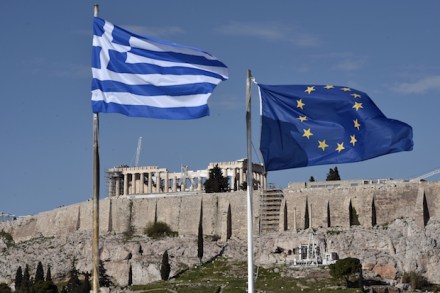
Amidst the hullabaloo of the general election campaign, one thing that has generally gone unnoticed in Britain’s political discourse is the worsening Greek situation. You now have European finance ministers openly talking about the possibility of a Greek default. What has changed is that there is now no goodwill and very little trust between Greece and the rest of the Eurozone. The rest of the Eurozone think that the Greeks are obfuscating and not providing the details needed. While the Syriza-led Greek government feel that the rest of the Eurozone is not providing them with the political cover they need to make a deal. They feel that the Eurozone’s insistence that Athens runs a Budget surplus even before debt repayments have been taken into account is unreasonable.

Ed Miliband thinks Libya’s failure is so obvious he’s barely mentioned it until now

From our UK edition

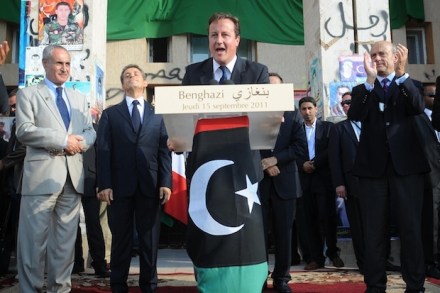
With less than two weeks until polling day, it’s nice to see that Ed Miliband has discovered foreign policy as an important issue worth discussing. The Labour leader will attack the Tories today on a failure of post-conflict planning for Libya which has contributed to the migrant crisis in the Mediterranean. The Conservatives have decided to get very cross about this, claiming that the overnight briefing on this included Labour spinners saying the Tory party was responsible for the deaths. They have decided to make this about Miliband’s fitness to be Prime Minister.

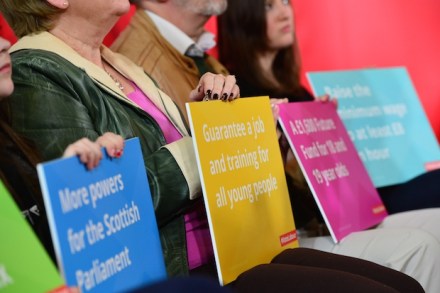
Jim Murphy rallies Labour activists in Edinburgh

From our UK edition

Jim Murphy held a street rally in Edinburgh today. Given many of the election events from the main parties have been behind closed doors, the Scottish Labour leader deserves credit for pitching up right outside the Scottish National Gallery and standing for about an hour in a space where real genuine members of the public were walking.  He was, of course, protected by a rubber ring of activists wearing T-shirts with key Scottish Labour pledges on it, such as ending exploitative zero hours contracts and lowering tuition fees. They had placards with #toriesout splashed across them. And given the rally was secret and only advertised to the media before it happened, there wasn’t much of an opportunity for real genuine members of the public to plan to pop by and ask questions.