Theresa may

Theresa May tries to calm Snooping Bill nerves

From our UK edition

It seems the Home Office is growing a little bit nervous about its flagship Communications Data Bill. I understand that Home Secretary Theresa May took time out of an Abu-Qatada-packed day yesterday to ring internet service providers to try to give reassurances about the legislation. As I explained yesterday, there's a growing sense in Westminster that this Bill won't survive. Many backbench Tory MPs tell me of a rumour sweeping their party that it is already dead. Other sources involved in the negotiations suggest that there's a possibility that the Home Office might jettison the more controversial parts of the legislation in order to get the darned thing through.

Snooper’s charter faces rocky road

From our UK edition

We're only a few weeks away from the Queen's Speech, yet there's one significant piece of legislation from this session which has yet to be resolved. It has already caused one big row, and will certainly cause another one when it is published. The Snooper's Charter, better known to the ministers as the Communications Data Bill, was supposed to be published before this session ended, but it's looking like the government is going to have to re-announce it in the Queen's Speech instead.

Theresa May’s abolition of UKBA shows how the immigration consensus favours the Tories, and her

From our UK edition

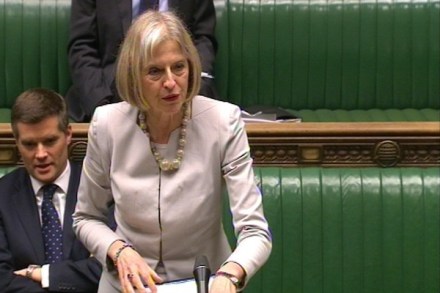
Theresa May has announced that the UK Border Agency is to be abolished.  In an unscheduled statement to the House of Commons, she described UKBA as ‘a troubled organisation’ with a ‘closed, secretive and defensive culture’. She said that the agency’s size, lack of transparency, IT systems, policy remit and legal framework ensured that its ‘performance was not good enough’. May declared that the agency will be split in two. One arm will deal with immigration and visa services, while the other tackles enforcement. May will also bring both arms back directly under the control of ministers, reversing the arms-length policy established by Labour in 2008.

Steerpike | 21 March 2013

From our UK edition

Westminster’s top amateur prize-fighter, Eric Joyce, may face assault charges after his latest unscheduled bout in the House of Commons. The Falkirk MP had to be restrained last week after an alleged unseemly set-to at the Sports and Social Club. Ex-soldier Joyce first revealed his flair for pugilism in February 2012 when he ‘went berserk’ in the Strangers’ Bar after declaring it ‘full of fucking Tories’. ‘He won’t have that problem in the nick,’ says a Conservative friend. ‘It’s full of Lib Dems.’   Panic in Whitehall! Jeremy Hunt’s decision to dump health officials in hospital wards in order to give them ‘first-hand experience’ on the front-line has caused alarm among civil servants.

Theresa May tries to deter Tory uprising on foreign criminals

From our UK edition

MPs are hard at work in the Chamber tonight: once they've finished voting on the Leveson amendments to the Crime and Courts Bill, they'll move on to everything else in this piece of legislation. And everything else includes that amendment signed by over 100 MPs on Tory and Labour benches which limits the ability of foreign criminals to resist deportation. The Leveson debate has been a bit of a gift to ministers, as this big proposal would have enjoyed far greater attention had the Chamber not ben more exercised over press regulation. But that hasn't stopped a 'Dear Colleague' letter going out from Theresa May to Conservative MPs to explain why the government isn't supporting this call.

Liam Fox, Theresa May and the meaning of conservatism

From our UK edition

Speeches by Theresa May and Liam Fox have produced a surge of interest in what Conservatives stand for. Politics in recent years has become an endeavour by a political class, divided by only superficially different beliefs, to use mass advertising techniques to manipulate public opinion. The emphasis on ‘modernisation’ and detoxification grew out of this narrow, calculating spirit, but it has led the Conservatives away from the ideals that have made this country worthy of allegiance. And yet, readily to hand, there are guiding principles that could stir the heart of many a potential Conservative voter. Many conservatives see themselves as champions of liberty. But what does such a claim imply for the role of government today?

PMQs sketch: Nothing changes, yet everything is different

From our UK edition

There comes a moment in a PM’s journey when he crests the ridge and starts on the downhill leg. David Cameron made that unhappy transition today. PMQs began with a gag from a Labour backbencher. Tom Blenkinsop: ‘The prime minister may believe there’s no alternative to the double dip. But some in the cabinet believe there is an alternative. To him!’ Cameron replied by listing his usual trinity of attainments. Lower deficit, more jobs, interest rates at record lows. Then Ed Miliband had a go. Instead of raising an issue, he went for Cameron’s reputation. ‘Given the government’s U-turn on alcohol,’ he said, ‘is there anything the prime minister could organise in a brewery?’ Cameron improvised.

Clegg: the Tories are like a broken shopping trolley – they always veer to the right.

From our UK edition

If you want to know what the Liberal Democrat’s message at the next election will be, read Nick Clegg’s speech to the party’s Spring Conference today. He kept to the refrain that the Liberal Democrats are for a stronger economy and a fairer society and you can’t trust the Tories with society or Labour with the economy. In a sign of the new, more disciplined Lib Dem machine there were no detours from this core theme. Listening to Clegg, you would have had no idea that the leadership had lost a vote on secret courts this morning. Clegg knows that his internal position hasn’t been this strong since the Liberal Democrats entered coalition.

May blossoms

From our UK edition

The question about Theresa May has always been what does she believe? Well, today in the widest-ranging speech of her political career she went a long way to answering that. You can read the speech, delivered at the Conservative Home conference, here. Several things struck me about the speech. First, on economics May is not a classical liberal or a Lawsonian. Instead, she is more in the Michael Heseltine camp. She made the case for a buy British government procurement programme that strikes a ‘better balance between short-term value for the taxpayer and long-term benefits to the economy’. But, in other areas, May is prepared to be more free market than the Tory party has been to date.

Bloomberg will buy the Financial Times — but only if it jettisons The Economist

From our UK edition

How much would you stump up for the Economist? Most of us would draw the line at a fiver, but I’m told that Mike Bloomberg, mayor of New York, is drawing the line at £300 million. Bloomberg is busy relocating to London and he’s poised to snap up the Financial Times later this year. But the Pink ’Un comes with a 50 per cent share in the Economist. And the small print conceals a pesky restrictive covenant that prevents the owner from replacing the editor. This is proving a drag for Bloomberg, who admires the Economist’s boss, John Micklethwait, but who sees little sense in buying a ship if he can’t appoint the captain. Enter minority shareholder Lynn Forester, Lady de Rothschild.

Theresa May and Chris Grayling signal bold new Tory direction on the ECHR

From our UK edition

Tonight brings two major developments in terms of Tory policy on the European Convention on Human Rights and the European Courts of Human Rights. The Mail on Sunday reports that Theresa May is close to announcing that under a post 2015, majority Tory government Britain would leave the Convention. All the articles of the Convention would be incorporated into a British Bill of Rights. But no one would be able to appeal to the European Court of Human Rights. This would end stand-offs such as the one over prisoner voting where the Strasbourg Court is telling parliament it has to enfranchise convicted inmates. Under this system, the Supreme Court in this country really would be supreme.

Government will appeal controversial immigration decision

From our UK edition

Further to the row that has erupted between Theresa May and some judges over the deportation of foreign criminals, the government is understood to be applying to appeal the case of MF. The Home Secretary is plainly confident that her arguments will be well received in the Court of Appeal, having been found wanting in the Upper Tribunal (Immigration and Asylum Chamber). The issue of deporting foreign criminals has been cast by some as a disagreement between senior judges and their more activist juniors, and not merely a clash between different arms of government. Theresa May’s team have been at pains to point out that the majority of senior judges support her case.

Stop blaming judges, Ms May, and repeal the Human Rights Act

From our UK edition

The latest session in May versus Judges over foreign criminals’ right to family life (Article 8 of the European Convention) is running as prescribed. Theresa May used the Sunday papers to demand that judges follow the wishes of parliament and deport more foreign criminals. A gaggle of retired judges and eminent lawyers told (£) her where to get off. In terms of the PR and the politics, it is game, set and match to Ms May. As Trevor Kavanagh notes in The Sun, the Eastleigh by-election, where immigration may play as an issue, is an important backdrop for the Home Secretary, particularly given the imminent arrival of Romanian and Bulgarian migrants.

More Tory splits and plots

From our UK edition

David Cameron arrived back in the UK this morning to newspapers full of talk of Conservative splits and plots. The moment of unity that followed his Europe speech has well and truly passed. There’s no doubt that the gay marriage is causing a ruckus in Conservative Associations up and down the country and that Conservative MPs will go through different lobbies on Tuesday night. To some extent, this division in the Conservative ranks was priced in. What was not is the continuing and increasingly frenzied leadership speculation. The Mail and The Independent this morning detail plans by allies of the Home Secretary Theresa May to position her for the leadership in the event of a vacancy.

Tory MPs to press Theresa May on Bulgarian and Romanian migrants

From our UK edition

Tory backbenchers will raise concerns about the government's preparations for the lifting of controls on Bulgarian and Romanian migrants at a meeting with the Home Secretary in the next few weeks, I understand. Conservative MPs are becoming increasingly nervous about the situation, fearing that if handled poorly, it could have a particularly bad impact on the party's performance in the 2014 European elections, as the transitional controls end on 31 December 2013. One of those worried backbenchers is former ministerial aide Stewart Jackson, who tells me he is considering introducing a modified version of the 10-Minute Rule Bill that he brought before the House in October.

New terrorism control measures under the spotlight

From our UK edition

It has not been a very happy start to the new year for Theresa May, who will have to answer difficult questions in the Commons about the disappearance of a terrorism suspect. Ibrahim Magog has been on the run since Christmas eve when police first realised he had failed to meet the conditions of his overnight residence requirements. Magog has been under investigation for two years and is believed to have trained with al-Shabaab, a Somali terrorist group linked to al-Qaeda. The group has waged a violent campaign in East Africa and has long threatened attacks against the West (although none have actually materialised).

Exclusive: Tory MP accuses Theresa May of ‘dereliction of duty’ over Qatada case

From our UK edition

A Tory MP has accused the Home Secretary of a 'dereliction of duty' that will put the British people at risk. His criticism concerns the way in which she is handling the Abu Qatada case. Theresa May won permission this week to appeal against the Special Immigration Appeals Commission's decision to block the deportation of Abu Qatada to Jordan. But the Home Office has confirmed in a letter to Tory MP Mark Reckless, seen by Coffee House, that it will base its strategy for the case on the judgement of the European Court of Human Rights in Strasbourg, which rejected the Islamist cleric's appeal in May, rather than the test confirmed by the House of Lords in Othman v SSHD 2010, when the House of Lords was at that time the highest court in the land for this country.

Theresa May makes a weak argument on the Communications Data Bill

From our UK edition

Despite a committee of both Houses of Parliament having yet to report after several months of inquiry, the Home Secretary took to the pages of the Sun yesterday to blast anyone who disagrees with her draft Communications Data Bill as a criminal, a terrorist or a paedophile. Hours later David Davis spoke in Parliament to ask why Theresa May had seen fit to traduce a large number of MPs. Aside from the Home Office panic the article revealed, the Blair-esque rhetoric of division was surpassed by the poor examples used by the minister in her interview. She cited two cases. One did not concern terrorism, paedophilia or a serious crime. Neither case requires the logging of every email, social media message and website visit we all make, every day.

Theresa May upsets the Lib Dems and David Davis in one fell swoop

From our UK edition

Theresa May has upset quite a few people from across the political spectrum with her comments in the Sun today about the Communications Data Bill. The Home Secretary told the newspaper: 'The people who say they're against this bill need to look victims of serious crime, terrorism and child sex offences in the eye and tell them why they're not prepared to give police the powers they need to protect the public. Anybody who is against this bill is putting politics before people's lives.' This irritated David Davis sufficiently for the Tory backbencher to raise May's comments as a point of order in the House of Commons this afternoon.

The Spectator Parliamentarian of the Year Awards | 21 November 2012

From our UK edition

The Spectator’s Parliamentarian of the Year awards are being held this afternoon at the Savoy Hotel. In total 14 awards were presented by Michael Gove, Secretary of State for Education, who was invited to be  guest of honour in recognition of his parliamentary achievement. The award winners were: 1. Newcomer of the Year - Andrea Leadsom MP (Con) 2. Backbencher of the Year - Rt Hon Alistair Darling MP (Lab) 3. Campaigner of the Year - Rt Hon Andy Burnham MP (Lab) 4. Inquisitor of the Year - Rt Hon Margaret Hodge MP (Lab) 5. Speech of the Year - Charles Walker MP (Con) & Kevan Jones MP (Lab) 6. Resignation of the Year - Rt Hon Lord Hill of Oareford (Con) 7. Apology of the Year - Rt Hon Nick Clegg MP (Lib Dem) 8.