Theresa may

Can politicians learn the toughest lessons of the Grenfell fire?

From our UK edition

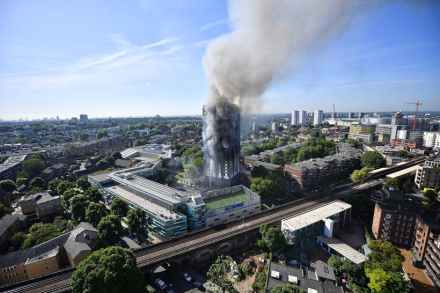
Jeremy Corbyn chose to focus his questions to the Prime Minister today on the government's response to the Grenfell Tower fire. It was the second anniversary last week of that fire, and campaigners have accused the government of not keeping its promises to the survivors of that disaster. The Labour leader asked about the slow progress in removing the same cladding from other buildings that was on the Grenfell Tower, and then moved on to a recommendation made years before the fire that tower blocks should have sprinklers fitted. That recommendation followed the fire at Lakanal House in 2009 in which six people died. The coroner at that inquest had recommended that sprinklers be fitted to all high-rise buildings.

PMQs showed the damage the leadership debate is causing to the Tory party

From our UK edition

Last night's Tory leadership debate was an illustration of where the wider party has ended up: fractious, confused, and without a clear plan for what to do next. Today's Prime Minister's Questions showed the damage that these blue-on-blue attacks are doing to the Conservative party. A number of the candidates have criticised the policies of their own government particularly when it comes to spending. It was inevitable that this was going to get picked up by the Opposition as an attack line. Labour's Paul Williams pointed out that Sajid Javid had pledged to reverse Theresa May's police cuts, while other MPs either made bids for the spending review or warned the Prime Minister not to make commitments which would bind the hands of the next leader.

Boris Johnson is Theresa May in drag

From our UK edition

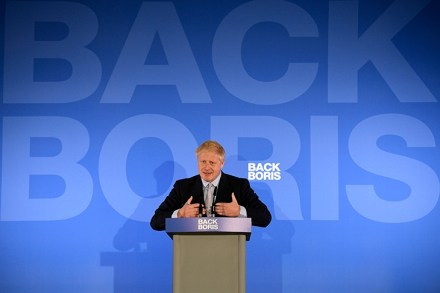
Boris Johnson seems the opposite of Theresa May. The worst thing she ever did was run through a wheat field. The worst thing he ever did remains open to debate. But dark suspicious prompted Charles Moore, whom older readers will remember as a defender of family values, to ask: 'Does it matter if our future prime minister is considered by some to be a sex maniac?' (Not if it’s a sex maniac Moore supports, apparently.) May is withdrawn. Johnson is outgoing. May will tell you how many children she has. Johnson won’t. May is viewed by the right as the head of a Remainer conspiracy. Johnson resigned rather than serve in her Vichy regime. As whoever comes after her will be worse, there is a danger of romanticising Theresa May’s premiership.

The problem with Theresa May’s desire for a legacy

From our UK edition

In less than a month, Theresa May’s premiership will be history. If she is remembered at all, it will mainly be for Brexit. She took on a near-impossible task, made it harder (her misjudged ‘red lines’ from autumn 2016 will always haunt her), and finally failed at it. That had many consequences, not least the neglect of domestic policy. The burning injustices she so memorably listed on the Downing Street step are still blazing away. Poor social mobility, health inequality, racial bias in the justice system, a dysfunctional housing market and poor provision for mental health problems – all remain unresolved.

Is an autumn election inevitable?

From our UK edition

There’s a joke going around the various warring tribes in the Tory leadership contest. They might not win this time, they tell each other, but not to worry: ‘We’ll all meet again in November.’ The point is that whoever succeeds Theresa May is doomed: the 31 October deadline will pass not with Britain leaving the European Union but with a political crisis and a general election that will be won by Jeremy Corbyn. After that, the Tories will in a few months go through the whole process again — this time to pick a leader of the opposition. ‘We’re using this leadership campaign as a test run for when the whole thing collapses in the autumn,’ says one aide.

May confirms she’ll stay on as an MP at dull PMQs session

From our UK edition

A fair few MPs felt there was no reason to come to today's Prime Minister's Questions, given the real action is in the Conservative leadership contest. There were spaces behind Theresa May as she took questions from Jeremy Corbyn. The Labour leader clearly hadn't put much effort into preparing for the session, either, offering a bizarre hotchpotch of questions ranging from no-deal Brexit to the government's record on renewables. Those Tories who had turned up weren't interested in asking May tricky questions: what was the point, when she has just weeks left as Prime Minister? Instead, they wanted to praise what existed of her record, with Peter Bone praising her 'superb' work on human trafficking, and Huw Merriman criticising his colleagues who had forced her resignation.

Barometer | 30 May 2019

From our UK edition

Tears for fears Theresa May welled up while announcing her resignation in Downing Street. How often do leaders cry? — Lady Thatcher was seen to have tears in her eyes while being driven away from Downing Street for the last time. — Tony Blair nearly broke down in public, but not while in office — while responding to the publication of the Chilcot Report in 2016. — Several US presidents have been witnessed crying — and at a time when it was rare for men to be seen showing emotion in public. Dwight Eisenhower had to cover his face with a napkin to hide his tears in 1952, when recalling wartime experiences. — In the same year Richard Nixon was seen crying after surviving a funding scandal and being retained as vice-presidential candidate.

Portrait of the week | 30 May 2019

From our UK edition

Home The Brexit party, led by Nigel Farage, received 5,248,533 votes (out of 17,199,701 cast) in the European parliament elections, securing 29 seats — more than twice the seats won by the Conservatives (in fifth place, down from 19 seats in 2014 to four now) and Labour (down from 20 seats to ten) put together. The Liberal Democrats, with 3,367,284 votes, pushed Labour into third place by winning 16 seats (up from one). The Greens won seven seats (up from three). The Yorkshire party secured more votes than the right-wing English Democrats did in the whole country. The Animal Welfare party received more votes than the Women’s Equality party. Ukip won no seat and nor did Change UK. The turnout was 36.9 per cent, the second highest since the elections began in 1979.

Diary – 30 May 2019

From our UK edition

Recording the BBC Radio 4 Reith Lectures has brought me to five cities and five styles of questioning. Cardiff had been pungent, positive and intelligent, with a cameo appearance from a belligerent Mark Reckless, who seemed to think that the judges were responsible for the legislative impasse over Brexit. In London, people came armed with prepared speeches about every subject under the sun, followed by the usual ‘Howzat?’. Birmingham was quieter, thoughtful and to the point. Edinburgh was about human rights: plenty of room for confrontation there, but courteous and well-reasoned points from a knowledgeable audience. In Washington the theme was what British politics could learn from the United States (not much in my view).

Learn from your enemies

From our UK edition

The MPs wishing to replace Theresa May as prime minister have policies — but do they know what their electorate makes of them as human beings? In one of his many essays, Plutarch (fl. ad 100) analysed how your enemies could help you see how you came across to others. He began by stating that all governments had to put up with malice, jealousy and the desire to come out on top. But as early man learned that wild animals, his natural enemies, could in fact be a most agreeable source of food, clothing and medicine, so politicians could learn how to turn their mortal enemies to advantage.

Ministers take advantage of power vacuum left by May resignation

From our UK edition

Parliament is in recess at the moment, though the difference between a House of Commons Chamber that is sitting and one that isn't is scarcely noticeable at present, given how few votes MPs are being required to attend. There is a similarly thin distinction between a government led by Theresa May as she insists she's not going anywhere, and one led by the Theresa May who, last week, finally conceded that she was going. Not much is happening, as per usual. In fact, there will be even less happening as a result of May's resignation announcement. Today at the Number 10 lobby briefing, the Prime Minister's official spokesman was asked whether the Withdrawal Agreement Bill was really going to return to the Commons next week as planned.

The bitter legacy of Theresa May

From our UK edition

Theresa May will inevitably be remembered for the Brexit farce, but it may not turn out to be as harmful as some of her other legacies. In her resignation speech she claimed to have led ‘a decent, moderate and patriotic Conservative government on the common ground of British politics’. She said that our country was not ‘just a family of four nations, but a union of people’. We stand together, she said, ‘regardless of ‘our background, the colour of our skin, or who we love’. As prime minister she believed she had fought ‘the burning injustices that still scar our society’ by introducing the race disparity audit and gender pay reporting to shine a light on inequality ‘so it has nowhere to hide’.

In defence of Theresa May

From our UK edition

Pretty much all the bad things that people are saying today about Theresa May are true. She’s bad at politics, bad at communicating, bad at dealing with colleagues. She created the conditions that made her job as prime minister handling Brexit almost impossible. Her 'red lines' in the autumn of 2016 gave Britain almost no room for manoeuvre and made the sort of cross-party consensus approach to Brexit that is the logical response to a 52:48 referendum result practically impossible. Her 2017 general election cost her the Commons majority that might just have made that hardline approach viable. Her response was quintessentially Theresa May: she compromised on policy but not on politics. When you hear people today scoffing that May didn’t do compromise, they’re wrong.

Does Theresa May have a domestic legacy?

From our UK edition

Theresa May isn’t leaving at a time of her choosing, nor has she been able to focus on the domestic policies she listed in her inaugural speech on the steps of Downing Street. But today, as she announced she was resigning, she still tried to set out what she believed was her legacy in tackling the ‘burning injustices’ in Britain.  It wasn’t a long list, and the achievements on that list were in themselves rather small. She said she had committed more funding to mental health in the NHS long-term plan, which is true. This funding increase was greater than those in NHS England had initially hoped for.

May’s speech is a message to Brexiteers: compromise

From our UK edition

One of the aims of Theresa May’s resignation statement was to try and shape the Brexit debate in the Tory party ahead of the forthcoming leadership contest. Her decision to emphasise the need to find consensus in parliament was a clear pop at those such as Boris Johnson, Dominic Raab, Esther McVey and Andrea Leadsom who have accused her of compromising too much. Though the irony of this is that May didn’t level with her party in 2017 on what her loss of the Tory majority meant for Brexit, and what could be achieved. Equally telling was that May didn’t talk at all about her successor going to Brussels and seeking changes from the EU. May clearly believes that the solution to this impasse will have to be found at Westminster.

May becomes the latest Conservative prime minister to be brought down by Europe

From our UK edition

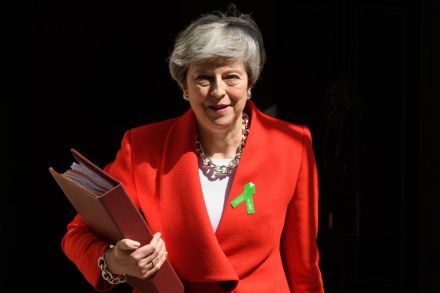
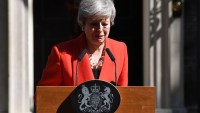
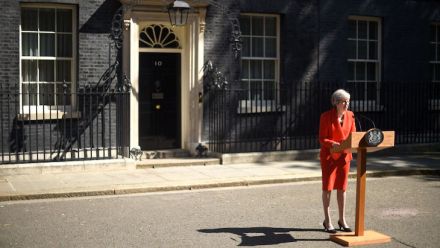
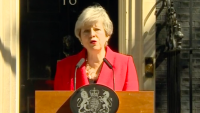
Theresa May has become the latest Conservative prime minister to be brought down by party divisions on Europe. Speaking outside 10 Downing Street, the Prime Minister gave a statement in which she confirmed that she will step down on June 7 to pave the way for a leadership contest to find her successor the following week. She admitted that her Brexit strategy had failed – having tried to pass her deal three times – and said this was something she deeply regretted. However, she suggested that she did not regret her approach – stating that 'compromise is not a dirty word'. At the end of the speech, May had a rare show of emotion as she declared that it had been an honour to 'serve the country I love': 'I will shortly leave the job that has been the honour of my life to hold.

The end of May

From our UK edition

This week’s European election was always going to be pointless, at least from a British perspective. It is possible that the elected candidates will never even take up their seats. In one important sense, however, the election campaign has been useful: as a reminder of where public opinion stands on Brexit. A few weeks ago, many believed that Change UK, the party founded by Labour and Conservative dissidents spoiling for a revocation of Article 50, would capture the public mood. Instead, another new political party would appear to have triumphed — a party set up with the sole purpose of expressing anger at the failure of Parliament to effect Britain’s departure from the EU on the date which had been set into law.

The Spectator’s Notes | 23 May 2019

From our UK edition

Almost everyone agrees it is a pity that so few pupils from ‘disadvantaged socioeconomic backgrounds’ get into Oxford. But no one has successfully proved that it is Oxford’s fault that they do not. (I went to Cambridge, by the way, so I do not have a dog in this fight, except that I imagine the same arguments apply.) One reason that some universities, including Oxford, are classified as ‘world-class’ is that they admit the best. The definition of ‘best’ cannot refer only to native ability, but must also take some account of how well prepared a pupil is.