Tech

China wants robots to look after the elderly

An AI data centre – imagine a factory of buzzing wires and computing equipment cooled by industrial fans – can consume as much power as a city. It has been estimated that, not too long from now, we’ll require 92 cities’ worth of extra power just to meet the demands of artificial intelligence. Ergo, the heat is on – but so, it is said, is a new cold war. On Radio 4 last week, Misha Glenny was exploring how the rapid evolution of technology is shaping the rivalry between the US and China. It turns out that the race for pre-eminence – in AI, at least – is as close as the 1973 Grand National. Red Rum (China) has the current lead, but that lead is ‘razor-thin’ and is thought to owe something to the nature of American tactics.

Is Keir Starmer prepared for the AI-pocalypse?

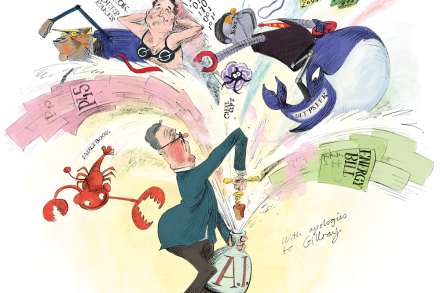
Is there any area of public policy which Keir Starmer’s government has got right? ‘Where very little is working, AI is a bright spot,’ says a former adviser. ‘They’ve started well but they are now in danger of blowing it.’ When Labour came to power they consigned much of the past 14 years of Tory rule to the dustbin. But Starmer poured resources into Rishi Sunak’s AI Security Institute and published an AI Opportunities action plan in January last year, declaring (very un-Starmerishly) that he wanted to ‘mainline AI into the veins’ of the economy. Last week an audit found that 75 per cent of the proposals had already been delivered – a level of success rare in Whitehall.

Sleepwalking into censorship: a reply to Nadine Dorries

In this week’s magazine I look at the threats posed by the so-called Online Safety Bill now making its way through the House of Commons. It gives sweeping censorship powers by creating a new category of speech that must be censored: 'legal but harmful'. The government will ask social media companies to do the censoring – and threaten them if they do not. The idea is for the UK to fine them up to 10 per cent of global revenue (ie: billions) if they publish 'harmful' content – but harmful is not really defined. So censorship potential is wide open. Nadine Dorries, the Culture Secretary, has suggested that the jokes of the comedian Jimmy Carr would be "harmful".

Boris is about to give Silicon Valley censors more power than ever

Four years in the making, the Online Safety Bill has now been sent to senior ministers for review — a process that allows them to protest, to shout if anything obvious that has been missed. In this case, the process is invaluable because something huge has been missed. The Bill, if passed, would empower the Silicon Valley firms it’s designed to suborn. It would formalise and usher in a new era of censorship of UK news — run from San Francisco. This Bill would backfire in a way that its Tory advocates have so far proven unable to understand let alone address. That’s why it needs to be halted, and a rethink ordered. The original aim is to make Facebook, YouTube, Twitter and others liable for any genuine filth promoted online.

Will our future lives be like a video game?

A few years ago, the software company Owlchemy Labs released a computer game called Job Simulator. Its premise was simple. Players find themselves in a future world, roughly 30 years from now, in which super-efficient robots have snaffled up all the jobs. No longer needed for work, humans entertain themselves instead by donning virtual reality headsets and reenacting 'the glory days' — simulating what it was once like to be an office clerk, chef, or shopkeeper. The gameplay, therefore, consists entirely of, well, yeah… carrying out endless mundane tasks: virtual photocopying, virtual cooking, virtual newspaper sales. Job Simulator is pretty tongue-in-cheek, crammed full of dry, self-referential jokes.

WhatsApp collapse throws Tory plots into chaos

The world’s oldest democratic party has had a few problems with technology in recent years. Famously it was the 2018 Tory conference which saw a security breach where the official party app allowed anyone to access the private phone numbers of members of the Cabinet – or in the case of Boris Johnson change his profile picture to that of a pig. Once again, tech issues are plaguing Tory conference, with three of the world’s most popular apps – Facebook, Instagram and WhatsApp – all being offline since 4:30 p.m. today. The last of these is the favoured platform for disloyal backbenchers and scheming hacks to conspire mischievously to make life harder for long-suffering Tory whips.

Matt Hancock isn’t the only politician who is clueless about cyber security

It is widely acknowledged that Britain has some of the world’s finest cyber capabilities. GCHQ is a global leader in those dark arts, and its offshoot, the National Cyber Security Centre (NCSC), is making that expertise available to businesses and others in need of help with their digital defences. All the more shocking, then, that our political leaders seem so utterly clueless. They have pledged to make Britain the ‘safest place in the world to be online’, but instead are running around like stars in a digital age ‘Carry On’ movie. Exhibit number one is Matt Hancock.