Schools

Long live eccentric school traditions

From our UK edition

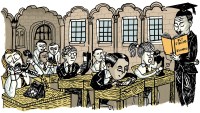
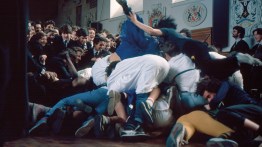
On every Shrove Tuesday since at least 1753, boys at Westminster School have gathered in the hall for a mad scramble over a pancake. The Pancake Greaze (pictured) is a cherished tradition that sees one pupil crowned the winner for grabbing the biggest portion, which the cook tosses into the centre of the hall from a height of 15ft, as the rest of the school cheers on. The champion is awarded a golden coin by the Dean of Westminster, accompanied by the headmaster and sometimes royal visitors. The more unsavoury part of the tradition – nominally beating the cook with Latin primers if he fails to get the pancake over the iron bar three times – has been abandoned. There have been other modern updates.

School portraits: snapshots of four notable schools

From our UK edition

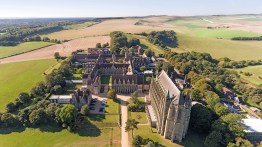
Lancing College, West Sussex Lancing is a public boarding school for children aged 13 to 18 in West Sussex. Set within the South Downs National Park, it offers an open-air theatre, a state-of-the-art music school, an equestrian centre and even the tallest school chapel in the world. As impressive as its facilities, though, are its alumni: Evelyn Waugh, Sir David Hare and Lord (Stephen) Green to name but a few. Nowadays, many students at the college – where fees start from £12,602 – come from its sister preparatory schools in Hove and Worthing. Also arriving this month is a new headteacher, Dr Scott Crawford, who will replace Dominic Oliver after 11 years.

The school tie renaissance

From our UK edition

In the street across the road from my third-year Christ Church room, sat a pub called The Bear. It marketed itself as Oxford’s oldest inn – as so many of the city’s hostelries do – but it is most famous for its tie collection. More than 4,500 are on display, enclosed in cases around the walls. The collection began in 1952, when the landlord offered half a pint to anyone who would let him snip off a tie end. To qualify, the ties had to indicate membership of some institution: a club, college, regiment, sports team or school. Over the decades, a cornucopia of colours, stripes and logos has been collected. Inspector Morse once enlisted the landlord’s help in identifying one. The collection is now listed and cannot be altered or added to. I’m rather glad.

Why do people feel sorry for me for going to boarding school aged nine?

From our UK edition

Sometimes, when I’m chatting about childhood, at some point it will become clear I went to a boarding school from the age of nine. Reactions can be comical. ‘You poor thing!’ an interlocutor might gasp, gripping my forearm, no doubt picturing cold showers and cruelty. I’ve always responded with bemusement, since my experience largely featured comfort and crumpets. I loved my prep school – Dorset House in West Sussex. It was a world in itself, enclosed and beguiling. In some ways it was unchanging, such as the graffitied Latin primers which were the same our grandparents had used. Yet it could be surprisingly forward-looking, as when it made a satellite link-up to a school in America, many years before the internet.

The ADHD racket

From our UK edition

In 1620, in the Staffordshire market town of Bilston, a teenage boy decided he didn’t much fancy going to school. Rather than resort to conventional methods, 13-year-old William Perry claimed that he was possessed by a demon. His symptoms included reacting with spasms to the reading of the first verse of St John’s Gospel and peeing blue urine. Thousands flocked to Bilston to witness his supposed possession. King James I, who wrote a book on necromancy and black magic, took a personal interest in the case. It was only when the Bishop of Coventry had the bright idea of reading him the equivalent scriptural passage in Greek – a language the boy didn’t speak but the Devil presumably could – and drew no reaction that suspicions were aroused.

Is Angela Rayner pushing up house prices?

From our UK edition

By George There is a popular movement to fly St George’s flags from lampposts. The St George Cross was used as an emblem of Henry II of England and Philip II of France during the Third Crusade in 1189. From 1218 it was used as the flag of Genoa, and in 1348 became a flag used by the English royal family. Some others using it today: — Georgia: national flag incorporates a large St George’s Cross with a smaller one in each quadrant; Sardinia: St George’s cross with a Moor’s head in each quadrant; Barcelona: St George’s crosses in two quadrants, with stripes in the other; naval flags of Bahamas, Jamaica and St Kitts and Nevis; autonomous Caucasian regions of Abkhazia and Adjara; Swedish freemasons.

Let’s slash the school summer holiday

From our UK edition

There are three little words that strike horror into the heart of every parent of school-age children. They are the words that cause you to break out in a cold sweat or let out a moan in your sleep in the dead of night – even in the middle of winter. They are ‘school summer holidays’. Hear those three words and you may very well envisage jubilant children spewing from the school gates and then remember the dim, distant sun-kissed summers of your own youth. But mention them within earshot of a parent of appropriately aged offspring and you’ll see the light go out in their eyes. Oh yes, the kids are happy – just like the waving teachers who weep with joy to see their charges depart. But now it’s time for the parents to weep.

Don’t call me ‘Mr’

From our UK edition

‘Please call me Mark,’ I’ve always said to the teachers at my son’s school. ‘If you call me “Mr Mason” it makes me feel 85 – and if I call you “Mrs Smith” it makes me feel seven.’ I know their first names, and always use them, in emails, phone calls and in person. A few return the compliment, but most keep it formal. It feels wrong, putting distance between us when we’re having a conversation, often an in-depth and important one, about my only child. The best teachers and staff have taught me fascinating things about how to deal with Barney. I’ve only been a parent once; they’ve encountered thousands of kids. It was the same at his primary school, starting with Sonja, when I was a volunteer helping with the class’s reading.

Letters: Our private schools are China’s next target

From our UK edition

Ka-shing in Sir: Ian Williams highlights (‘Chasing the dragon’, 3 May) the degree to which the Chinese state has acquired interests in the UK. Yet he overlooks a few tentacles of the Asian octopus that have curled around my home region of eastern England. Swathes of high-quality arable land are being subsumed into solar farms, panels for which are manufactured in China. The resultant electricity will be distributed by UK Power Networks, controlled, as Ian points out, by Li Ka-shing. East Anglia’s biggest brewer, Greene King, has been China-owned since 2019, held by Li Ka-shing through CK Asset Holdings. Our government seems craven in its attempts to lure Chinese fast-fashion retailer Shein to list on the London Stock Exchange.

When did RE teaching become so muddled?

From our UK edition

I recently offered my services as a part-time RE teacher to my local comp, an inner-city affair with a Muslim majority. Yes please, said the nice headmistress: the Covid-blunted Year 11s needed all the help they could get with GCSE revision. The syllabus consisted of Christianity and Islam. What could go wrong? The first thing that went wrong was that I talked about the Jewish roots of Christianity and Islam: Judaism was the original monotheism. ‘I don’t know if that’s right,’ said one girl, frowning. Well, you do now, I wanted to say. But of course what she meant was: I don’t know if you are to be trusted on this. I consulted the textbook, for objective evidence.

School portraits: snapshots of four notable schools

From our UK edition

Ludgrove, Berkshire Ludgrove, which was founded in 1892 by the footballer Arthur Dunn, is a boarding prep school in Berkshire and has 130 acres for its pupils to learn, run around and play in. The school is one of the last preps to provide full boarding (which is fortnightly). At weekends, boys can use 11 football pitches, four tennis courts, two squash courts and a nine-hole golf course. It’s not just Prince William’s alma mater: other old boys include Alec Douglas--Home, Simon Sebag Montefiore and Bear Grylls (who opened the new Exploration Centre in June 2021). Most of the boys go on to Eton, Harrow, Radley or Winchester.

Why I’ve never forgotten Sister Cecilia

From our UK edition

It is never people, always buildings. Faces change, time blurs them, but – unless they undergo a complete makeover – buildings remain pretty much the same, bar a few coats of paint. Along the second-floor corridor lined with arched windows that overlook the street. Buses grind by below. Up the last short steep staircase and along the very top corridor, which is narrower and lined with books. They call it the library and I am often here, tucked into the window seat reading, but otherwise heading for the arched door – everything is arched here – at the far end. It opens on to a low-ceilinged room with roof lights through which the sun seems always to be shining.

Letters: The brilliant uselessness of art

From our UK edition

Wonderfully useless Sir: Michael Simmons overlooks some scandalous examples of frivolous funding right under his nose (‘Waste land’, 15 February). A few minutes from our offices, there are several vast buildings, all lavishly subsidised by the taxpayer, whose sole purpose is to allow hordes of strangers to stare at rectangular sheets of fabric on which are daubed various colours and shapes – most of which quite wastefully replicate things that we can already see with our own eyes in the real world.

Letters: The real value of independent schools

From our UK edition

Strength of service Sir: Matthew Lynn and Steven Bailey (Letters, 1 February) are quite wrong to deplore the decline of Britain as a manufacturing nation. Manufacturing – especially of the heavy sort – is best suited to a country with plenty of space, little regulation, cheap energy and cheap non-unionised labour. That was once the case for Britain but it is no longer; nor is it so for the majority of European countries. Germany epitomises the folly of mindlessly adhering to manufacturing, as is well explained in Wolfgang Munchau’s excellent book Kaput. Britain, on the other hand, has successfully diversified into services and is now the world’s second-largest exporter of this income earner.

What I learned from my meeting with the Education Secretary

From our UK edition

Dear Secretary of State, thank you for meeting me and one of my deputies on Monday. You will have noticed in our meeting how disappointed we were with your responses to the questions teachers have about the government’s proposals. I assure you, we are not alone in that feeling. As teachers, we often hear politicians say how much they care about education. One of two things follows: either they turn out to be that rare politician who is truly interested in schools; or they are that all too common politician who simply wants to appear that way. Our meeting confirmed that you are firmly in the latter category. Politicians who truly want to raise standards for our most deprived communities would ordinarily be interested in hearing from the people who know best how to do it: teachers.

What Bridget Phillipson has in common with Plato

From our UK edition

One does not like to disagree with one’s editor, but while the image of Rome salting the earth of its bitter rival Carthage is a striking way of describing Labour’s plan to wreck our current system of education, Rome was not in the habit of destroying the advantages that its conquests produced. The salting story is a 19th-century invention, endorsed by no less an authority than the Cambridge Ancient History (1930), but now rescinded. As Mr Gove made clear in last week’s magazine, the universal imposition of a national curriculum, among other measures, will remove the freedom and choice – the two words you will find nowhere in discussion of Labour education policy – which played such a crucial part in improving educational attainment.

The sad demise of the scathing school report

From our UK edition

As the first term of the school year draws to a close, pupils’ reports will soon be landing, encrypted and password-protected, on parents’ smartphones. But once they’ve finally managed to open them to find how little Amelia or Noah has been performing, there will be another code for them to crack: what on earth the teachers are actually trying to say about their child. These days, reports tend to be written with the help of AI software or templates, which makes it impossible to work out how your child is really doing. In our super-sensitive age, many schools now play it safe by couching all comments as positives, and only using approved adjectives from word banks and drop-down menus.

Must try harder, Education Secretary

From our UK edition

The headmaster of one of the best comprehensives in the country was once asked the following question by Tony Blair: ‘If you could do one thing to improve state education in this country, what would it be?’ ‘Oh, that’s easy,’ he said. ‘I’d line up every civil servant in the education department and machine gun the lot of ’em.’ No prime minister has ever asked me that question, but my answer would be more diplomatic. It would be to insist that every incoming education secretary memorise the serenity prayer. This is the prayer that members of Alcoholics Anonymous recite at the end of their meetings: ‘God, grant me the serenity to accept the things I cannot change, the courage to change the things I can, and the wisdom to know the difference.

The 38 candidates to be Oxford’s chancellor

From our UK edition

Being Cambridge, I thank God that we have no nonsense about electing our chancellor. We have had a blameless, unchallenged succession of eminent persons. Since 1900, three prime ministers (Balfour, Baldwin and Smuts), two military commanders, one royal Duke (Prince Philip), two great scientists (Lords Rayleigh and Adrian) and now that prince of commerce and philanthropy, Lord Sainsbury of Turville. Their presence has passed almost unnoticed, rightly so: a chancellor’s role is to be, not to do. Poor Oxford, however, has a form of democracy to choose its chancellor, and now has insanely extended its effective franchise by online voting. So there are 38 candidates, and pressure that they should stand for something or other, know how the university works and play a part in academic politics.

Did Michael Gove mean what he said?

From our UK edition

I thought the Spectator dinner for Michael Gove hosted by Fraser Nelson would be cancelled. To be clear, this wasn’t a dinner where the Ming vase would be passed from one custodian to another, witnessed by the magazine’s general staff. Rather, this was a dinner to celebrate Michael’s legacy as education secretary organised weeks earlier by Rachel Wolf, founder of the New Schools Network, and which Fraser had kindly agreed to host. But – talk about bad timing! – at 1.30 p.m. on the day it was due to take place it was announced that Michael would be succeeding Fraser as editor.