Schools

Who Benefits Most From School Choice?

Who benefits from school choice? Conventional wisdom claims it’s the sharp-elbowed, well-heeled middle-classes that do the best. That’s the same CW that thinks the Big Society is all very well and good for Hampstead but it can never work in Hackney. This has never seemed especially persuasive to me, not least because these ideas are really designed to release untapped social capital and, almost by definition, there may be more of that untapped potential in less-affluent areas. Rapid growth and improvement should not be thought impossible. I’m glad to see, then, that there’s at least some academic support for this thesis. Overall or on average charter schools in the United
How far will Cameron go to break the state monopolies?

Call it the Big Society, decentralisation, people power, whatever – but David Cameron’s vision for society just became a good deal more concrete. In an article for the Telegraph this morning, the Prime Minister makes a quite momentous proposal: that there ought to be a new presumption towards diversity in public services, whereby the private, voluntary and charitable sectors are as privileged as the state is now. Or as he puts it: “We will create a new presumption – backed up by new rights for public service users and a new system of independent adjudication – that public services should be open to a range of providers competing to offer

Labour tries to reheat the Building Schools for the Future row

It was predictable that Labour would use the outcome of the judicial review last Friday to try and re-heat the Building Schools for the Future row. Andy Burnham was in florid form in the House of Commons on the subject. He demanded that ‘Michael Gove apologise to the communities who suffered from the devastating effects of his disastrous decision making.’ Burnham is now writing to the PM to demand that Gove recuse himself from the judge required review of six BSF projects. In truth, most of Gove’s problems in cancelling BSF projects have been a result of the shambolic and wasteful way in which the programme was run. As Gove

Introducing Britain's skills crisis

Did you know: Britain trails well behind other countries such as the US, Germany and Poland when it comes to educating its workforce? Did you know: the number of young people not in employment, education or training has risen by around 40 per cent over the last decade? Did you know … oh, you get the idea. All the statistics, and more, are in the booklet on Britain’s Skills Crisis that is included in this week’s Spectator. For CoffeeHousers who don’t buy the magazine (although you should, etc – purchasing options here), you can read the supplement for free via this snazzy, page-turning whatsit. We’ll also put one or two

Gove entrenches his reforms

In another sign of how the pace of Gove’s reforms is quickening, the education secretary has told local authorities that all new schools should be free schools or academies. This is a big step towards changing the default nature of the system from state-funded and state-run to state-funded but independent.   Local authorities will not be able to open a bureaucrat-controlled school unless they can satisfy the Secretary of State that there is no free school or academy provider willing to step in.   Gove has always argued that once free schools and academies become a significant part of the system it’ll be no more politically possible to abolish them

Is it worth paying young people to stay on at school?

Today’s political news is brought to you by the letters E, M and A. Eeeema. While the political establishment debates the abolition of EMA – the Educational Maintenance Allowance – inside Parliament, campaigners will be protesting against it on the streets outside. The police, who are used to these things by now, have already set up the barricades. Behind all the fuss and froth, the argument is really this: is EMA good value? The coalition claim that paying 16-18 year-olds up to £30 a week to stay on at school is not only expensive, but also wasteful. Labour – who introduced this allowance in the first place – claim that

Gove's school reforms approach a tipping point

Today marks something of a milestone for Michael Gove’s school reform agenda. Free schools – i.e. ‘Academies’ which are independently run, yet within the state sector – now account for more than 10 percent of British secondaries. This is what I have always thought of as a tipping point – where independent schools offer real competition to council schools (i.e. those run by their local authority). One hesitates to sound too confident, but the genie of choice seems to have been yanked out of the bottle, and a few facts are worth nothing: 1. There are now 407 Academies open, twice the amount in May 2010. The 400 mark was,

The final sting

It’s Christmas Eve, and the Daily Telegraph have wrapped up their sting operation in time for tomorrow. The final victims are the Foreign Office minister Jeremy Browne and the children’s minister Sarah Teather. As it happens, Teather gets off without blemishing her copybook: her greatest indiscretion is to claim that Michael Gove is “deeply relieved” to be in coalition, as it means more funding for schools. Browne, though, is a touch more forthright: he says that Tory immigration policy is “harsh” and “uncharitable,” but that Lib Dem involvement will provoke a “more enlightened” outcome. He adds that the Tories’ EU grouping contains parties that “are quite nutty and that’s an

How far our schools have fallen

Comparing GCSE or A-Level results to previous years is a meaningless exercise. Leaving aside all the arguments about whether or not these exams are getting easier, it doesn’t much matter if children today are doing better academically than their peers a generation ago. What does matter is how they are doing in comparison to children in other countries, the people they’ll be competing with in the global marketplace.   Today’s PISA rankings, the OECD’s comparison of education standards, makes for depressing reading on this front. England has fallen from 7th in reading in 2000 to 25th today, from 8th to 27th in maths and 4th to 16th in science. Admittedly,

Status Anxiety: I can’t wait for Superman

You have to admire the marketing savvy of Paramount Pictures UK. It has picked the perfect moment to release Waiting for Superman, a 111-minute documentary about the crisis in American education. It comes out this Friday, following hot on the heels of the government’s White Paper on education and Ofsted’s report on Labour’s education record. The conclusion of both the White Paper and Ofsted is that nothing is more important to educational attainment than good teachers and that is also the theme of Waiting for Superman. It follows the fate of half a dozen children, all of whom have applied for places at charter schools. We’re introduced to them at

Round and round the garden

Juliet Townsend finds that children’s arcane playground rituals have survived television, texting and computer games When Iona and Peter Opie published their groundbreaking work The Lore and Language of Schoolchildren in 1959, they started their preface by pointing out that Queen Anne’s physician, John Arbuthnot, friend of Swift and Pope, observed that nowhere was tradition preserved pure and uncorrupt ‘but among School-boys, whose Games and Plays are delivered down invariably from one generation to another.’ Theirs was the first study to establish that this was still largely true in the mid 20th century. Steve Roud now brings the story up to date, and seeks to find out whether this rich

How to prevent schools from being hijacked by extremists

The coalition plan to let parents, teachers and voluntary groups set up schools and be paid by the state for every pupil they educate has the potential to transform education for the better in this country. But this policy also requires the government to prevent these freedoms from being abused by extremist groups who want to teach hate. The revelations on tomorrow night’s Panorama about weekend schools that use Saudi textbooks that ask pupils to list the “reprehensible”  qualities of Jews and teach the Protocols of Zion as fact are  a reminder of how serious this threat is. A new report from Policy Exchange, a think tank that has done

The Gove reforms grow even more radical

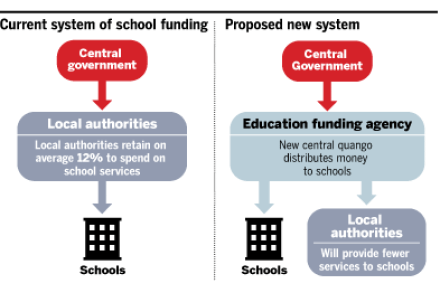
Local authorities are already doing their utmost to block the coalition’s schools reforms, so just how will they respond to this story on the front of today’s FT? It reveals how Michael Gove is planning to sideline local authorities from the funding of all state schools – not just free schools and academies. The idea is that state schools will get cash directly from the state, without any need for the council middlemen that currently control the system. Here’s an FT graphic that captures the change: The money would be allocated to schools in proportion to the number of pupils they have, and headmasters would have much more freedom in

Spectator Debate: ‘Taxpayers’ money should not fund faith schools

Ninja Turtles were the first witnesses at last week’s Spectator debate. Ninja Turtles were the first witnesses at last week’s Spectator debate. Proposing the motion ‘Taxpayers’ money should not fund faith schools’, the Sunday Times columnist Minette Marrin said that the child of a friend had been denounced as ‘satanic’ at his Christian school for wearing Ninja-branded pyjamas. Religious schools, she went on, led to ghettoisation and contempt for the host culture. Three Islamic schools in the UK require girls to wear the full veil, and they boast that they ‘oppose the lifestyle of the West’. Cristina Odone, former editor of the Catholic Herald, trumpeted the success of faith schools. A newspaper survey

Sticking up for free schools

I’m on the train back from doing Radio Four’s Any Questions – broadcast live from Derby, repeated at 1.10pm tomorrow – where I had a bust-up with Christine Blower of the NUT. CoffeeHousers may recall she was the star of a cover story we ran a few weeks back, about the campaign of bullying and intimidation levelled against headteachers who are trying to seek Academy status. She raised that article during recording, and things kinda kicked off. I told her she should be ashamed of the way her union thugs try to intimidate young teachers who seek to break away from local authority control and reach independence. She denied writing

Laws helps Gove

Michael Gove has just been explaining in the Commons where the £7 billion for the fairness premium that Nick Clegg announced on Friday will come from. Revealingly, David Laws was present as Gove answered this urgent question. I understand that Laws was crucial to both the pupil premium being implemented at a decent level and the real-terms increase in the schools Budget.   Laws himself told John Pienaar’s show last night that “obviously I’ve talked to him [Nick Clegg] about some of the things that I’ve been associated with in the past, like the schools funding issue… because I was the schools spokesman in the last parliament”. I hear that

Clegg sweetens the pill with a fairness premium

Only five days to go until the spending review – and after weeks of emphasis on the cuts we’re about to see, the government has today unveiled a new spending commitment. It comes courtesy of Nick Clegg: a new “fairness premium” targeted at the least well-off young people. Lib Dem Voice has full details here, but the basic point is that £7 billion will be spent, across 4 years, on programmes for disadvantaged 2 to 20 year-olds. Much of this will go towards the “pupil premium” that we’ve heard so much about, and which should advance school choice in the most deprived areas. Putting aside his genuine commitment to it,

Returning to the fray

I am travelling to Conservative Party conference in Birmingham today and thought this would be a good time to return to this blog. Thanks to everyone for your thoughtful comments in my absence. As ever, I will try to respond where I can. I should be up to full speed during the week. Meanwhile, I thought I would lay out the five themes I will be addressing over the coming weeks. So do feel free to  provide me with ideas. I’m sure you will. 1. Ed Miliband may not be the answer, but he is a pretty good question for Labour. The new Labour leader is neither their equivalent of William

Cameron, more ideological than he appears

The Tory conference in Birmingham is the last big political event before the cuts come. After the 20th, every time a senior Tory appears in public for the next few years they will be about why this or that is being cut. As the row over defence shows, these questions will come from right across the spectrum. For this reason, Simon Schama’s interview with Cameron in today’s FT is probably one of the last that will start with the assumption that Cameron is genial, non-ideological fellow. Once the cuts are happening, it will be harder to cast Cameron as a consensual figure. His edges will appear harder, more defined.  But

Another obstacle in the way of free schools

A few weeks ago, I wrote a cover story about how teachers’ unions are trying to strangle the Gove schools agenda at birth. But I fear it is facing an even greater, more immediate threat: basic bungling by government departments. The FT today says that the Department of Transport wants to make sure that local authorities keep the right to veto a new school. Armed with such a weapon, it is a sure way of crushing any competition. The DoT’s argument is staggeringly banal: that a new school may play havoc with the traffic. If you’re a local authority, wanting to use any means possible to stop a new school