Schools

How to build a school

From our UK edition

King’s College London Mathematics School is precisely one year old. And on 13 August it woke up to AS-level results that make it one of the ten best state schools in the country. 97 per cent of students got an A in mathematics. 90 per cent of grades in maths and further maths were As. Students’ grades were, on average, two grades higher, across all their subjects, than would be expected from their GCSE results. As a governor, I bask in reflected glory. Ours is a ‘free school’ sponsored by King’s, and it teaches talented, committed 16- to 18-year-olds. We select for potential, using our own test. But we also select by the education, and especially the quality of the A-level maths, that applicants could expect at their current school.

Labour asks school pupils to act as informants ahead of vote

From our UK edition

Although Buzzfeed managed to successfully register a cat to vote in the Labour leadership election, the party remains insistent that they are successfully weeding out 'supporters' who are not genuine. However, in a sign that they may not have quite as good a grasp on these checks as claimed, it turns out that they are asking school children to help by acting as whistleblowers on fellow pupils.

The lessons of exam results season

From our UK edition

Every year without fail, as the trees start thinking about losing their leaves, the papers are full of the same photographs and the same stories. The pictures are of groups of teenagers grinning triumphantly — hugging one another or throwing their exam results in the air in joy. What we have just experienced is exam results week; or, to be precise, results fortnight: first A-levels and then, one week later, GCSEs. GCSEs lead to A-levels, A-levels to university (and yet more exams) — and then at the end of it all? Well, that’s the next obstacle. But for parents, as well as children, the endless tests can be incredibly confusing. A colleague recently told me about her son, who is due to start school in September.

Why are private schools so touchy about state schools’ success?

From our UK edition

The success of school reform in Britain seem to be worrying the private schools’ spokesmen. They’ve taken the unusual step of releasing a statement in response to my Daily Telegraph column yesterday, where I show that the top state schools outperform top private schools in A-Level league tables. I’m not sure why they’re so upset; I didn’t have a word of criticism for private schools. I think their success is admirable. I just argued that there is, now, just as much excellence in the state sector - and I produced data to back this up. Barnaby Lenon, chairman, Independent Schools Council, didn’t seem to that one bit.

Don’t act white, act migrant

From our UK edition

A black head teacher told me a story of his early days at a failing inner-city school. The job was a thankless one and everybody was waiting anxiously for the arrival of the new ‘super-head’ (the school had gone through three leaders in two years). In the playground it was leaked that the new head was an old-school type from Jamaica. During his first encounter with the students, they asked him how many children he had. He told them he had one and that she lived with him and his wife. ‘No sir, how many do you have in Jamaica?’ they asked. He replied: ‘None.’ They jeered, ‘Oh sir you’re not a yard man, not a real Jamaican — you’re acting white.’ This, I’m afraid, is typical.

Common sense, moral vision — and the magic touch

From our UK edition

An Intelligent Person’s Guide to Education is Tony Little’s valedictory meditation on his profession, published on his retirement as headmaster of Eton. In a series of loosely connected essays, erudite and eccentric, he contemplates issues of fundamental concern to us all. What are schools for? How should teachers be educated? How do good schools work? The book is rather oddly larded with insights from The Schoolmaster (1902) by A.C. Benson (brother of E.F. and Robert Hugh) who was, like Little, an Old Etonian who went back to teach at the school. Benson’s commentary on his own teaching experience is used as a touchstone, generally reinforcing Little’s civilising, rational approach to education. These essays reveal Little’s vigorous moral vision.

Portrait of the week | 2 July 2015

From our UK edition

Home At least 30 British people were among 38 shot dead at a beach resort at Sousse in Tunisia by Seifeddine Rezgui, aged 23, a Tunisian acting for the Islamic State and said to have been trained in Libya. Soldiers, emergency services and 1,000 police took part in a two-day exercise in London simulating a terrorist attack. A statutory obligation became binding on public bodies, including schools, to prevent people being drawn towards terrorism. Nicky Morgan, the Education Secretary, said that schools should look out for ‘homophobia’ as a symptom of Islamist jihadism.

Nicky Morgan: intolerance of homosexuality in schools may be a sign of extremism

From our UK edition

Nicky Morgan is taking the fight against radicalisation into the classroom. On the Today programme, the Education Secretary outlined what her department is doing to support schools in tackling, what she called, this ‘very real threat’. The DfE will release new guidance for teachers today, offering ‘examples and support in how they might look for young people who are risk at radicalisation – perhaps changes of behaviour or things they might say’.

How to grapple with discipline in schools

From our UK edition

The government’s new school discipline leader Tom Bennett has a difficult brief; he’s in charge of stopping the schoolchildren of the entire nation swinging on their chairs, playing on their telephones, making silly comments and passing notes. Discipline is a problem the Spectator has often grappled with over the years. Writing in 1970, Rhodes Boyson said although there had been incidents in the early19th century when schools had called in troops to put down riots, modern schools weren’t much better at keeping control.

Coffee Shots: Introducing ‘ISIS Schools’

From our UK edition

Earlier this week the chief inspector of schools Sir Michael Wilshaw warned that schools needed to show Muslim pupils that they are valued by society in order to stop them running off to join ISIS. So Mr S was surprised to hear that there is an 'ISIS school' operating in Greenwich: On closer inspection, the school is one of a number of 'ISIS schools' based in Britain and Canada, teaching English to foreign students. Mr S suspects it's time they considered a rebrand, starting with their name.

The best way to end the ‘poshness test’

From our UK edition

There’s a warning buried in the detail of the new report by the Social Mobility and Child Poverty Commission on why top companies employ so few applicants from comprehensive schools: ‘Though this study provides valuable insights into barriers to the elite professions, there are nevertheless some limitations associated with the chosen research methodology. As a small-scale qualitative study, the aim is to explore issues and generalisability is limited.’ But most pundits who’ve commented so far missed this caveat. ‘New research… reveals the privileged choose and look after their own,’ wrote Owen Jones in the Guardian. ‘They don’t like accents that sound a bit, well, “common”.

Diary – 4 June 2015

From our UK edition

For the first time since the terrorist attack on the Sri Lankan team six years ago, a Test match side has visited Pakistan. The Zimbabwe tourists, playing at the same Lahore stadium where the attack was mounted, were greeted with wild enthusiasm. Less well reported has been the fact that a team of English cricketers (including myself and Alex Massie of this parish) has been touring the Hindu Kush. We played in Chitral, Drosh, Ayun, Kalash and Booni. In these mountain areas many of our opponents were using pads, gloves and a hard ball for the first time. Still, we were overwhelmed, rarely losing by fewer than 200 runs in games which never exceeded 30 overs.

Dear Mary | 28 May 2015

From our UK edition

Q. I felt uncomfortable during a dinner for 20 in a private house. The young man on my left had failed to turn to the woman on his left when it was time to do so and instead stared vaguely down the table with his back slightly turned to her. She looked devastated. I wonder what I could have said, without sounding nanny-like, to remind this youth of his manners and his special duty, as one of those staying in the house, to make those locals who had been invited in feel particularly welcome. I know the man’s parents vaguely and they know how to behave, but I had never seen him in this context before. — Name and address withheld A. You might have broken his narcissistic spell by whispering, ‘Is it true that the woman on your left is the second richest person in Europe?

Freedom for free schools

From our UK edition

I was disappointed to hear Andy Burnham on Marr last Sunday declare his opposition to free schools. He put plenty of distance between himself and Ed Miliband, even admitting Labour spent too much in the run-up to the recession, which is quite something given that he was the Chief Secretary to the Treasury at the time. But Miliband was spot on, apparently, when it came to free schools. He then reeled off all the usual guff about ‘experimenting with children’s education’, ‘surplus places’, ‘unqualified teachers’, etc. It’s tempting to take Burnham to task over this, since he’s the favourite to become the next Labour leader. What could be clearer evidence that he’s in the pocket of Len McCluskey than siding with the teaching unions?

Tristram Hunt: Education Secretaries can send their kids private

From our UK edition

In the Daily Politics education debate just now on the BBC, Tristram Hunt declared that it was acceptable for an Education Secretary to send their own child to private school. Under questioning from Andrew Neil, Hunt said that it was fine in ‘certain circumstances.’ The other members of the panel—including Nicky Morgan and David Laws—then agreed with Hunt’s statement. Is it acceptable for an education secretary to send their child to a private school @afneil asks his #bbcdp panel? https://t.co/A5VI9mnHlz — DailySunday Politics (@daily_politics) April 23, 2015 Hunt’s remarks are politically brave.

Did Radio 4 have to deal with the Germanwings disaster as it did?

From our UK edition

‘You can hear pretty clearly the sound of one of the helicopters and you can see it in the darkness,’ yelled James Reynolds over the noise of helicopters, police sirens, vehicles on the move. It was 8.10 a.m., the Today programme on the morning after the fatal Airbus A320 crash in southern France last week. Reynolds, a fine reporter, had been sent off to the crash site for an on-the-spot report, ‘live’ action, high-octane drama, tension so taut it’s almost visible. ‘I can see a convoy of police vehicles coming up the road with blue sirens,’ he continued. ‘There goes the police helicopter...’ Huge noise of rotors whirring. ‘It’s almost passing overhead.’ No doubt about that as the noise boomed around the kitchen.

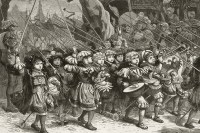
A rebellion among Rugby schoolboys proved perfect training for its ringleader in putting down a Jamaican slave-rising in later life

From our UK edition

The public schools ought to have gone out of business long ago. The Education Act of 1944, which promised ‘state-aided education of a rapidly improving quality for nothing or next to nothing’, seemed to herald, as the headmaster of Winchester cautioned, the end of fee-paying. Two decades later Roy Hattersley warned the Headmasters’ Conference to have ‘no doubts about our serious intention to reduce and eventually to abolish private education in this country’.Yet David Turner is able to conclude in this well-researched, impeccably fair and refreshingly undogmatic history, that this is their golden age. He takes the unfashionable line that they are now vital contributors to the country’s economic, political and scientific well-being. It was not always so.

I’m working to make education fairer. But I’m still not sure what ‘fairer’ means

From our UK edition

Civitas has just published an interesting book called The Ins and Outs of Selective Secondary Schools. Edited by Anastasia de Waal, it’s a collection of essays by the usual suspects in the never-ending argument about grammar schools. De Waal points out that the two sides have more in common than you’d think. In particular, they share a common goal, which is to sever the link between a child’s socio-economic status and attainment. In 2009, according to the OECD, the variance in the scores of British children in the Pisa international tests in maths, reading and science that could be explained by their backgrounds was 13.8 per cent. By this measure, the best-performing region in the world is Macau (2 per cent) and the worst is Peru (27.5 per cent).

The Conservatives should be the party of immigrants — and here’s how they can be

From our UK edition

For a long while, the Conservatives have been puzzled about their lack of popularity among immigrants. In theory, the Conservative party should be the natural home of new voters who are ambitious, entrepreneurial, hard-working and family-orientated. The immigrant vote — to the extent it can be considered a coherent block at all — ought to be fertile Tory territory. By and large, these are families who have moved to Britain to get ahead and to avail themselves of what Michael Howard called ‘the British dream’. Yet at the last election fewer than one in five ethnic minority voters endorsed Conservative candidates and the party is unlikely to fare much better in May.

A lesson in bias on private schools

From our UK edition

What’s wrong with low-cost education in poor countries? Quite a lot, you might think, if you read a new report from the Department for International Development. Low-cost private schools serve around 70 per cent of children in poor urban areas and nearly a third of rural children too. But the issue raises controversy among academics and experts, not least because it goes against 65 years of development dogma that the only way to help the poor is through government education, with big dollops of aid thrown in. Every aid agency and government has gone along with that. The only fly in the ointment is that poor parents disagree, which is why low-cost private schools are burgeoning wherever you look.