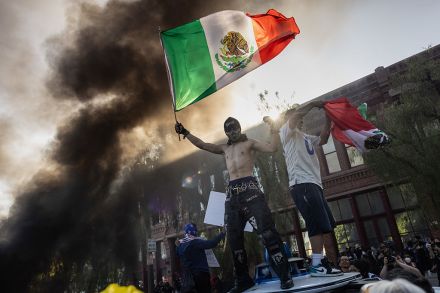
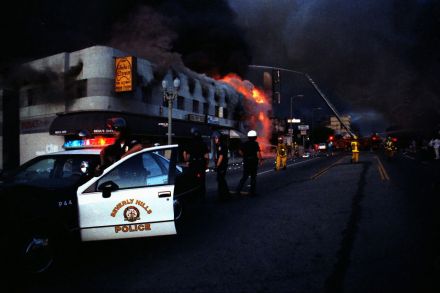
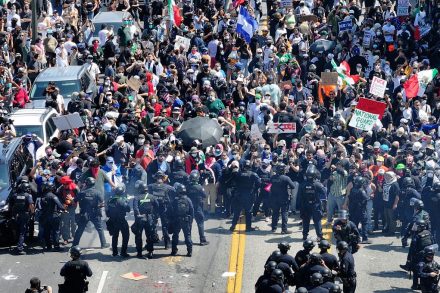
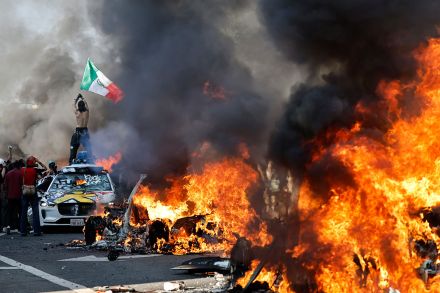
Riots

Our resentment of migrants is centuries old: the Little Englanders of the Tudor era

This Little World opens with a description of the riots of 1517, an explosion of pent-up hostility and resentment against ‘strangers and aliens’. Recently arrived migrants from France and the Low Countries were blamed for aggravating the poverty and want suffered by locals. That Easter, a rabble-rousing preacher had called for Londoners to remedy this injustice: ‘As birds would defend their nest, so ought Englishmen to cherish and defend themselves, and to hurt and grieve aliens for the common weale.’ Soon afterwards, on the May Day holiday, apprentices gave drunken, unruly vent to their frustration in riots. Five hundred years flash by and so little has changed.

100 Days of Starmer: the verdict

25 min listen

Today marks Labour’s 100th day in office. But they are unlikely to be popping champagne corks in Downing Street – even if Lord Alli offered to pay for the Dom Pérignon. This has been a disheartening time for the government and those who wished it well. The promise of dramatic change has been overshadowed by a series of errors, misjudgments and scandals that one would associate more with an administration in its dying days than a government enjoying a fresh mandate, a massive majority and an absent opposition. Former shadow culture secretary Thangam Debbonaire and former deputy prime minister Thérèse Coffey join The Spectator's Katy Balls to discuss what went wrong and – if we think hard enough – what went right?  Produced by Natasha Feroze and Oscar Edmondson.

Who will protect me?

Police are hunting a ‘hooded figure’ who sprayed ‘no whites’ on the wall of a primary school in Birmingham. The coppers presumably have racial hatred in mind, but there could be a much more innocent explanation for that which otherwise would be simply a case of vandalism – or even one of laudable graffiti art which may, one day, sell for millions of pounds to a rich idiot devoid of discernment. The school is located in the Alum Rock area of the city, a ward which consists almost entirely of ‘BAME’ people, according to a city council factsheet. So it may be that the hooded figure with the spray can was simply stating a fact, much as perhaps you are inclined to do when looking at television adverts or trailers for new BBC drama series.

Portrait of the week: riot justice, Olympic success and Ukraine’s Russian advance

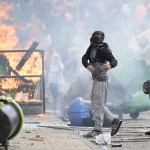
Home Riots subsided after 7 August, a night when many were expected but only empty streets or demonstrations against riots eventuated. By 12 August there had been 975 arrests and 546 charges in 36 of the 43 police force areas in England and Wales. Rioters could be released from jail after serving 40 per cent of their sentence, as part of the early release scheme to ease prison overcrowding, Downing Street said. Ricky Jones, a councillor for Dartford, now suspended from the Labour party, was remanded in custody after being charged with encouraging violent disorder in Walthamstow.

How Ancient Greece handled riots

Riots are difficult enough for us to deal with, let alone for the ancients, who had neither police nor prisons; and only late on housed troops in cities. Since Athenian citizens – the poor – made all political decisions, and the state and the rich funded them, there was little for them to riot about. The two riots organised by oligarchs to destroy democracy failed. But in republican Rome, political tensions between the rich and the poor could produce serious rioting, often designed to disrupt the voting. Tiberius Gracchus’ Bill (132 bc) forbade anyone from owning more than 120 hectares of public land (50 soccer pitches), the excess being distributed among the poor at 30 hectares per family. After blood-soaked rioting, it was passed.

Letters: Britain doesn’t have a ‘two-tier’ policing problem

Less is more Sir: While I wholeheartedly agree with Toby Young’s observation that ‘more censorship would make things worse, not better’ (No sacred cows, 10 August), I’m confused by his remedy – ‘more and better speech’. First, how does one decide what better even means, without it becoming a form of censorship? Second, and perhaps more worryingly, it feels like something Stalin might appreciate. ‘Quantity has a quality of its own,’ he once said. In their different ways, both incessant social media and weekly magazines rather disprove that.

Why Britain riots

33 min listen

This week: The Spectator’s Gus Carter was in Rotherham and Birmingham in the days after the riots. Locals tell Gus that ‘violent disorder isn’t acceptable but people from down south don’t know what it’s like up here’. A retired policeman in Birmingham adds that ‘it’s just yobs looking for an excuse – and yobbos come in all sorts of colours’. You can hear Gus’ report on the podcast. (02:25)  Next: Gus and Lara take us through some of their favourite pieces in the magazine, including Flora Watkins’ notes on ragwort and Isabel Hardman’s review of Swimming Pretty: The Untold Story of Women in Water.

Sharing riot videos? You’re part of the problem

We’re told these riots are about immigration, racism, angry Islam, elite blindness and identity politics – and, to a point, that’s all true. But the disorder in British cities is also about the internet – and online videos in particular. People just can’t stop sharing ‘riot porn’, whether it be savage beatings, vicious clashes between rioters and the police, or buildings and cars being set on fire. Violence, like sex, goes viral because it is so addictive to watch. Unlike with pornography, however, there’s no stigma attached to the circulation of such footage, especially if the person on the receiving end of the brutality seems to be a villain. It’s schadenfreude on steroids.

Why Britain riots

Riotous summers seem to occur in Britain with about the same frequency as sunny ones: roughly every decade. Sometimes it’s Afro-Caribbeans protesting (Brixton in 1981), sometimes Asians (Oldham in 2001). The white working classes rioted over the poll tax in 1990 and in Southport this year. The riot in Harehills, Leeds, last month was precipitated by social services removing children from a Roma couple. Whatever sparks the unrest, what all riots have in common is that they involve mindless destruction. Rioters smash and burn their own communities and opportunists descend, trying to exploit the situation for political ends. Fake news and misinformation abound.

Starmer’s first big test

During the election campaign, Keir Starmer confessed to taking Friday nights off. ‘I’ve been doing this for years – I will not do a work-related thing after six o’clock, pretty well come what may,’ he told a radio host. But one month into his premiership, and the Prime Minister is struggling even to take his pre-planned summer holiday. Claims that Labour’s decisive victory would make the UK a pocket of stability in a polarised world now look hubristic. Starmer leads a country that others such as Australia and Malaysia are warning their citizens not to travel to. Meanwhile he is engulfed in a very public Twitter spat with tech billionaire Elon Musk. As if in response to No.

Free speech stops riots 

With depressing predictability, the riots have led to calls for more censorship. Historically, it was the authoritarian right who blamed outbreaks of civil disorder on too much free speech, but this knee-jerk, illiberal reaction is now more likely to be found on the left. I’m not just thinking of Paul Mason, who called for Ofcom to revoke GB News’s broadcast licence, or even Carole Cadwalladr, who tweeted: ‘This should be our Dunblane moment. Only with social media not guns.’ I’m thinking of statements by the Prime Minister and the Home Secretary. Is Sir Keir going to urge the police to investigate his own role in ‘whipping up violence’?

Will Starmer crack down on social media?

17 min listen

Courts have started giving out severe sentences to those involved in the riots today, but there is a continued clamouring for Keir Starmer to do more. The next step seems to be cracking down on discussions online, where social media platforms such as X and Telegram could be inflaming the riots. Could the government give in to this pressure, and what do we, as a society, lose if so? Cindy Yu talks to Katy Balls and non-affiliated peer Claire Fox. Produced by Cindy Yu.

Europe is worried that Britain’s riots might spread

The riots that have erupted across England in the last week have been splashed across Europe’s newspapers and broadcast on the primetime news. There have been editorials in France’s Le Monde, video reports in Spain’s El Pais and podcasts in Sweden’s Aftonbladet. The Italian newspaper, La Stampa, published video footage of disturbances in Plymouth on Monday night, and described the rioters as a mix of ‘extremists and hooligans’. Why did the anti-immigration riots not explode first in France or Germany? Some of the coverage has been superficial.

Can our prisons take these ‘thugs’?

16 min listen

Keir Starmer will be chairing his first Cobra meeting, as the government continues to grapple with the rioting that has broken out across the country. The weekend saw numerous examples of violence, including at hotels thought to be hosting asylum seekers. We had a statement from the prime minister condemning the ‘right wing thuggery’, but do we need a more complete approach to extremism? And will our prisons and our courts be able to accommodate the huge influx of offenders?  Oscar Edmondson speaks to Katy Balls and Ian Acheson, senior advisor to the Counter Extremism Project.  Produced by Oscar Edmondson.

The ‘community cohesion’ concept explains confusing police tactics

Merseyside police were very keen to rule out the Southport attack as ‘terrorism-related’. This was despite subsequent remarks from the Home Office that counter-terrorism police were still assisting the investigation. That muddled explanation will fall on deaf ears. Whether this turns out to be an act encompassed within the dry legalistic definition of terrorism, the dead are still dead. Why are the police in the firing line this weekend? Why have they not been more forthcoming originally on details? Could a quicker reaction have dampened the riots we have seen over the past few days? One reason that the police strategy looks so baffling could be Merseyside’s concern that nebulous ‘community cohesion’ must be protected at all costs. Was it a flawed calculation?

Why there’s rioting in Leeds

As something of a fan of riots and social unrest I was interested to know who, precisely, had gone doolally in the Harehills area of Leeds last week and started setting fire to buses and so on. The local police announced that it was a ‘serious disorder incident’, but I could find no information at all about who it was doing the rioting. Just people, I suppose – and we are all people, aren’t we? Still I scoured the paper – and nope, no enlightenment. Perhaps it was just northerners – Leeds is full of them, after all, and they can be fractious and violent when the mood grips hold of them. Inner-city northerners with their slavering pitbulls, their skag and their misplaced sense of pride and grievances.

Was the French Revolution inevitable?

In the middle of the 18th century, on the north side of the Palais Royal gardens in Paris, there stood a magnificent chestnut tree called the Tree of Cracow. In his presidential address to the American Historical Association in 2000, Robert Darnton explained that the name Cracow probably derived from the heated debates that took place in Paris during the War of the Polish Succession, but also from the French verb craquer: to tell dubious stories. News-mongers or nouvellistes de bouche, agents for foreign diplomats and curious members of the public gathered round the tree, which was at the heart of Paris’s news network, a nerve centre for transmitting information, gossip and rumours.

The fine art of French rioting

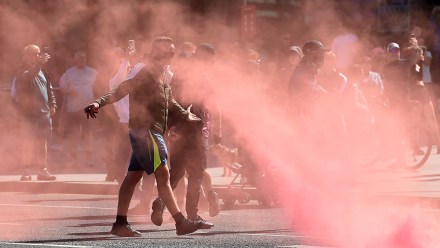
Marseille One of the benefits of holidaying during a riot is you feel remarkably safe. Ruffians have no interest in you while they can be having fun at the expense of a much more exciting foe, the police. And besides, there are Lacoste stores to be raided: they have no time for your wallet. The other major benefit is you can get a table anywhere. We had the best seat in France last week: the first-floor balcony of La Caravelle, an old-school bar overlooking Marseille’s historic port and the perfect vantage point for taking in the fine art of French rioting. The choreography unfolded in fits and starts. The police vans snaked around the water’s edge in military formation. Out filed the riot cops, their tessellated body armour making them look like mutant woodlice.

Why Europe riots

Montpellier A spectre is haunting Europe. In France, Sweden, Germany, Belgium and even Switzerland, the rule of law is being challenged by the rule of gangs. Disaffected young people cut off from society feel nothing but nihilistic contempt for it. Higher temperatures and social media are creating a heated summer. Judging from recent events in Paris and Stockholm, this year could be the worst so far. The rise of gang violence is associated with immigration. Europe has shown itself incapable or unwilling to control the influx of migrants, some of them genuine asylum seekers, others simply opportunists. Nor have European politicians succeeded in dealing with the problems created by immigration, despite spending billions on social projects.