Regard the protestors. See how happy they are. Can you hear them whoop and whistle? The burning clock tower of the town hall has fallen inside the old building. Houp-là. How they whistle and whoop! The baying of such mobs in public places is as old as the history of towns and cities, the burning of buildings equally antique. Order and chaos, civilisation and barbarity, the call of the primeval.
Limoges has long been famed for its ‘arts of fire’, of the elements and crafts involved in the making of enamelware that reached its artistic zenith between the 12th and 14th centuries with a host of exquisite crucifixes, crosiers and tomb effigies, a hosanna of book covers and reliquary caskets. In 2017, Unesco awarded Limoges the honorary status of ‘Creative City’ in recognition of its traditions in the fields of arts and crafts. In 2026, vandals whooped as the ornate spire of the town hall’s clock tower plunged past a split pediment adorned by allegories of enamelling and goldsmithing, the city’s ‘arts of fire’.
Vandals whooped as the ornate spire of the town hall’s clock tower plunged past a split pediment
Very few buildings have deserved this assault by the mob – the luxury of destruction – no matter how important the mob has believed, or believes, its cause to be. Limoges Town Hall, a debonaire French renaissance-revival design of the late 1870s was the work not just of the Parisian architect Charles Leclerc, but of artists and craft workers, of local masons and builders. These were workers who, in their different disciplines, gave to their city. Last Saturday, those who took away the dignity of Limoges were – if not in fact, then certainly in spirit – those who looted grand French shops in their lust for luxury goods, electronic gizmos and the sound of breaking glass.
Ah, yes, but for the French, this is, how you say, their way of expressing political dissatisfaction and has been since the revolution of 1789 and the reign of terror – such fun for the whooping, yelling, trick-and-tricoteusing mob. The French, though, are not alone. Across the Manche we have our own history of burning, looting, shrieking and yelling. Encouraged by Lord George Gordon, in June 1780, a 40,000-strong anti-Catholic mob marched on the old Houses of Parliament. How dare politicians think allowing treacherous Papists into the army a good idea. Down with the lot of them, and, of course, Catholics standing in the mob’s way.
Among the buildings torched were the Fleet, King’s Bench and Newgate gaols, Catholic churches, chapels and homes and, in a chaotic scene William Hogarth would have relished, Thomas Langdale’s Holborn gin distillery. Firemen arrived, accidentally pumping gin they mistook for water into the flames. Ignatius Sancho, who was born on a slave ship in the Atlantic Ocean and ran a grocery shop on Charles Street, Westminster, recalled how the mob attacked Catholic embassy chapels without mercy. ‘The Sardinian ambassador,’ he wrote, ‘offered 500 guineas to the rabble, to save a painting of our Saviour from the flames, and 1,000 guineas not to destroy an exceeding fine organ: the gentry told him, they would burn him if they could get at him, and destroyed the picture and organ directly.’ They went on to burn down the entire building.

The Gordon riots flamed on for five days, brought to a halt on 7 June when the mob marched on the Bank of England. Here they met musketry. By the time the smoke cleared, and the mob finally dispersed, the Gordon riots death toll stood at 285 with 200 wounded and 450 arrests made.
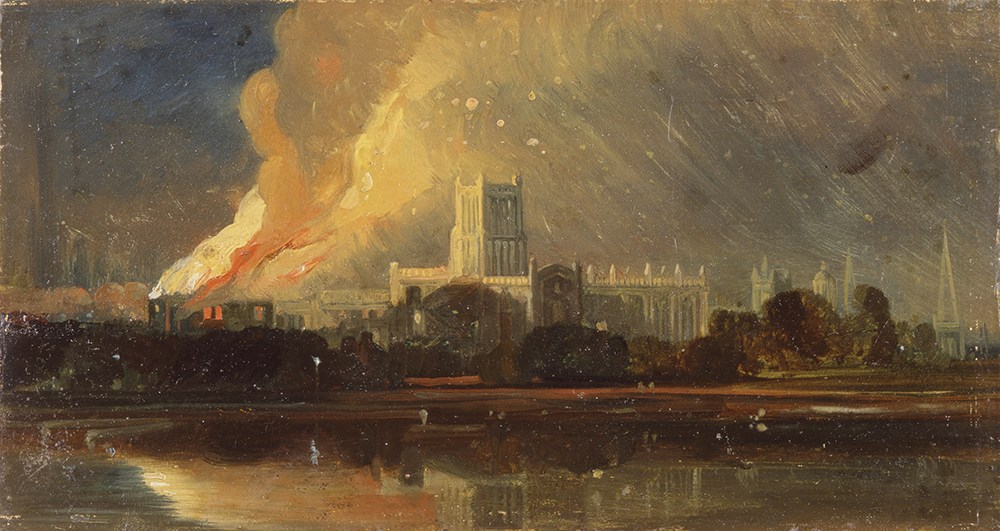
The Bristol riots of October 1831 made the toppling, defacement and immersion of the statue of Edward Colston by Black Lives Matter protestors seem little more than some boy scouts’ or girl guides’ weekend activity. Prompted by the House of Lords’s rejection of the second reform bill, a mob of Bristolians, some carrying ‘fireballs’ of tow and pitch, others broken railings and looted tools, set fire to casks of civic buildings and church properties. The crowd is said to have chanted, ‘Oh! It’s only Corporation property’ and ‘Down with the churches and mend the roads with them!’ The fires were visible from across the Bristol Channel. In captivating oils and watercolours, William James Müller, a talented 19-year-old Bristol artist, sketched the fires in a ‘live’ sequence: ‘The Burning of the Bishop’s Palace’; ‘The Burning of the Mansion House’; ‘The Burning of Queen Square: the Custom House’; ‘The Burning of the New Gaol’.
The events at Bristol were only the most dramatic of British riots that autumn. In Birmingham, the Royal Scots Greys were deployed yet sided with the protestors. This was not Waterloo, nor were working-class Brummies Napoleon’s Grande Armée. In July, 1919 army ex-servicemen were at the forefront of the Luton Peace Day riots. Luton’s mayor Henry Impey had read the King’s peace declaration that day outside the 1840s Doric town hall while looking forward to a slap-up banquet with fellow councillors and placemen, the bill footed by ratepayers enduring unemployment and a lack of housing among other social ills.
The King’s words and the prospect of the banquet went down with the crowd facing the town hall like a cup of blood siphoned from corpses on Flanders fields. A mob rushed inside, hurled chairs and tables from windows, ripped down Peace Day bunting, looted pianos, and returned that evening to set the building on fire singing ‘We’ll keep the home fires burning’. According to the Luton News, they severed firemen’s hoses and fought a pitched battle with mounted police, stabbing horses. Soon after midnight, the clocktower, added in 1856 in celebration of Britain’s victory over Russia in the Crimean War – the Catholic Sardinians were among our allies – toppled and fell. Troops in helmets and fixed bayonets arrived at three in the morning to restore order.
Across the Manche we have our own history of burning, looting, shrieking and yelling
Immediately after the 872-day Siege of Leningrad was lifted in January 1944, street after street of what had been one of Europe’s most beautiful cities were lined with cardboard and timber façades of how they had looked before Nazi German designs on them. It remains a hugely touching gesture; in fact, more than a gesture, these façades represented a promise of what citizens would see and experience again in years to come. The restoration of Leningrad proved to be a marvel, so, too, that of the Tsarist palaces beyond its classical streets. Who, looking for the first time at the fairytale magnificence, the finely judged exuberance, of Peterhof or Catherine’s Palace could imagine that these stunning buildings and landscapes lay in ruins at the end of the second world war, deliberately wrecked by German military engineers and flame-throwing soldiers?
Who knows just how left wing the pyrotechnic demonstrators of Limoges and other French cities are, yet in communist Russia, a desecrated city was rebuilt, and not least because, as Russian architects have told me, these buildings, these streets, were the creation of Russian workers as well as architects and engineers. The same is true of Warsaw, almost completely erased by the Germans, its old centre faithfully restored postwar. In 1980 Warsaw’s Old Town was designated a Unesco World Heritage Site, ‘an outstanding example of a near-total reconstruction of a span of history covering the 13th to the 20th century’.
We know how wretched and incompetent governments can be, and yet the sheer braying luxury of being able to destroy historic buildings while craving branded luxury goods and costly disposable digital detritus from the broken windows of looted shops is so very vacuous, especially in the face of the recent histories of Leningrad (St Petersburg again, of course, since 1991) and Warsaw. What survives of us in the long term is architecture, along with the hands, minds, souls, dreams and desires of those who create it, from Tsarist palaces and 18th-century London gin distilleries to the town halls of Luton and Limoges.





Comments