Renaissance art

The life of the revolutionary Albrecht Dürer

From our US edition

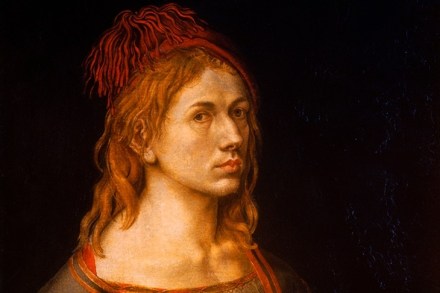
Great books make genres jump. It happened with W.G. Sebald’s The Rings of Saturn, which looked like a travelogue, claimed to be a novel and felt like neither. Albert and the Whale by Philip Hoare, which recalls and converses with Sebald, is such a work. An antic and original creation, it is not exactly a biography of the revolutionary Renaissance printmaker, painter and theorist of geometry and perspective. For the fuller story of Albrecht Dürer, turn to Erwin Panofsky’s mighty monograph, as Hoare does frequently. Instead, Hoare has made a book as much for Dürer as it is about him. Dürer’s life and art are thrillingly encountered.
Dürer

Meet the Medici at the Met

From our US edition

Someone turned up the lights on portraiture in 16th-century Florence. Lyrical poetry went hard rock. Colors became high key. Posers now scowled at the oil-on-canvas flashbulbs, giving attitude, hands on hips, codpieces a-thrusting. Not that they even cared about looking as good as they do. Sure, they got dressed for the occasion, but notice the sprezzatura, the indifference in their eyes to the whole affair. That was the maniera moderna, the new mannerism in art, and no one captured it better than Agnolo Bronzino. Whether it’s the ‘Portrait of a Young Man with a Book’ (mid-1530s), his haughty painting in the collection of the Metropolitan Museum of Art, or ‘Lodovico Capponi’ (1550-55), his side-eye romancer at the Frick Collection, these figures are boys interrupted.

Medici

Pictures at an exhibition

From our US edition

Deeply learned and with a style all his own, Marco Grassi is as at home with Duccio as with Norton Simon; Bronzino as with Bernard Berenson; a painting on his desk as with a ‘Last Supper’ in Florence’s Basilica of Santa Croce. In the Kitchen of Art presents Grassi’s most memorable essays over a span of nearly 20 years. Beginning with a previously unpublished memoir of his Florentine upbringing, and continuing with in-depth critical discussions of the greats of Italian art along with recollections of the grandest collectors of the 20th century, this book shows the art world in the round.

grassi

The art of the hermit

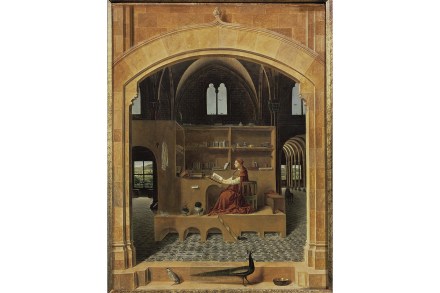
Late in the afternoon on Valentine’s Day, I walked through an almost empty Uffizi. Coronavirus was then a Wuhan phenomenon. Our temperatures had been taken at the airport, but there were no restrictions on travel and those wearing masks looked eccentric. I congratulated myself on finding Florence so quiet. Off-season, I thought smugly. That’s the way to do it. Heaven knows it’s empty now. The painting that caught my eye on that distant-seeming visit was a long, low cassone-shaped painting on the theme of the Thebaid attributed to Fra Angelico (c.1420). The Thebaid is a collection of texts telling of the saints who in the first centuries of Christianity retreated to the barren lands around the Egyptian city of Thebes.

Are there ways in which virtual exhibitions are better than real ones?

Six months ago I published a book about travelling to look at works of art. One such journey involved a round trip of about 6,000 miles to contemplate minimalist sculptures in the Texan desert. But the point wasn’t so much the distance as the importance of standing physically in front of the works themselves. Seeing the actual thing, I argued, was fundamentally different from looking at it in a book or on a screen. Nowadays, of course, unless you live within walking distance of a notable sculpture, that’s really all there is. A week ago my inbox was flooded with messages announcing that the art institutions of the world were closing until further notice. A few days later there was another deluge of announcements, but this time it was online exhibitions.

Urbino legend

From our US edition

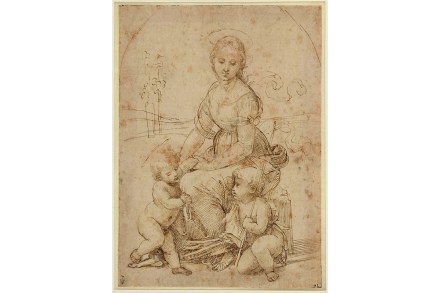
This article is in The Spectator’s February 2020 US edition. Subscribe here. At the time of his death on Good Friday, 1520, Raffaello Sanzio of Urbino was the most successful artist the world had ever seen. In terms of sheer skill, expert judges like the historian Paolo Giovio rated him third among the supreme trinity of Renaissance artists — after the stiffest imaginable competition, Michelangelo and Leonardo da Vinci. But in terms of worldly success, Raphael died as the unchallenged prince of artists. He was the favorite artist of the greatest patron in Christendom, the Medici pope Leo X. He had been commissioned to decorate the most prestigious monuments in Rome.

raphael