Puccini

A first-class production of Puccini’s Western

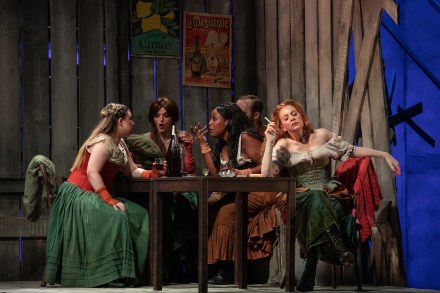
Nature smiled on the opening week of Opera Holland Park’s new season. There’s no better advertisement for semi-outdoor opera than an unseasonal heatwave, and it brought its own authenticity to Puccini’s La fanciulla del West, in a new production by Martin Lloyd-Evans. The wooden cabins and trestle tables of the set had a parched look and you could imagine the smell of pines and sagebrush as the evening grew dark in real time. And never more so than in the final scenes, where Puccini’s gunslinging heroine Minnie gets her man and the world flushes red and gold as they venture off into the sunset. True, you needed to factor out the squawking of the Holland Park peacocks – and the blizzard that Puccini specifies in Act Two – but the point stands.

A spring mood lifter: Tales of Love and Loss at the Linbury Theatre reviewed

This year’s Jette Parker Artists showcase is a triple bill of modern-ish operas; a cleverly assembled trittico of one-acters, linked by a theme of bereavement. That sounds bleak until you consider that Puccini’s Trittico was originally inspired by The Divine Comedy, and who bothers about that today? Anyway, the three operas that make up Tales of Love and Loss are far from dispiriting in their overall effect. Like Puccini, Talia Stern – who directs all three – has gone for two tragedies plus a raucous, palate-cleansing comedy. And like Gianni Schicchi, the final laugh-fest (Elena Langer’s Four Sisters) plays out around a barely cold corpse and sends you into the night feeling uneasy, but undeniably entertained. The Puccini parallels stop there.

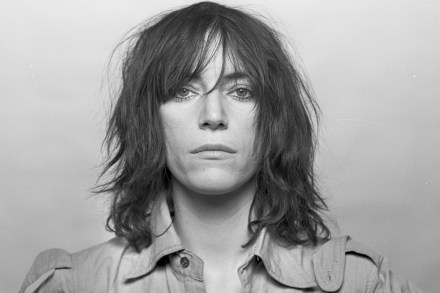
Childhood illnesses and instability left Patti Smith yearning for ‘sacred mysteries’

The punk icon Patti Smith’s latest memoir stretches from 1940s Michigan to present-day Nice, weaving around and complementing her other works of autobiography in its rendering of formative scenes. These include descriptions of periods of childhood illness, displays of sibling loyalty, powerful encounters with art and poetry, attachment to beloved clothes, marriage to Fred and the deaths of people close. Smith looks ahead to a time when she and her dwindling companions are gone: ‘Write for that future, says the pen.’ Our attention is periodically drawn to the pen’s motion as it ‘scratches across the page’, conjuring a lifetime of fluctuation.

Anna Netrebko’s still got it

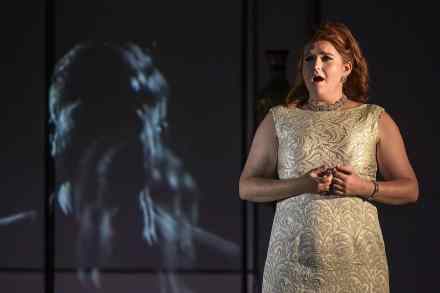
In the opera world, you’re never far from a Tosca and last week we had two of them, both brand new. That’s healthy: any opera company with a functioning survival instinct is wise to maintain a stock of solid, revivable Puccini favourites. Critics yawn, academics snipe, but Puccini prevails because the simple fact is that Tosca is a straight-up banger. I took a Tosca virgin to the first night in Cardiff. She hadn’t read a synopsis or done any of those homeworky things that novice opera-goers are told they should do, but which they really, really shouldn’t need to. ‘This is bloody marvellous, isn’t it?’ was her reaction after Act Two. Welsh National Opera has acquired the American Psycho-ish updating that Edward Dick originally directed in 2018 for Opera North.

Splendid revival of an unsurpassed production: Royal Opera’s Turandot reviewed

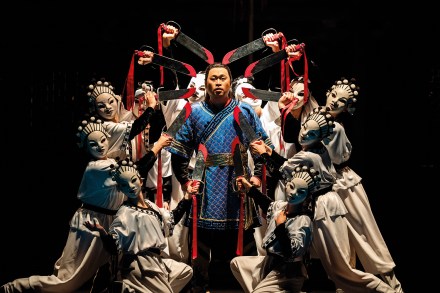
Puccini’s Turandot is back at the Royal Opera in the 40-year old production by Andrei Serban and… well, guilty pleasure is an unfashionable notion these days, but I still feel a batsqueak of shame at enjoying it so much. It’s not the chinoiserie – anyone who believes that an opera based on an 18th-century Italian pantomime should be taken literally is probably beyond help. No, it’s a Spectator headline from years back that still nags. ‘Turandot is a disgusting opera that is beyond redemption’ was the gist of a review of this same staging by the late Michael Tanner, and if it was anyone else you’d put it down to snobbery and move on. But you can’t do that with Tanner, a thinker of piercing intelligence who spent decades interrogating how opera works and why it matters.

Sparky and often hilarious: Garsington’s Un giorno di regno reviewed

Hang out with both trainspotters and opera buffs and you’ll soon notice that opera buffs are by far the more trainspotterish. It’s the pedantry, the one-upmanship (‘Really? You should have heard it with Goodall in 1976’). Above all, it’s the impulse to collect. You can’t actually buy little pocket books with lists of obscure operas to be underlined in biro once you’ve seen them (blue for a full staging, red for a concert performance) but there are certainly opera-goers who compile their own lists of personal stats – and they let you know it. The completist urge is powerful. Hardcore opera-spotters will cheerfully cross continents to cop a rare performance of Schreker’s Der Schatzgräber or César Franck’s Hulda.

Modest means, but striking results: Opera North’s La rondine reviewed

Opera North is ending its autumn season with a big-hearted production of a lopsided opera. There’s much to love about Puccini’s La rondine, and much to drive you up the wall. This bittersweet love story about an older woman and a younger man, set in Paris and Nice and channelling the operetta sweetness and sparkle of Puccini’s great friend Lehar, ought to sweep you off your feet. Instead, it tempts critics into that most shameless form of condescension, the armchair rewrite. Giacomo, old chap, isn’t five minutes into Act One a bit soon to be introducing your big hit aria? We’re halfway through Act Two: shouldn’t the lovers be together by now? And isn’t this basically just La traviata played for lower emotional stakes? Come on, man, you wrote Bohème.

Holds out huge promise for future seasons: If Opera’s La Rondine reviewed

One swallow might not make a summer, but it certainly helps rounds the season off. ‘Perhaps, like the swallow, you will migrate towards a bright land, towards love,’ sings the poet Prunier to Magda, the heroine of La Rondine, but love itself is the real bird of passage in Puccini’s gorgeous Viennese operetta-manqué. Magda trades in her old lover for a younger, cuter model and after a summer of happiness leaves him too, without undue regret. That’s basically it. No death leaps from battlements, no ritual disembowelling; none of that stuff that we’re meant to find so regressive and problematic in an opera house, and so visceral and cool in an HBO drama. Just a simple, plausible romance, played out to glowing waltz melodies.

Convincing performances and unexpected sounds: Opera Holland Park’s Delius/Puccini double bill reviewed

Delius and Puccini: how’s that for an operatic odd couple? Delius, that most faded of British masters, now remembered largely as a purveyor of wistful aquarelles. And…well, and Puccini. Early, neglected Puccini, true, but this is Opera Holland Park, where they make it their mission to rescue the waifs and strays of Italian late romanticism, and see how they scrub up. Demonstrable dud by unfashionable Englishman vs youthful ambition from Italian opera’s ultimate marquee name. We all knew, in advance, how that was likely to play out. And we were all wrong. It turns out that both Puccini’s Le Villi (1884) and Delius’s Margot la Rouge (1902) were written for the same long-running competition that gave us Mascagni’s Cavalleria Rusticana.

I pounded my car horn like a Neapolitan cabbie: ENO’s drive-in Bohème reviewed

The email from English National Opera was blunt: ‘Your arrival time is 18.25. If you arrive outside your allocated time slot, you may not be allowed entry.’ Perhaps, to habitual London drivers — if such people exist — negotiating the residential streets of Muswell Hill during a Saturday rush hour is all good clean urban fun. I couldn’t say. I just know that by the time I’d been marshalled into a parking space at Alexandra Palace, my no-claims bonus miraculously still intact, I was in no mood for an evening of updated and interval-free Puccini. Three hours later I was pounding my car horn like a Neapolitan cabbie.