Oxford

Bugs, biscuits, trench foot: from the front line of the uni protests

From our UK edition

On the grass in front of UCL’s main building, on Sunday night, there were about 30 tents and the portico was plastered in handwritten signs: ‘Students: You’re in debt so UCL can fund a genocide!’ Some protestors sat on chairs, eating biscuits. Others stood at the front gate chanting ‘From the River to the Sea’. ‘Do you want a tent, bro?’ asked one protestor. I explained that I was a reporter and was immediately whisked away to talk to a spokesman. ‘Spectator, Spectator … yeah, I think that’s left-wing. All good.’ A girl who had come along for the day received a keffiyeh tutorial and as night began to fall, I watched as most of the demonstrators headed towards the front lawn to pray. One student didn’t fall asleep until 6.30 a.m.

How universities raised a generation of activists

From our UK edition

It was only a matter of time before America’s student protests spread to the UK. In Oxford, tents have been pitched on grass that, in ordinary times, no student is allowed to walk on. The ground outside King’s College in Cambridge looks like Glastonbury, complete with an ‘emergency toilet’ tent. Similar camps can be found at UCL, Manchester University and more. There have been no clashes with police, but that may yet come. In Leeds, for example, pro-Palestinian students tried to storm a university building, leading to bloody clashes with security guards. From the Sorbonne to Sydney University, the movement has gone global. Its ostensible cause is hardly ignoble. It’s possible to be appalled both by the 7 October attacks and the tens of thousands of Palestinian deaths.

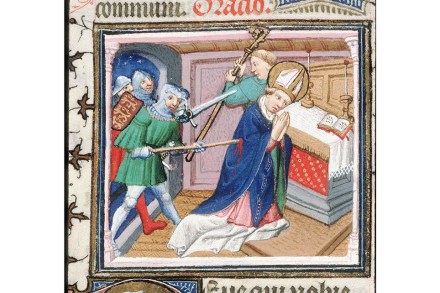
What became of Thomas Becket’s bones?

From our UK edition

The St Brice’s Day Massacre? I must admit I hadn’t heard of this ‘most just extermination’ of Danes in Oxford at the instigation of King Aethelred the Unready in 1002, perhaps because the teaching of history in this country tends to kick off in 1066. You certainly don’t think of Oxford as a place that pioneered techniques of ethnic cleansing. Crypt is a collection of seven essays that unearth details about how certain people lived and died in the past. If you didn’t already know Alice Roberts’s background as an anatomist and biological anthropologist, you’d have a good chance of deducing it from this book.

An Oxford spy ring is finally uncovered

From our UK edition

Oxford and Cambridge have many rivalries, but espionage has always been a one-sided contest between the two. Burgess, Maclean, Philby, Blunt and Cairncross were all Cambridge men. If this were put in Boat Race terms, Cambridge would have rowed halfway to Hammersmith Bridge before the dark blues had their blades in the water. Charles Beaumont’s excellent A Spy Alone (Canelo, £9.99) tries to redress the imbalance with its depiction of a richly imagined Oxford-based spy ring. His protagonist, Simon Sharman, is a former agent turned private security consultant. An Oxford man, he is approached when a Russian oligarch decides to donate some of his millions to the university. Sharman is tasked with investigating just how dirty the money on offer is.

America’s professor: the afterlife of C.S. Lewis

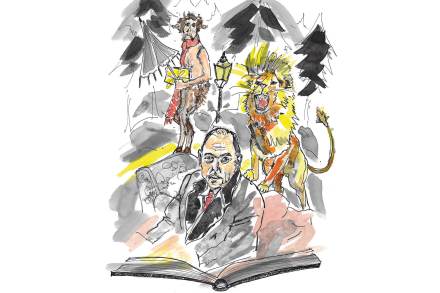
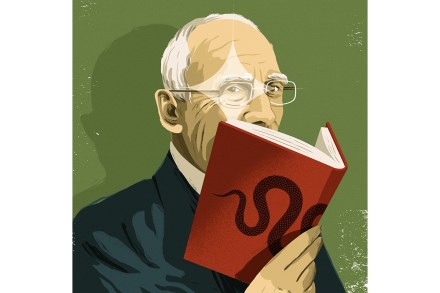
In the summer of 1955, an unusual meeting took place. Billy Graham visited the writer and academic C.S. Lewis in Lewis’s rooms at Magdalene College, Cambridge. It was unusual because leading British academics typically avoided Southern Baptist revivalists. But rather than encountering a fussy, prim don, Graham found a kind, intelligent scholar who was very happy to spend the afternoon with him. Later, Graham admitted he was intimidated by Lewis, but the English professor quickly dispelled any anxiety, probably by offering Graham a cup of tea. Graham’s impact on American religious culture, for good or ill, is unquestioned, but it is difficult to imagine what that same culture would look like without the works of C.S. Lewis.

lewis

Who would be a farmer’s wife?

From our UK edition

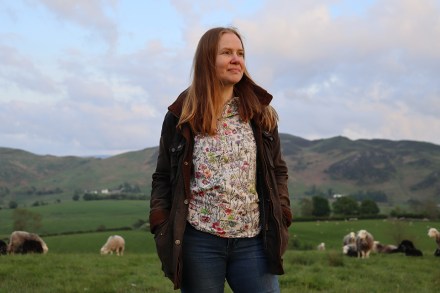
On the opening page of The Farmer’s Wife, Helen Rebanks quotes George Eliot’s famous passage from Middlemarch. Dorothea adds to ‘the growing good of the world’ through her ‘unhistoric acts’ and by having ‘lived faithfully a hidden life’. With this enchanting, funny, fearless book, Rebanks brings her own ‘unhistoric’ life unequivocally out of hiding. The blood, mud, slog, exhaustion, bureaucracy and financial angst of farming are ever-present She lives with her husband James (a bestselling writer) and their four children in the Lake District on their farm shared with six sheepdogs, two ponies, 20 chickens, 500 sheep and 50 cattle.

Espionage dominates the best recent crime fiction

From our UK edition

The best espionage novels cater to our fantasies while still persuading us of the authenticity of their worlds. Of the titles published this year, two stand out in the field, and each author understands that, in fiction, veracity is not the same as authenticity. In Hemingway’s words: ‘All good novels have one thing in common. They are truer than if they had really happened.’ An extended chase, beginning in Siberia, is a kind of Russian version of The Thirty-Nine Steps White Fox (Bantam, £18.99) is the concluding volume of a trilogy of thrillers by Owen Matthews, one of the best of many western writers on Russia. It can happily be read on its own, though it is sufficiently gripping to send readers back to the earlier two books.

In defence of the 15-minute city

From our UK edition

At the end of last year, the subject of the ‘15-minute city’ began to creep into neighbourhood WhatsApp groups, interrupting the usual discussion of lost cats, car crime and blocked drains. Oxfordshire County Council had proposed a traffic-zoning scheme to reduce car usage in the city – and suggested that to address unnecessary journeys, every resident should have ‘all the essentials (shops, healthcare, parks) within a 15-minute walk of their home’. But critics up and down the country hit on the proposals as an example of the ‘international conspiracy’ and ‘tyranny’ of the 15-minute city – which, they warned, is probably coming to a neighbourhood near you soon.

The bookish life of John Carey

One of the most revealing moments in Sunday Best — a collection of book reviews dating back to the late 1980s — comes when John Carey, invited to appraise some items about Robert Graves, remembers hobnobbing with the author of I, Claudius half a century ago in Oxford’s High Street. Instantly, two of Carey’s signature marks — his love of literature and his eye for personality — come crashing together. Graves, then in his late seventies, tall, craggy and mage-like, is still a “commanding sight.” The drawback is his conversation: from the great poet’s lips, “in disconcertingly loud, upper-class tones, issued a bizarre stream of superstition and bogus history.

carey

Fellowship of the Lamb: how we’re saving Tolkien’s pub

From our UK edition

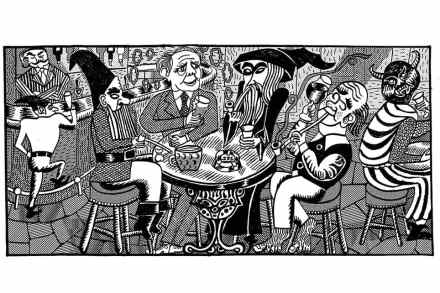
I’ve just bought Tolkien’s pub in Oxford. Well, to be more precise, I and more than 300 fellow drinkers have bought the Lamb and Flag, the 400-year-old Oxford pub where the Inklings group of writers – including J.R.R. Tolkien and C.S. Lewis – drank. Like so many pubs across the country, the Lamb and Flag closed, in January last year, thanks to the pandemic trading slump. Across the road, the Eagle and Child pub also closed, in 2020, because of Covid. Tolkien and Lewis drank there, too – they called it ‘the Bird and Baby’. It remains shut. What rare survival stories these two pubs are – or were. The Eagle and Child, owned by St John’s College, opened in 1650.

Letters: Why I love Warhammer

From our UK edition

Troubles ahead? Sir: Jenny McCartney’s article ‘Border lines’ (1 October) was a profoundly depressing one. Perhaps there will be a united Ireland within the next 30 years; but will it be a peaceful and happy place? I have my doubts. Might not areas such as overwhelmingly Unionist Antrim, north Down, north Armagh, east Belfast and indeed much of Co. Londonderry become no-go areas for the new Irish governing authorities – rather in the same way as Derry, west Belfast and south Armagh were for the British in the times of the Troubles? Most of the wiser commentators observe that the Good Friday Agreement was only a truce, not a perpetual cessation of hostilities.

Why has Oxford killed off a much-loved Catholic college?

From our UK edition

Few institutions can match the global prestige of Oxford University. Just look at the gifts lavished on it, like offerings brought to some mighty emperor of the ancient world. There’s the Saïd Business School, controversially funded with £50 million from Wafic Saïd, who helped to broker the British-Saudi arms deal. There’s the carbuncular Blavatnik School of Government, criticised by Russian dissidents for how the funder made his millions. There’s the new student housing at St Peter’s College, partly paid for with a donation whose original source was the mid-20th-century fascist demagogue Oswald Mosley. Yes, people do sometimes ask whether there’s any cash the university won’t accept. And now they have an answer.

A.N. Wilson has many regrets

From our UK edition

‘Spare thou them, O God, which confess their faults.’ A.N. Wilson seems, on the surface, to have taken to heart the wise words of the Anglican general confession. Aged 71, he looks back on his life and career and records his regrets and failures both private and professional. His major concern is the failure of his marriage, at the age of 20, to Katherine Duncan-Jones, the Renaissance scholar. Katherine, ten years his senior, was a distinctive Oxford figure, recognisable by her sideways limp and for riding a wicker-basketed sit-up-and-beg bicycle. In later years they reconciled and met weekly for lunch. Wilson records Katherine’s sad, slow descent into dementia, which mimics that of one of his chief mentors, Iris Murdoch.

‘Oxford or Cambridge?’: the vacation edition

"Oxford or Cambridge?" No, it isn’t just shorthand for which of Britain’s most famous universities you attended — or were rejected from. It’s also a question about your taste in weekend vacation spots. Oxford is an urban, bustling city, full of multiculturalism, wide-eyed gangs of tourists and a literary heritage that’s long since tipped over into cliché. Think Alice in Wonderland, C.S. Lewis, J.R.R. Tolkien, even — God help us — Harry Potter, claimed for posterity because of its use of Christ Church as a filming location. But its Eastern cousin — decidedly not Cambridge, Massachusetts — is a very different proposition.

A poet finds home in a patch of nettles

From our UK edition

Towards the end of a long relationship – ‘resolved to have a conversation about the Future, which meant Separating’ – Nancy Campbell’s partner suffered a stroke. Campbell’s life then became a hell of hospital visits, supporting and fearing for the brilliant Anna, an intellectual who worked with virus analysts in Moscow, reduced by brain insult and aphasia to a kind of infancy. Thunderstone is the story of Campbell’s response to this crisis. Her diary extracts jump from Anna’s stroke in 2019 and her slow healing, to Campbell’s own new life, which begins when Anna is strong enough to be encouraged to move on, from June to September 2021. Campbell is a poet and travel writer, with many friends and contacts.

Michael Beloff QC drops names – but they’re not the ones we’re curious about

From our UK edition

‘The law,’ according to W.S. Gilbert’s Lord Chancellor, ‘is the true embodiment of everything that’s excellent’ and, by common consent, Michael Beloff QC has been one of the prime exemplars of that excellence over the past 50 years. While he may not enjoy the profile of contemporaries such as Helena Kennedy, Michael Mansfield and Geoffrey Robertson, the Times, on his retirement, described him as ‘one of the great ornaments of the Bar’, and he himself notes that he has argued more than 475 reported cases (a lawyer’s way of assessing their significance). In a more dubious honour, he has appeared in two novels by his friend Jeffrey Archer.

The culture wars have crept into Oxbridge admissions

From our UK edition

The characters in Sarah Vaughan’s thriller Anatomy of a Scandal include rich Oxford undergraduates from Eton whose main preoccupations are drinking and trashing rooms. They are what it is fashionable to call ‘privileged white males’; while the typical female Oxbridge student is ‘slim, tall, well dressed. Entitled… they knew they belonged there’. The truth, however, is that although Eton is one of the top academic schools in the country, its ‘beaks’ are puzzled by the sharp reduction in the number of their brightest pupils gaining places at Oxbridge. The number of offers has halved between 2014 and 2021.

Et in Arcadia ego

"Oxford I do not enjoy,” wrote T.S. Eliot to Conrad Aiken in February 1915. “The food and the climate are execrable, I suffer indigestion, constipation, and colds constantly.” The poet was clearly having one of his bad days. Since arriving at the university the previous October, he had found himself in and out of love with the place, which was hardly surprising, given the timing. Most of the undergraduates at Oxford had either left or were on the verge of leaving to fight for their country, meaning that the lecture and tutorial rooms were almost empty, the sports fields green through lack of use, and the centuries-old traditions stalling like motor cars on the long stretch of the High.

Oxford

Character is king in the latest crime fiction

From our UK edition

Thriller writers are hard pressed to stand out in what’s become a very crowded field. As a result, from Cardiff to Kansas we meet every conceivable kind of detective: if one walks with a telltale limp, another has no legs at all. Even the requirements of diversity can’t disguise the desperation of the search for distinctive heroes, or how variety itself has become a convention. Simon Mason’s A Killing in November (Quercus, £14.99) begins with more than a nod to thriller traditions. It’s set in the fictional Oxford college of St Barnabas, with a grumpy provost wooing a corrupt Middle Eastern potentate, a college servant with a hidden agenda and, naturally, an unknown woman found strangled in the provost’s office.

The women who challenged a stale, male philosophy

From our UK edition

Metaphysical Animals tells of the friendship of four stellar figures in 20th-century philosophy — Mary Midgley, Iris Murdoch, Elizabeth Anscombe and Philippa Foot — who attempted to bring British philosophy ‘back to life’. Fuelled by burning curiosity — not to mention chain-smoking, tea, wine, terrible cooking and many love affairs (sometimes with each other) — they tackled an ancient philosophical question: are humans a kind of animal or not? Dazzled as we are these days by technological possibility, their question only gains in urgency. This splendidly entertaining book, fizzing with character and incident, constitutes an extended joyful reply in the affirmative. Others would disagree.