Optimism

Why I’m increasingly drawn to optimistic sci-fi

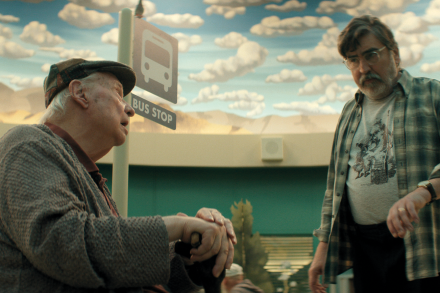
You know you’re getting old when you see Geena Davis from Thelma & Louise cast as a granny sex symbol and Alfred Molina as a character so elderly you’re supposed to believe that he could drop at any time. This is one of the running gags of The Boroughs, a sci-fi/monster series set in an upmarket, Stepford Wives-esque desert retirement village, and clearly aimed at aging farts like I very nearly am who imagine themselves to be much younger and groovier than they now are. “Don’t worry, wrinkly kids,” the series reassures us. “By the time you hit your seventies you’ll be taking more drugs and having more sex – even crazy, orgy sex [note to squeamish viewers: this scene takes place off camera] – than ever before.
boroughs

Hope springs eternal: The Café with No Name, by Robert Seethaler, reviewed

Call it a mosaic. Here it all is – the pathos of a botched first date, a birth, a death, a feud, a stumble into love. The Café With No Name deals with the small dramas of everyday life.  The setting is Vienna – not the elegant city of Schönbrunn but the Karmelitermarkt, one of the poorest districts, debris from Allied bombs still filling the basements in 1966. Robert Simon has worked in the market for seven years, shifting crates of swedes, restacking firewood, cleaning the floor at the fishmonger. He enjoys his work, but he’s 31 and restless. He finds himself casting a speculative eye at the café on the corner, shabby and abandoned, ivy climbing up the wall. His landlady, a war widow, encourages him: ‘You always need a bit more hope than worries.

An AI visionary looks forward to the best of all possible worlds

In 1993 Vernor Vinge popularised the notion of the Singularity – the point at which exponentially accelerating trends in multiple technologies move out of control in an endless positive feedback loop. Vinge was a science fiction writer; Ray Kurzweil is not. In 1993 he had already pioneered optical character recognition and synthesisers that could precisely mimic real instruments. His mission crystallised into making Vinge’s conceit a reality. He is principal researcher and ‘AI visionary’ at Google – and principal proselytiser, too, through any number of portentously titled books. The Age of Spiritual Machines (1999) set out his stall; The Singularity is Near (2005) staked a claim for human-level intelligence in computers by 2029 and a generalised apotheosis in 2045.

Only an idiot would choose to live at any other time than the present

Steven Pinker’s new book is a characteristically fluent, decisive and data-rich demonstration of why, given the chance to live at any point in human history, only a stone-cold idiot would choose any time other than the present. On average, humans are by orders of magnitude healthier, wealthier, nicer, happier, longer lived, more free and better educated than ever before. Moreover, as Bill and Ted’s Excellent Adventure noted: ‘Bowling averages are way up, minigolf scores are way down, and we have more excellent waterslides than any other planet we communicate with.’Some of the many graphs in this book slant from the bottom left towards the top right, showing the rise of Good Things, and some of them (charting the decline of Bad Things) go the other way.