Nhs

The View from 22 – fixing the NHS in the wrong way, the whining intern and Ed Miliband’s summer of discontent

Are David Cameron and Jeremy Hunt going about fixing the NHS in the wrong way? On this week’s View from 22 podcast, former No.10 advisor Sean Worth and director of Reform Andrew Haldenby discuss Dr J Meirion Thomas’s Spectator cover feature on the problems with the Health Secretary’s plans to reshape the NHS. Is Dr Thomas right in saying we need more focus on training GPs, and not centralised technological solutions? Will the government’s reforms be remembered in 100 years as a landmark moment for the NHS? And do we need more focus on recruiting British doctors, to improve the quality of care? Freddy Gray and the Economist’s Daniel Knowles
The wrong way to fix the NHS

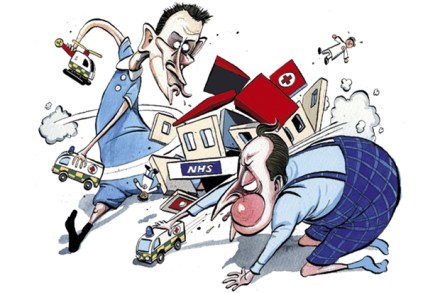
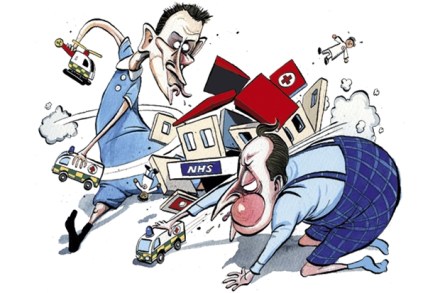
Jeremy Hunt, the Health Secretary, is a decent and well-meaning man. He’s genuinely excited about the new, radical reforms planned for the NHS which he announced last weekend. I have been told that Hunt and his old friend David Cameron see this restructuring of the NHS as the next great step, as significant and successful as Gove’s education reform; something the Prime Minister will be remembered for gratefully in 100 years’ time. I’m afraid they’re wrong. If implemented as announced, these plans will be both expensive and ineffective. The main trouble is that Hunt’s NHS revamp will rely on a vast, integrated and enormously complicated IT system. The idea is

Jeremy Hunt’s tough talk on the NHS doesn’t address the toughest question of all: what is the purpose of modern medicine?

Jeremy Hunt’s quiet demeanour is deceptive. The Health Secretary has a bit of what my late grandfather called ‘iron in the soul’ – a measure of self-confidence, calculation and the determination not to let the bastards get you down. ‘Iron in the soul’ came in handy during the Burma campaign in the Second World War. And I imagine that it’s vital if one is to prosper as Secretary of State for Health. Hunt was sent to the Department of Health last year in order to clean up the political mess left by Andrew Lansley. Hunt’s tenure has been beset by scandals beyond his or his predecessor’s control – from Mid

Matt Hancock sketches an incumbent's re-election argument

Matt Hancock is both a competent economist (read his account of the Great Recession) and a keen political strategist. Where possible he has used his position as minister for skills to position the coalition on the compassionate side of the employment argument; for example, with his considered support for the minimum wage. Yesterday, in an article for ConservativeHome, he pre-empted Labour’s attempt to shift economic focus to the cost of living, now that hopes of a recovery are building. He made two basic points: 1). Labour’s record on the cost of living is abysmal – wages did not keep pace with growth during the boom. He says that gross disposable income

Ancient and modern: Herodotus on 111

The NHS 111 line, designed to deal with problems that do not count as emergencies, is in financial and organisational trouble yet again, but the Greek historian Herodotus (c. 490-c. 425 BC) may be able to help. In his travels he came across a ‘most ingenious’ public medical service. Many ancient cultures made important observations about the workings of the body and cures for illness, but it was ancient Greeks who tried to rationalise the process. Hippocrates, the father of rational medicine (5th-century bc), laid down the key principle as follows: ‘What escapes our vision we must grasp by mental sight, and the doctor, being unable to see the nature

The NHS must improve its approach to costing if the market is to work

News that one of the health service’s largest operators of the non-emergency 111 helpline is to pull out of the market will have raised very few eyebrows in the health sector. NHS Direct, which ran the telephone helpline that preceded 111, is on track to record a deficit of £26 million this financial year and, along with other providers, has attracted criticism for a host of operational and qualitative mishaps. NHS Direct’s unsustainability and 111’s myriad problems have been all too apparent. Like the service itself, the reasons for 111’s many failings are complex. What it does illustrate, however, is a more fundamental issue regarding the application of market principles to

The demise of 111 spells trouble for the government

From David Cameron’s declaration that you could sum up his political priorities in the three letters N H S, to the commitment to increase the health budget every year, the Cameroons have sought to reassure on the health service. They want voters to believe that it is safe in their hands. This is what gives the row over the NHS’s 111 helpline number its political importance. Labour, still fuming at how the Tories used the Keogh review to attack its record on the NHS, is trying to use the help-line’s problems to show that ‘you can’t trust David Cameron with the NHS’. The other problem for the government is that

Hunt prods Burnham for NHS policy details

One of the many problems that Andy Burnham has encountered this week is that he has had to spend more time defending his record in the last Labour government than scrutinising the current government’s changes to the health service. He has performed the first task in a rather emotional manner, and the Conservatives may well feel that politically this week has been rather successful. But now they’re going after him on the policy side of things too, perhaps to underline how preoccupied Burnham is with his own reputation. Jeremy Hunt has this afternoon written a letter to Ed Miliband, seen exclusively by Coffee House, which demands to know whether Labour

Jeremy Hunt's letter a day to keep NHS myths away

Attending the funeral of Margaret Thatcher in April, the Health Secretary, Jeremy Hunt, was much impressed by the bit in the sermon by the Bishop of London about how Mrs Thatcher had replied personally to so many letters. He went back to his department, and asked it to give him each day one letter from a member of the public which recounted particularly shocking problems in the Health Service. He now uses these letters to dive into the problems that patients experience. It is a good idea, but how alarming that it is a novel one. The Department of Health receives more letters than any other part of government except

Leader: Ring-fencing the NHS is only making matters worse

According to popular wisdom on the left — and even among some in the Conservative party — this ought to have been a tough week for the government. On Monday, the new £26,000 cap on benefits came into effect and with it a new principle: that no one on welfare should receive more than the average working family. Such a move, it was said, would expose the Conservatives to what is supposed to be their weak point: that they are the ‘nasty party’ who care about money, not people. Yet something remarkable has happened. Iain Duncan Smith’s welfare cap is turning out to be not just the boldest but the most popular

The bloody tussle for the moral high ground

Alan Johnson and Stephen Dorrell have just conducted an impressively reasoned debate on the NHS on Radio 4. This was all the more impressive given both their parties have boxed themselves into corners on NHS care scandals, from which they will continue to lash out today at the last PMQs of the summer. Whether or not Andy Burnham bears responsibility for the hospital failings detailed yesterday, his circumstances significantly constrained his ability to scrutinise the policies the government announced. Because he is in the extremely uncomfortable position of shadowing the brief he held in government, Burnham spent more time defending his own record than he did anything else. And his

NHS review: Where did the "13,000 deaths" figure come from?

There is a lot of rage in Westminster today (beyond the everyday anger exhibited by some of its inhabitants that Parliament contains other people who disagree with them) about the 13,000 deaths figure that has been bandied around ahead of the publication of the Keogh review. It’s worth noting firstly that Jeremy Hunt did not refer to this 13,000 in his statement to the Commons, but the figure made its way into the newspapers before the report’s publication.  He did say that ‘no statistics are perfect, but mortality rates suggest that since 2005, thousands more people may have died than would normally be expected at the 14 trusts reviewed by Sir

NHS political football, full-time report: Hunt and Burnham's fouls and fury

Jeremy Hunt’s statement on the Keogh review marked one of the uglier Commons sessions in this parliament. Amid shouting, muttering and angry pointing from the Opposition benches, the Health Secretary announced that 11 of the 14 hospitals in the review would be put into ‘special measures’, while making clear that he blamed the culture the Labour government had nurtured in the NHS, and pressure from ministers to cover up bad news. Labour MPs hated the last assertion in particular, roaring with disagreement as Hunt said: ‘It is never acceptable for the government to put pressure on the NHS to accept bad news because in doing so they make it less

NHS political football, half-time report: Crosby and warnings ignored

Labour and the Tories played the first half of NHS political football this morning at health questions. The scrap began with Opposition MPs asking what influence Lynton Crosby had over the decision to drop plain packaging for cigarettes. It is their equivalent of the Tory attack on union influence, and as such has a fair bit of clout. The first question came from Labour’s Cathy Jamieson, who asked: ‘Given some of the previous pronouncements by the Public Health Minister I think some of us could be forgiven for thinking that the government’s policy has changed in relation to this. And I wonder therefore if she could advise the House, who

Angry Burnham hits back

listen to ‘Andy Burnham defends Labour’s record on Health’ on Audioboo Andy Burnham was in a furious mood this morning when he toured the broadcast studios. It was hardly surprising: most people would grow rather ratty if CCHQ wasn’t just coming after you but briefing that it is coming after you. He angrily told listeners that he did not ‘accept this attack on the integrity of the last Government’. He listed all the actions of the Labour government that he believed showed he and colleagues were not in the wrong. That list included: ‘It was the last government that introduced independent regulation into the NHS’. ‘I brought in Robert Francis

All else has failed. We have to liberalise the NHS

What to do about the NHS? I’ve just been on a Newsnight which took as its premise that the model is broken and needs to be fixed. “Uncaring. Cruel. Inadequate. Lax,” said Kirsty Wark, opening the show. “Why is the NHS now failing so many patients?” The Keogh report is published tomorrow and is expected to be devastating – but not detailed enough: it’ll refer to 13,000 ‘excess’ deaths across 14 hospital trusts but it will not explain why these people died. Or even who they were: those who suspect they lost a relative due to NHS blunder will be none the wiser. Towards the end of the show, Newsnight ran

Conservatives ramp up the pressure on Andy Burnham

One of the striking things about politics at the moment is how the Tories are behaving like an opposition, campaigning against Labour with even more intensity than they managed in 2009. The Tories intend to use the Keogh report, out tomorrow, to — in the words of one Number 10 insider — give Labour ‘both barrels’ over the NHS. As one Tory minister puts it, ‘Labour’s argument about Mid-Staffs is that it is one isolated, bad case. Keogh disproves that.’ As part of this, the Tories are going after Andy Burnham. The Tory leadership is convinced that Ed Miliband will move Burnham in the reshuffle, there’s a reason why people

Jeremy Hunt turns on Labour over union policy influence

One of David Cameron’s better lines at Prime Minister’s Questions was that the trade unions ‘buy the candidates, they buy the policies and they buy the leader’. In his final response to Ed Miliband, he said: ‘What is Labour’s policy on Royal Mail? It is determined by the Communication Workers Union. What is its policy on health? It is determined by Unison. What is its policy on party funding? It is determined by Unite.’ To underline that point, Jeremy Hunt has sent a letter to Andy Burnham this afternoon asking for ‘clarification about union influence over Labour health policy’. The letter, which you can read in full here, says Burnham

Letters: Sir Peter Lampl replies to Charles Moore, and the memories of a wasteful GP

Medical waste Sir: Susan Hill’s article (‘Patient, heal thyself’, 29 June) dealt only with the unnecessary visits to GPs for minor ailments. In Wales we have an extra incentive to waste GPs’ time — all prescriptions are free. There are many people who are prepared to make a GP appointment just to get routine medicines for free, and GPs are powerless to resist. Tim Johnson Aberystwyth, Ceredigion   Sir: Susan Hill’s article revived pleasant memories of my stint as a locum general practitioner in the early 1970s in Goring-by-Sea. As the registered patient number of the solo practice was the maximum allowable by the NHS at the time, I was

How the Spectator blew the whistle on the International Health Service

At Prime Minister’s Questions today, backbencher Philip Lee ambushed David Cameron on the subject of health tourism. He asked: ‘As a doctor who once had to listen incredulously to a patient explain, via a translator, that she only discovered she was nine months’ pregnant on arrival at terminal 3 at Heathrow, I was pleased to hear the statement from the Secretary of State for Health today on health tourism. Does the Prime Minister agree that although the savings are modest, the principle matters? The health service should be national, not international.’ The Prime Minister replied: ‘My hon. Friend makes a very important point. This is a national health service, not