This year’s other Royal Wedding
From our UK edition
Coffee House congratulations to Zara Phillips and Mike Tindall, who were married in Edinburgh today.
From our UK edition
Coffee House congratulations to Zara Phillips and Mike Tindall, who were married in Edinburgh today.
From our UK edition
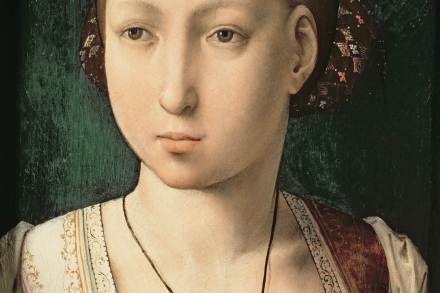
The Catholic Monarchs — Ferdinand II of Aragon and Isabella I of Castile — had five children together. The Catholic Monarchs — Ferdinand II of Aragon and Isabella I of Castile — had five children together. Each child was married off to a promising European neighbour, thereby acting as a diplomatic tool in the Monarchs’ reassertion of royal authority over Spain. Two of those children remain famous today, chiefly for their reputation as the 16th century’s most wretched doormats. Katherine of Aragon was the youngest child. As we know, her first marriage was to Henry VII of England’s eldest son, Prince Arthur. When he died, her second marriage was to the man who would become Henry VIII. The rest barely needs rehearsing.
From our UK edition
The Spectator is very proud to be the purveyor of a long-distance birthday message to Prince Philip, who turned 90 yesterday, from some of his most devoted admirers: the tribe that actually worship him as a god. The cult of Philip began in the 50s when islanders on Tanna in the South Pacific noticed how devoted colonial officials were to the Queen. If she's so great, then her husband must be awesome they (understandably) concluded. Four years ago, six Philip worshippers from Tanna — Chief Yappa, JJ, Joel, Albi and Posen — were brought over here to make make a TV documentary. For various reasons they stayed with me for a while and they were some of the most charming and joyous people I've ever met.


From our UK edition
Prince Philip’s childhood was such that he had every right to be emotionally repressed and psychologically disturbed. Prince Philip’s childhood was such that he had every right to be emotionally repressed and psychologically disturbed. Born sixth in line to the Greek throne, at the age of 18 months he was hounded from what, in name at least, was his homeland. His father came within an ace of being executed for high treason. When he was only eight his mother suffered a devastating nervous breakdown; in 1930 she was drugged into placidity, bundled into a car and consigned to a sanatorium-cum-prison. His father shrugged off his responsibilities towards his children, of whom Philip was by far the youngest, and installed himself with his mistress in the south of France.
From our UK edition
A lovely picture of Her Majesty with the Obamas. Captions please! (Also, what joke is Prince Philip keeping to himself?) Meanwhile, I've a piece on Obamamania at the Daily Beast and a grumpy take on the "Special Relationship" at Foreign Policy.
From our UK edition
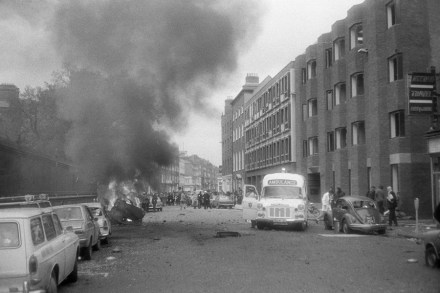
On 17 May 1974 — 37 years ago today — I was a 19-year-old student at Trinity College Dublin, celebrating the end of term in the Pavilion Bar near the sports fields. The summer exams were still to come, but we were carefree; the main subject of conversation was whether we could organise a disco party later on. Then, a little after 5.30 p.m., everything changed. First, all about us seemed to shiver, as if there were an earth tremor. Then, just as it occurred to me that Dublin did not generally suffer tectonic stress, there was a deafening bang that seemed to go on for an age. Somebody shouted: ‘It’s a fucking bomb!
From our UK edition
Pete is right to say there's a definite "resonance" to these pictures. Nevertheless, I suspect that British people's view of the "historic" significance of Her Majesty the Queen's visit to the Republic of Ireland is inversely proportionate to one's experience of Ireland. That is, the more time you have spent in Ireland and the better you know the country the less you are likely to swoon at the sight of a British monarch setting foot in southern Ireland. Perhaps I'm extrapolating too much from my own experience and perhaps the over-40s think differently. But my impression strengthened, to be sure, by some of the breathless, hyperbolic BBC coverage is that many British people over-estimate how "controversial" this visit is.
From our UK edition
There is something incredibly resonant about the images of the Queen arriving in the Republic of Ireland this afternoon. You have probably heard the facts by now — that she is the first British monarch to do so for 100 years, and the first since Irish independence — but they are no less striking. Against a backdrop of terror threats and of Britain's participation in the country's bailout, Queen Elizabeth II is making some kind of history today. It is also, as Ed West says in a thoughtful post over at the Telegraph, a time for remembrance. He suggests that we remember the 300,000 Irishmen who fought in the Great War — and rightly so.
From our UK edition
The success of Prince William's wedding was one thing but if you want another indication that, whatever people think they think of Prince Charles right now, the monarchy is in no imminent danger consider the fate of the referendum on introducing the alternative vote for Westminster elections. I suggest that republicans are among today's losers. Assuming the polls are right, that is. If the British public rejects a relatively minor change to the electoral system there is almost no chance, at any conceivable point in any conceivable future, they will vote for a republic. Custom and the Burkean arguments for custom are powerful things (and probably the best arguments in favour of FPTP).
From our UK edition
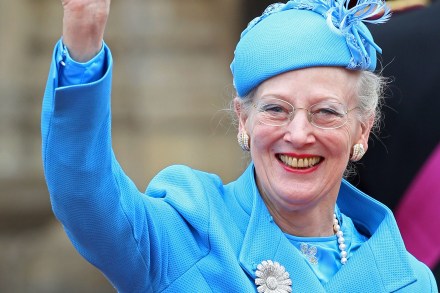
With the newspapers still full of Royal Wedding pictures, I thought I’d draw CoffeeHousers' attention to something remarkable: a visit by Queen Margrethe II of Denmark (pictured, left, at Westminster Abbey last Friday) to Helmand Province. That’s right, the 71-year old Danish monarch visited the her country's troops in late March this year, accompanied by the defence minister. Crown Prince Fredrik persuaded her mother to visit the troops after his own previous trip to the region. In this YouTube clip recorded in Helmand, Queen Margrethe talks to the camera (sorry, it is in Danish) about her experiences in the war-torn province. She pays tribute to the two British soldiers who died while she was visiting, saying the loss is also her loss.
From our UK edition
There are some things that Britain does better than any country in the world, and we saw one of them today. Two particulars will have jumped out at the tens of millions watching the Royal Wedding from overseas: the sheer splendour of our monarchy, and the depth of its popular support. HD television made the beauty of today's ceremony all the more breathtaking. If this were a movie, it would win an Oscar for best cinematography. The shots from the roof of Westminster Abbey were jaw-dropping, the camera angles throughout were perfect. But no less awesome was the sight of the thousands thronging the streets, or watching in Hyde Park.

From our UK edition
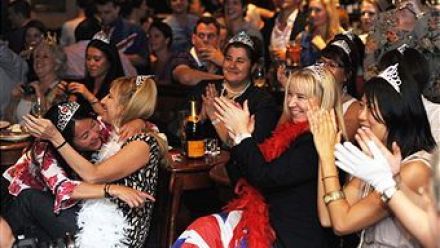
So we’ve seen the ceremony at Westminster Abbey. How was the Royal Wedding celebrated – by expats and locals alike – around the world? In Afghanistan, British troops celebrated with bunting on the front line. In Australia, foods associated with the ‘Mother Country’ flew off supermarket shelves, with the biggest sellers being Maynards wine gums and Colman’s classic mint sauce. Even Aussie republicans appear to have been inspired to hold parties and wear tiaras. In China, a couple recently had a knock-off Royal Wedding, complete with horse-drawn carriage and archway of swords. And cashing in perhaps on the wedding fervour, McDonald’s in Hong Kong started offering wedding party packages.
From our UK edition
From our UK edition
From our UK edition
This, it has to be said, is not much of a day for politics. Although the world's laser-like attention will be focussed on Westminster, it will not be on the operations of our Parliament or its actors, but on Westminster Abbey and the marriage, of course, of Prince William and Kate Middleton. The cameras might pass for a moment over David Cameron, or Ed Miliband, or Nick Clegg. But even their best morning suits will not compete, you fancy, with the collected fascinators and finery on display — let alone with the wedding dress itself. We shall be marking proceedings on Coffee House with video, with archive posts and with our general observations.
From our UK edition
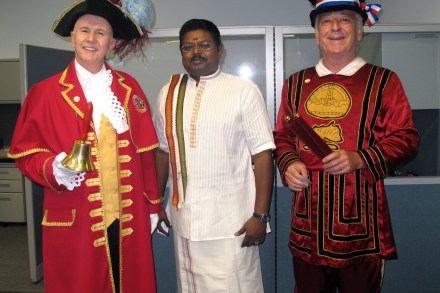
Last month, dressed as a town crier, the head of the British Club in Singapore, Sean Boyle, visited the offices of every major newspaper in the country. Accompanied by an entourage also in fancy dress, he declaimed that the British Club would be celebrating the nuptials of Prince William and Kate Middleton in a festival that would last 10 days. The reception to his announcement was warm. An editor of the Tamil Murasu, the newspaper that serves Singapore’s ethnic Indian population, left the newsroom to return dressed in traditional Indian costume, to pose for photos with Boyle (see above). The team at the Berita Harian, the Malay-language daily, gave the entourage a standing ovation.
From our UK edition
I know, I know, it's deeply unromantic to anticipate tomorrow's Royal Wedding through the prism of opinion polling. But as no one ever said that a political blog has to be romantic — and as there are some quite noteworthy findings among all the data — we thought we'd put together a quick round-up for CoffeeHousers. So here goes: 1) The guest list. There has, I'm sure you've noticed, been quite some hubbub over the fact the Gordon Brown and Tony Blair haven't been invited to the wedding — especially in view of the Syrian ambassador's invitation, since withdrawn. But some new polling from YouGov — highlighted by PoliticsHome — suggests that the public agree with the twin snub for our former PMs.
From our UK edition
That, Watson, was the remarkable thing about the Royal Wedding: the dog barked and still no-one heard it. You can scarcely open a paper this week without encountering yet another thumbsucker on the future of the monarchy. Most of these, such as this New York Times effort from John Burns, suggest the old ship needs urgent repairs. Frequently this will be accompanied by yet another piece complaining that the press is devoting far too much attention to the whole anachronistic palaver. Someone, somewhere will complain this week that they've yet to meet anyone at all interested in Prince William's marriage. This will echo Pauline Kael's complaint that she'd never encountered a Nixon voter.
From our UK edition
It was, I'm sure CoffeeHousers noticed, the Queen's 85th Birthday yesterday. So here, as a belated commemoration, is an item from the archives that is a even more archival than usual. You see, it's an article that was written on the event of the Queen's 80th Birthday in 2006 — and it looks back at the issue of The Spectator that was published when the Queen was actually born, in 1926. Mary Wakefield, our deputy editor, is the author: The week the Queen was born, Mary Wakefield, The Spectator, 8 April 2006 It was press day at The Spectator when Queen Elizabeth II was born. The printers had set the lines of type for the edition of 24 April 1926, and were waiting for the extra paragraph about the new royal baby. Did their hearts swell with pride when it arrived?

From our UK edition
Draw two two-inch triangles, tip to tip, one on top of the other. A little way down the left flank of the upper triangle, take a perpendicular line out to an inch, then turn your pencil at a right angle and continue another inch. Repeat on the other side. Next, draw two short, splayed lines down from the base of the lower triangle. Finally, put an acute accent, an inch long, about two inches above the whole. What have you got? According to Dr David Starkey, who performs this trick at schools all over the country, Henry VIII in 13 lines. Apparently he is recognisable in this form as far afield as Japan, America, and even France. Each generation makes history in its own image and we, preoccupied with spin and profile-management, are impressed anew with Henry for his genius in this field.
