Modern art

Was Marcel Duchamp’s notorious ‘Fountain’ even his own work?

This slim volume has only one fault. It has no illustrations. So you’ll have to do some Googling or visit the current Duchamp exhibition at MoMA (until 22 August) if you want to know what ‘The Bride Stripped Bare by Her Bachelors, Even’ looks like. Otherwise it’s perfect – wittily written and packed with many fascinating characters besides the ever intriguing Marcel Duchamp. He didn’t actually arrive in New York until 1915, but when he did he found himself already famous. His ‘Nude Descending a Staircase, No. 2’ had been included in the 1913 International Exhibition of Modern Art, alongside works by Picasso, Van Gogh, Gauguin, Matisse and Braque, and completely stole the show. Duchamp didn’t even know the painting was being exhibited.
South America is flush with Nazi-looted art

From our US edition

This summer, a niche story from the art world caught fire: an Old Master painting, stolen by the Nazis from a Dutch-Jewish art dealer, surfaced in Mar del Plata, Argentina. Remarkably, journalists from a Dutch newspaper spotted it on the wall of a house in a promotional photo that was part of a “for sale” real-estate listing. It turned out that one of the sellers of the house was the daughter of a Nazi official who worked for Reichsmarschall Hermann Göring, a notorious art plunderer. When the stolen painting was recognized, the daughter allegedly removed it from the wall, replacing it with another artwork – a tapestry. Argentine authorities then arrested her and her husband and charged them with concealing a crime.

nazi

In ambiguity, Tancredi Di Carcaci finds inspiration

From our US edition

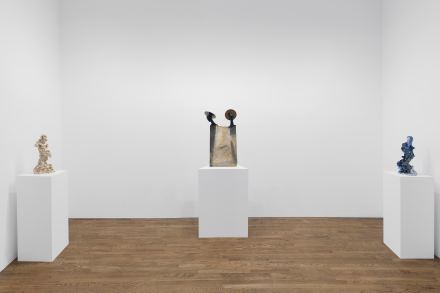
The narratives we tell ourselves about the past are hardly set in stone. It’s in this ambiguity where Tancredi Di Carcaci finds inspiration. Through his practice, the British artist contemplates, and sometimes perpetuates, the blurring of straightforward histories, especially that of art, as traditionally passed down. His sculptures – a mix of ceramic works and assemblages combining cast bronze, ceramic and hunks of marble and stone sourced from Siena, Egypt and elsewhere – have aesthetic and thematic roots spanning the Renaissance, neoclassical revival, Romantic painting and 20th-century modernism.“For me, with art, I don't try and restrict myself.

Palo Gallery

Inside the traditional art revolution

From our US edition

More and more often lately, people are rejecting tired modern art. They often find solace in the art of the past; online accounts admiring “traditional art” have amassed hundreds of thousands of followers, but they act as online repositories for a bittersweet recognition: what once was, no longer is. But the kind of art they seek, involving detail, meaning and skill, still exists, and it is growing. The cultural hegemony of contemporary, abstract art is slowly beginning to crack; through those cracks we can see new art surfacing. As I have become increasingly disillusioned with the state of politics, an observation from Ernst Jünger, the German philosopher and skeptic of the extreme politics of his day, rings true to me.

art revolution Milano Painting Academy

Philip Guston in the padded room

From our US edition

It was once a cliché of modern art that its principal aims included shocking its audience. Aesthetic aggression was the correlative of class warfare. It’s no accident, as the Marxists say, that avant-garde comes from the military lexicon. In painting, Gustave Courbet’s 1866 “L’origine du monde,” a rudely realistic, closely cropped view of an anonymous woman’s nude genitals, is often hailed as an early shot across the bow. Five years later, the artist would lead the Paris Commune in toppling over the Napoleonic Vendôme Column. For pugnacious creatives like Courbet and his descendants, consciousness-raising was always going to be a little bit uncomfortable. One can imagine how easily this gets out of hand.

guston

Kandinsky’s colors

From our US edition

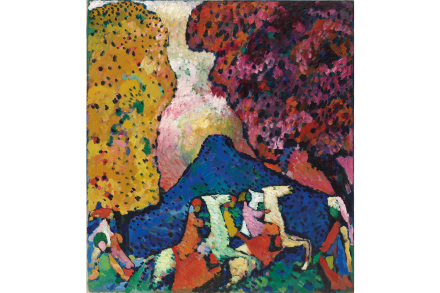
The paintings of Vasily Kandinsky (1866-1944) have never looked quite as good as they do, right now, at the Solomon R. Guggenheim Museum in New York City. It’s worth mulling why that is. I mean, Kandinsky is old news, right? He’s a mainstay in the common consciousness of those who make art their livelihood, and the paintings remain on view at any institution that presumes to untangle the story of Modern art. Given the current vogue for politics and inclusivity, Kandinsky seems an unlikely figure for reappraisal: he’s a tough nut to enlist for this or that cause. As for excluding him from the canon — forget it. Dead white male though he may be, Kandinsky is immovable. Granted, his status as the first abstract painter has been called into question.

kandinsky

The wizard that was Warhol

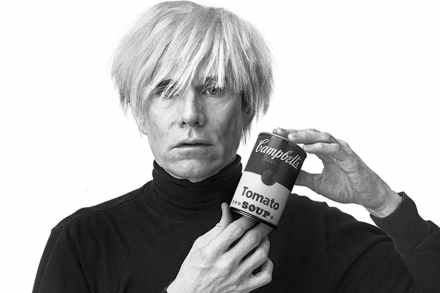
In 1983 I was sent to New York to interview Johnny Rotten and I took the opportunity to call on Andy Warhol. The Factory was in the phonebook; and the receptionist, Brigid Berlin, said that Andy was in Milan but would be back the following afternoon. ‘You better give him half an hour. Why don’t you come over at 2.30 p.m.?’ So I did. I’d never been part of that New York scene, but wanted to meet someone who had helped me develop my own freedoms almost 20 years earlier. According to Blake Gopnik’s book, I should have found a studio that was triple-locked, with an anxious artist hiding inside. But it wasn’t remotely like that.

What the Art Basel Banana says about our world

From our US edition

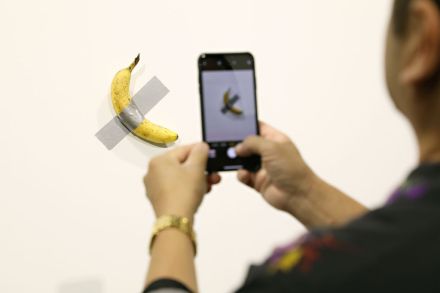
Every December, I make my way to the orgiastic display of wealth and ostentatious show-boating that is Art Basel in Miami. I go primarily to keep my finger on the racing pulse of our culture of conspicuous consumption and hedonism, and also because of an unhealthy fascination with human irrationality at scale, the kind of irrationality which drives bubbles. The high end of the global art market has always been a curious blend of vanity, self-absorption and what to every untrained eye is quite clearly commercial sophistry. Yet it persists and continues to grow, with worldwide sales for 2018 reaching $67.4 billion, up from $63.7 billion in 2017.

art basel banana