Mars

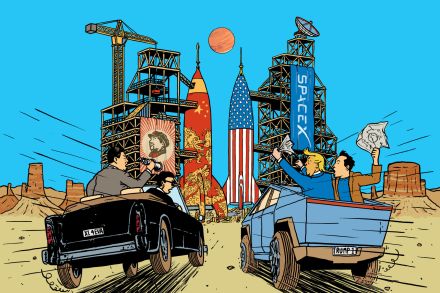
Could China colonize Mars before America?

From our US edition

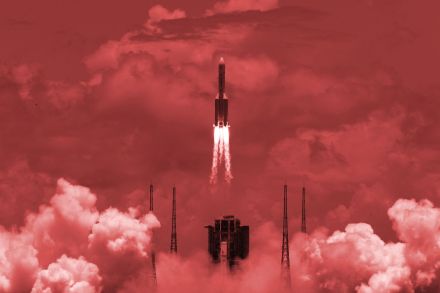
A 20-year-old Chinese researcher dressed in a red crayfish costume has become a symbol of Beijing’s ambition. At a scientific conference in Paris last fall, he explained that he was working on an important project. His plans would enable his country’s astronauts to prepare spicy crayfish soup, a Chinese favorite, on Mars. “That’s what we’re competing with. The vibe is good in Beijing,” Drew Endy, associate professor of bioengineering at Stanford University, said in evidence to a Senate hearing last month. The hearing examined whether the US is losing its innovation advantage to China. Concerned senators saw the big red crayfish as further evidence of the scale of Chinese ambition when it comes to Mars.

Trump has bet everything on Mars

From our US edition

America has what might be the best evidence for life on Mars. NASA’s Perseverance rover has gathered rock samples that could contain compelling biosignatures of ancient microbial life. No one is quite sure yet, and the samples need to be tested in a lab before we can conclusively prove that our distant neighbor once harbored life. Too bad. We’re never going to see the results. In January, funding for the project was canceled. Donald Trump has other plans for the red planet. He obsesses over competition with China and with planting the Stars and Stripes on alien soil. So to the horror of many of the world’s scientists, Trump has pulled the US space effort away from incremental robotic exploration to prioritize human landings on the Moon and Mars.

Elon Musk is deluded about life on Mars

From our US edition

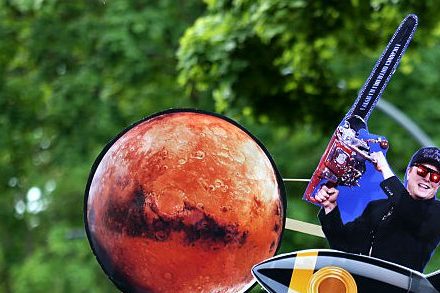
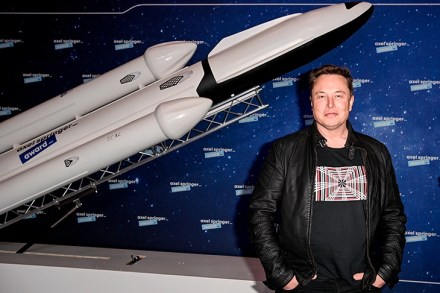
Elon Musk, already the richest person who ever lived, is at the center of the biggest share offering of all time. A valuation of $1.75 trillion at IPO would hand $75 billion to his company, SpaceX. Musk is being allocated two sets of shares, with performance-based conditions. They will materialize if SpaceX reaches a market capitalization of $7.5 trillion, and if a colony of a million people is established on Mars. The first of these is possible, the second is not. On the face of it, you wouldn’t bet against SpaceX. By 2024, it was launching more rockets than the rest of the world combined. Its Starlink internet service generates oodles of cash. It has more than 9,600 satellites in orbit that require constant replenishment, so the market is firm.

Elon Musk Mars

A piece of Mars to toy with

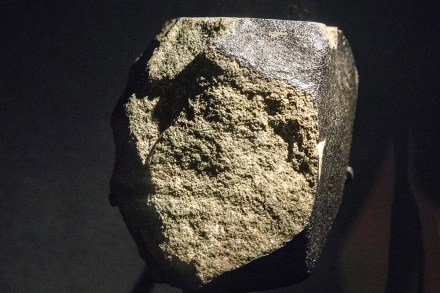
Since reading Helen Gordon’s The Meteorites, I keep catching myself in imaginary conversation with an Essex thatcher called Frederick Pratt. On 9 March 1923, he was working in a wheat field at Ashdon Hall Farm, near Saffron Walden, when he heard a strange ‘sissing’ sound and looked up to see ‘the earth fly up like water’. He later dug up, from a depth of two feet beneath the surface of the field, a stone weighing 1.27kg that had fallen from the sky. He took it to the police station, then on to the vicar, who shipped it off to the Natural History Museum. There we know it was classified as a stony chondrite meteorite, composed of feldspar, pyroxene and olivine, white specks of nickel iron and other oddments from which the solar system was formed 4.5 billion years ago.

A bird’s-eye view: Orbital, by Samantha Harvey, reviewed

This slender, gleaming novel depicts a day in the life of six astronauts at the International Space Station – but a day isn’t a day for a crew orbiting Earth at more than 17,000 miles an hour. Space ‘takes their 24 hours and throws 16 days and nights at them in return’. Weaving a line of philosophical enquiry through her luminous prose has become something of a trademark for Samantha Harvey, who probed the elasticity of time through a portrayal of Alzheimer’s disease in her prize-winning debut The Wilderness and, in All is Song, transported Socrates to the 21st century.

The culture war inside the space program

From our US edition

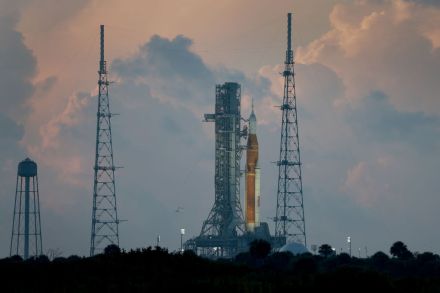
For many, the upcoming launch of NASA’s Artemis 1 (after a botched attempt earlier this week) undoubtedly seems the start of a new and exciting era in space exploration. Not only is the US finally planning to return to the Moon — this time to build a permanent outpost on the lunar surface — but in just a few months Elon Musk’s SpaceX will be sending its gigantic Starship, theoretically capable of carrying 100 astronauts, into Earth orbit. “Space is sexy again,” as astrophysicist Paul M. Sutter recently put it. “After the excitement of the initial Apollo missions dwindled into a subject only discussed by ultra-nerds, and the cool factor of the Space Shuttle gave way to the realization that it didn’t really do much, people generally lost interest in space.

Two hours of kitsch tomfoolery: Amélie at the Criterion reviewed

The latest movie to turn into a musical is Amélie, from 2001, about a Parisian do-gooder or ‘godmother of the unloved’. Some rate Amélie as the worst film ever made in France. Some consider it the worst film ever made. Our heroine is a 20-year-old waitress, a sort of proto-Greta, who plays truant from her restaurant job and wanders around Paris doing nice things to random strangers. Her inspiration is a box hidden by a child in her apartment 40 years earlier which she wants to restore to its original owner. Or, as the clunky narrator puts it, ‘Why is she holding that box like her future is inside it?’ Amélie’s odyssey brings her into contact with all kinds of misfits, pests and layabouts who belong in a magic realist novel.

Life on Earth is too tame for eccentric American billionaires

For many of us, Elon Musk is a hard man to like. He’s the richest man in the world (or second richest, as he and Amazon founder Jeff Bezos whirr back and forth in top spot), but acts online like a bratty teenager astonished by his own intelligence. He proposes underground tunnel networks as a transport solution for Miami (which is a swamp less than 10ft above sea level), moots takeovers of his companies with 420-themed weed jokes and hypes cryptocurrencies. Yet as you read Liftoff you can see what so many people find to admire in the man — at least for a while.

NASA’s multi-billion dollar Mars reality TV show green-lit for another season

From our US edition

The American businessman and astronomer Percival Lowell first popularized the notion of life on Mars in 1906 when he described vast canals observed on the planet, some spanning the equivalent distance of Boston to San Francisco. He believed an intelligent Martian civilization was in peril, their world drying out and dying, and they had constructed as a planet-wide irrigation system to move water from Mars’s polar ice caps to the rest of the planet.American folklore has it that the idea of Martian intelligent life was so pervasive that a 1938 radio drama of H.G. Wells’s War of the Worlds, about a Martian invasion, ignited mass panic when millions of people believed it was a real newscast.

mars