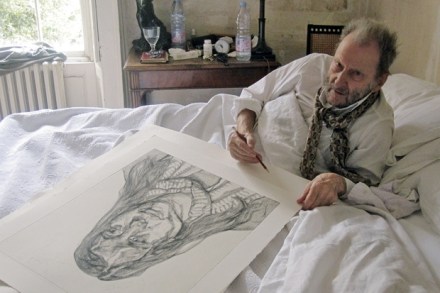
Lucian freud

The only art is Essex

From our UK edition

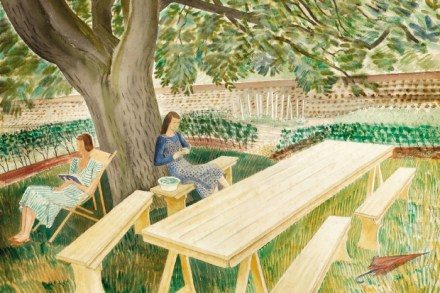
When I went to visit Edward Bawden he vigorously denied that there were any modern painters in Essex. That may not have been true then — this was in the 1980s — or even now. What is indisputable, however, is that there have been plenty of artists in the county. They are the subject of two small but delightfully jam-packed exhibitions at the Fry Art Gallery, Saffron Walden. Bawden (1903–1989) is at the heart of both of them, even if the second point he made to me — equally emphatically — was that he called himself a designer rather than an artist (‘out of self-defence, mainly’). That distinction, and the quirky humour, are both relevant to the question of Essex art, especially the variety that is the focus of attention at the Fry.
Portrait of the artist as a madman

From our UK edition

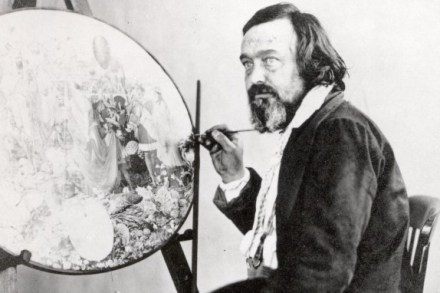
Charles Dickens’s description of Cobham Park, Kent, in The Pickwick Papers makes it seem a perfect English landscape. Among its ‘long vistas of stately oaks and elms’, he wrote, ‘occasionally a startled hare’ ran with ‘the speed of the shadows thrown by the light clouds’. It was there on the morning of 29 August 1843 that a butcher from Rochester got a nasty surprise. He discovered the corpse of an apothecary named Robert Dadd; he had been battered and stabbed to death by his son Richard. There is no doubt that Richard Dadd was far from sane. On the other hand, his loss of mental balance — though very bad in its consequences for his father — was the making of Dadd as an artist.

Dizzying swirls of impasto

From our UK edition

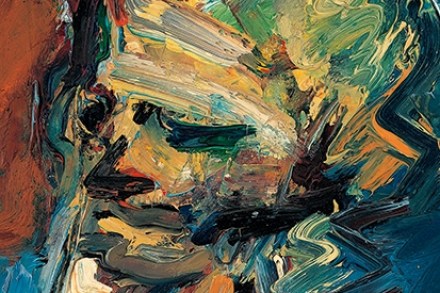
With a career of more than 60 years so far, Frank Auerbach is undoubtedly one of the big beasts of the British art world. His personal reticence, however, and the condensed, impacted idiom of his painting have contributed to his enigmatic, somewhat opaque reputation. Catherine Lampert, who has sat regularly and patiently for him since 1978, is uniquely qualified to throw light both on the man and his art, but the tactics she employs here are very different from those of Martin Gayford in Man with a Blue Scarf, his intimate, engrossing account of sitting for Lucian Freud. Matching Auerbach’s reticence with her own, she keeps herself largely out of the story, focusing instead on observations made by the artist over the many decades of his career.

A 50-year infatuation

From our UK edition

The subject of the least characteristic essay in this engrossing collection of meditations on painters, painters’ lives, painting and reactions to painting is René Magritte — whose best work David Sylvester rather rashly claimed induces ‘the sort of awe felt in the presence of an eclipse’. Julian Barnes discusses what he calls the artist’s doctrine (doctrine?) of ‘elective affinities’, which proposes the antipodes of Lautréamont’s ‘chance encounter on a dissecting table of a sewing machine and an umbrella’. Thus in the painting of that name a birdcage is filled not with a random safety razor or knuckleduster but with a giant egg.

The frog prince

From our UK edition

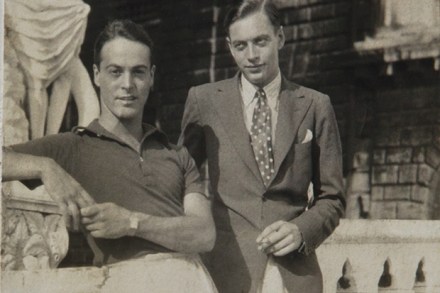
It would not have surprised their friends in the 1930s when Peter Watson had a fling with my grandfather, Robert ‘the Mad Boy’ Heber-Percy. Both gorgeous young men were known for their risky sexual escapades. What did ruffle feathers, however, was when Watson subsequently gave the Mad Boy a car. Cecil Beaton was so jealous that he demanded one too. And it was forthcoming: ‘Do please select any roadster which catches your fancy,’ replied the exceedingly wealthy Watson, who inspired lifelong unrequited love in poor Beaton. The Mad Boy’s long-term partner was Lord Berners, the famously eccentric composer, painter and writer, who retaliated by pinning Watson to the page of his wickedly satirical novel, The Girls of Radcliff Hall.

Sargent, National Portrait Gallery, review: he was so good he should have been better

From our UK edition

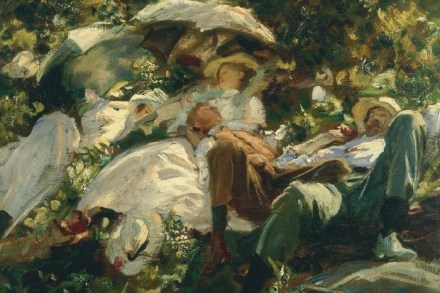
The artist Malcolm Morley once fantasised about a magazine that would be devoted to the practice of painting just as some publications are to — say — cricket. It would be filled with articles extolling feats of the brush, rather than the bat. ‘Well painted, sir!’ the contributors would exclaim at an especially brilliant display of visual agility. ‘Fine stroke!’ If such a periodical had existed in the late Victorian and Edwardian ages, no one would have been heaped with more praise than John Singer Sargent (1856–1925). Sargent: Portraits of Artists and Friends at the National Portrait Gallery is filled with mesmerising displays of his skills. There are so many, indeed, that to list them would be to describe just about every picture on view.

The death of the life class

From our UK edition

‘Love of the human form’, writes the painter John Lessore, ‘must be the origin of that peculiar concept, the Life Room.’ Then he goes on to exclaim on the loveliness of that name. It is indeed a venerable institution with a delightful description: a place devoted to looking at life — or, at any rate, to earnest attempts to depict people without a stitch of clothing. Currently two exhibitions in Norwich — at Norwich Castle Museum and Norwich University of the Arts — by Lessore and another distinguished painter, John Wonnacott, focus attention on this time-honoured practice, apparently remote from the contemporary art world of video, installation and performance.

The Duke of Wellington also invades Christmas art books

From our UK edition

Art books fall naturally into various categories, of which the most common is probably the monograph. Judith Zilczer’s A Way of Living: The Art of Willem de Kooning (Phaidon, £59.95, Spectator Bookshop, £53.95) examines its hero’s career from his extraordinarily accomplished — and resolutely conventional — teenage productions, by way of his glorious middle years, on to the final works, which were created when he was suffering from Alzheimer’s. Lavishly illustrated not only with works by the artist, but also with photographs of him and his friends, it does full justice to his towering — if not always entirely lovable — achievement.

Rembrandt at the National Gallery: the greatest show on earth

From our UK edition

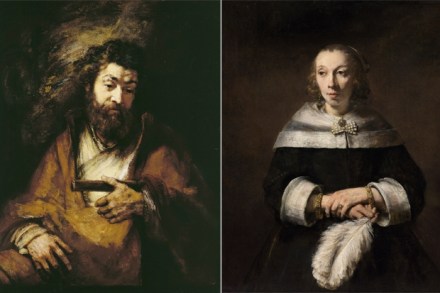
At the opening of Rembrandt: The Late Works at the National Gallery (until 18 January), I met a painter friend of mine in the final room. This was, he said, one of the most magnificent exhibitions he had seen in his entire life, which — considering he is perhaps 70 and a frequent visitor of galleries — was praise indeed (and entirely deserved). Mischievously, I mentioned that he had also been highly enthusiastic about Veronese at the National Gallery a few months ago. ‘Ah, but there is a huge difference between Veronese and Rembrandt,’ he vehemently responded. ‘When you look at a Madonna by Veronese, you see a glamorous model wearing expensive clothes, with Rembrandt’s “Bathsheba” [pointing at the picture in front of us] you can read her thoughts.’ He got it in one.

The age of the starving artist

From our UK edition

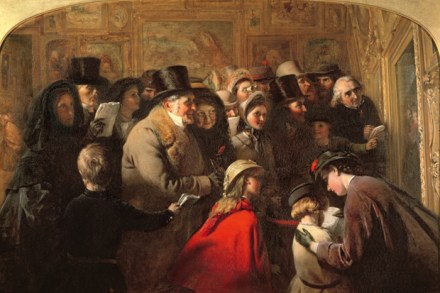
What remains of art is art, of course; and what chiefly interests us is the creative talents of a painter or a sculptor. What we forget is that the work of art wouldn’t be there without some kind of engagement with the brutal forces of money. James Hamilton’s riveting book is a richly detailed study of how, in Britain in the 19th century, artists and a small army of opportunists, art lovers, collectors and businessmen of all sorts used their ingenuity to turn the visual arts into money.

Taki: our leaders are weak and powerless in the face of religious fanatics

From our UK edition

This Christmas our thoughts need to be with our fellow Christians who are being threatened in the Bible lands. No ifs or buts about it, they are being told either to join the Sunni-led opposition to Assad and renounce Christianity or die. After decades of protection by a secular-leaning dictatorship, Christians are being given ultimatums by the Saudi-financed jihadists and face a very dark future.  There has already been Christian cleansing in Syria, especially in Homs, where 90 per cent of the Christians have fled the city for Assad-controlled areas near the Lebanese border. In Iraq things are not much better. Cities such as Mosul and Tikrit, Saddam’s home town, were once vital centres of Christianity. No longer.

‘Squiggle, squiggle, ooh, good…’ Tate St Ives shows how sexy the octopus can be

From our UK edition

One of the more exotic attractions at the 1939–40 World’s Fair in New York was Salvador Dalí’s ‘Dream of Venus Pavilion’, which behind its surreal façade — an architectural marriage between Antoni Gaudí and a coral reef — catered to the public’s aquatic fantasies of spume-born goddesses and topless sirens. Something similar is going on behind the cool modernist exterior of Tate St Ives. Aquatopia: The Imaginary of the Ocean Deep is a bottom-trawler of an exhibition that dredges the depths of the human psyche for fishy fantasies.

Breakfast with Lucian, by Geordie Greig – review

From our UK edition

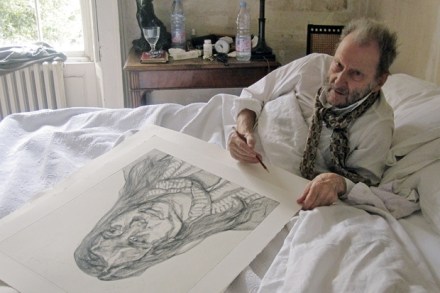
According to the medical historian Professor Sonu Shamdasani, Sigmund Freud was not the best, nor actually the most interesting, psychoanalyst in early 20th-century Vienna.  Rather, Freud’s genius lay in creating a loyalty cult around himself, collecting a group of acolytes who would ensure his reputation.  This is worth bearing in mind when considering the life of his grandson, the painter Lucian Freud, who died in 2011. Lucian was famous for his secrecy. ‘Devious and secretive. I have been described as that,’ he tells Geordie Greig, not without a certain pride. He demanded a strict omertà of his intimates.

Double exposure

From our UK edition

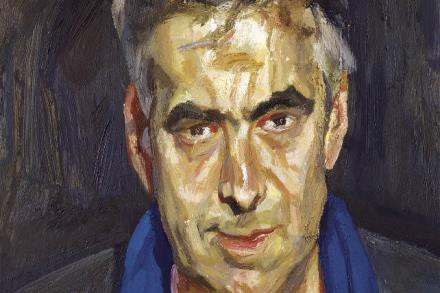
I never thought I’d write these words. I never thought I’d write these words. This book is unclassifiable. It belongs to a whole new genre. The field of literature has been extended! And I saw it happen. Martin Gayford, who writes for The Spectator and whom I’ve never met, kept a diary during the seven months he spent sitting for the painter Lucian Freud in 2003/4. The book is a journal, an act of confession, a character study of Freud, a piecemeal survey of art history and an investigation into the practicalities of portraiture. It’s also a hostage drama. Gayford has no idea how many months or years the painting will take, and his abductor-cum-immortaliser asserts his right to abandon the project at any moment, without warning.