Libya

Reversal of fortune in Libya, but the old questions remain

From our UK edition

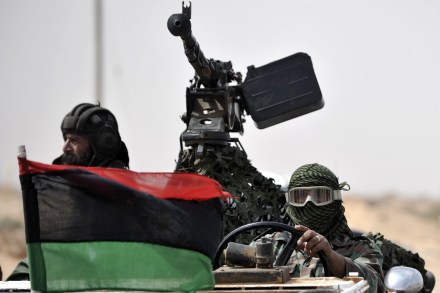
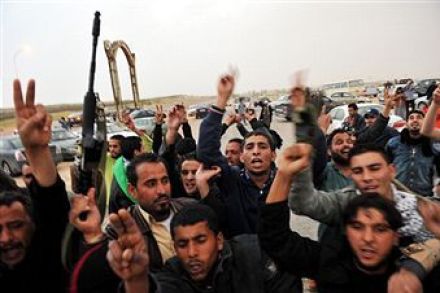
There has been a dramatic turnaround in the military situation in Libya. The rebels are now within 30 miles of Tripoli and the consensus is that Colonel Gaddafi’s days are numbered. The rebels have taken the strategically vital town of Zawiyah, which lies on the road between Tunisia and Tripoli, upon which Gaddafi relies for supplies. The town’s oil refineries are also of crucial importance in this conflict. With his communications shorn, the noose appears to be tightening around the Colonel’s isolated throat. This turn of events has taken observers by surprise. Just two weeks ago, Westminster types were blithe in their assertions that the end was still far off.
Syria and Libya overshadowed by London riots as Boris comes home

From our UK edition

President Assad’s tanks are still doing murder on the streets of Syrian, but the dictator’s isolation grows. After weeks of prevarication, several Gulf States have closed ranks against the Syrian regime. Saudi Arabia, Bahrain, Jordan and Kuwait have all recalled their ambassadors from Damascus, and King Abdullah of Riyadh has led the Arab League’s condemnation of Assad’s ‘death machine’. Better late than never, the international consensus says. Compassion for the oppressed is not a familiar trait among Arabian princelings, but their reticence on this occasion was particularly surprising given that Assad’s Syria is no friend of the Arab League, preferring to side with Iran in most things.

An American context for UK defence cuts

From our UK edition

Yesterday’s defence select committee report provoked stern critiques of the government’s defence policy from Alex Massie and Matt Cavanagh. It is hard to dissent from Matt’s view that Cameron, Fox and Osborne will be defined to some extent by how they handle the defence brief, which, as Alex points out, also proved to be Gordon Brown's undoing.  It is also clear, as both Matt and Alex say, that the SDSR suggests that Britain is entering a period of ‘strategic shrinkage’, in terms of the size of the defence establishment at any rate. A political squall has erupted over this, but it’s worth pointing out that western countries are narrowing their military horizons.

Petrol woes set to continue

From our UK edition

Despite small falls in petrol prices last month, the consequence of a supermarket price war according to the AA, motoring becomes ever more expensive. Political campaigns have opened as pressure builds at the pumps; and these campaigns have been co-opted by influential organs such as the Sun. The government has reacted: taking part in the International Energy Agency’s decision to release reserves onto the market to counter those members of OPEC that connive to sustain high oil prices. The government has also relaxed some of its windfall taxes on companies operating in the North Sea.

Massacre in Hama hastens the need to tackle Assad

From our UK edition

Syrian President Bashar Al Assad has praised his troops for ‘foiling the enemies’ of his country. Some enemies. 140 civilians are said to have died in a pre-Ramadan crackdown on protesters, adding to the toll of 1,600 civilians who have been killed since anti-government demonstrations began in mid-March. Details of the events in Hama are unclear because journalists have been kept out of Syria. But the pattern of events is familiar: protests against the Assad regime emerge; the army moves in to kill demonstrators; more protests then take place, which leads to more killings. Meanwhile, the international community stands by.

The shifting sands of public opinion on Libya

From our UK edition

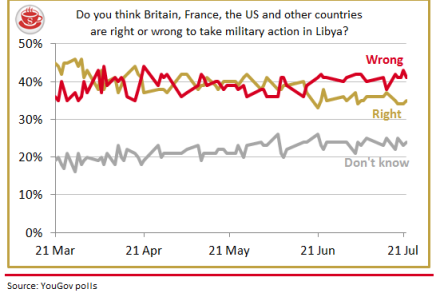
All of the buccaneering rhetoric has been sucked from the Libyan conflict this week, replaced with words of concession, compromise and caution. A few days ago, it was the news that — contrary to what they might previously have said — the government is prepared to let Gaddafi remain in the country after all. Today, William Hague deploys the same line in an interview with the Times (£), in which he also warns that there are "a lot of problems and even convulsions" to come in northern Africa. As it happens, the depressed mood of our foreign-policymakers reflects the tide of public opinion. Here, for CoffeeHousers' benefit, are a couple of graphs that we've made from YouGov's polling questions on Libya.

Cameron compromises, but Gaddafi might not

From our UK edition

What a difference four months of air sorties make. Back in the early days of the Libya intervention, David Cameron was unequivocal when it came to Muammar Gaddafi remaining in the country: there was "no future" for the dictator within its borders, he said. But now, on top of comments by William Hague yesterday, the Prime Minister is thought to be softening his stance. As the Independent says today, he has decided that "the time has come to find a way out of the conflict and back a French proposal to allow Gaddafi to stay in the country as part of a negotiated settlement with rebel forces." So, from no future for Gaddafi to some sort of future, and all while the bombs have been dropping. But France and Britain's change in tack is unlikely to have much effect on the ground.

Bomb blast near the Norwegian Prime Minister’s office

From our UK edition

  A reportedly enormous bomb blast has shaken the PM's office and the oil ministry in Oslo, the Norwegian police confirm. Reports have confirmed that the Norwegian Prime Minister is safe, but it's not clear if he's un-injured. Early reports suggested that this might be a gas explosion, but those were discounted because there is no mains gas supply in Oslo. Norway's state broadcaster has confirmed that one person has died, with more than 8 injured. Fortunately, it is the height of Norway's holiday season and there were few people about. The Norwegian police, however, warn that there are other casualties being treated. Details remain vague.

Some good news for Cameron?

From our UK edition

In the midst of the fall-out from the phone hacking scandal comes some positive news for David Cameron: it appears that the Libyan rebels have won control of Brega, as most pro-Gaddafi troops retreated westward leaving around 150-200 loyalist fighters pinned down inside the town. If true, this is an important step towards the end of the Gaddafi regime: control of the oil-rich town is decisive for the Transitional National Council in Benghazi. It gives the rebels control over Libya's eastern oil network, with access to more than 2m barrels of stored crude.

A Lovely Little Forgotten War

From our UK edition

I'm glad the kinetic military action faux-war in Libya has gone so well. What's that? Oh. Nevertheless, the war has this to be said for it: very few people seem to care one way or the other what happens in Libya. Granted, a churl could construe this as a good reason to have avoided getting involved in the (latest) Battle for Tripoli in the first place since the lack of interest in the conflict might be considered evidence that few vital interests  - for the United States or other NATO powers - are at stake. Nonetheless, alea iacta est and all that. So this is not a surprising development: “The United States views the Qaddafi regime as no longer having any legitimate authority in Libya,” Mrs. Clinton said.

It was the Times wot won it

From our UK edition

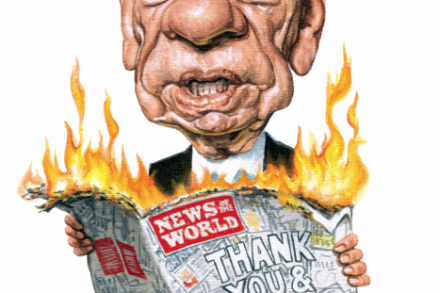
The latest issue of the Spectator features an article in qualified defence of Rupert Murdoch by William Shawcross, author of Murdoch: the Making of a Media Empire. In it, Shawcross writes: ‘Simon Jenkins, now a Guardian columnist, wrote before the current horrors that Murdoch ‘is the best thing that ever happened to the British media and they hate it.’ He was right. There are obviously many things wrong with Murdoch’s group, but without his epic victory over the print unions in the 1980s, there would be far fewer papers in Britain today. Murdoch means pluralism…Who else would have subsidised the huge losses of the Times, an excellent paper, for so long?

Might Gaddafi shunt Murdoch from the front pages?

From our UK edition

Loyal Tories and government types are hoping that the media will soon move on from Murdoch. And the unusually heavy briefings emanating from George Osborne’s office last night were perhaps an attempt to shift the spotlight. But it will take a very gripping story to displace the phone hacking saga, especially if yet more has-been politicians shuffle back into public life to settle old scores with Murdoch. With the British press immersed in this tempestuous revenge drama and the whirl of hypocrisy that surrounds it, you wouldn’t guess that the euro has embarked on a 72 hour ordeal that may decide its future.   But, Rupert Murdoch’s mugshots could yet be superseded by those of Colonel Gaddafi.

Coffee House Interview: Andrew Mitchell

From our UK edition

The government has stuck to its guns on overseas aid, promising to donate 0.7 per cent of our national income to other countries. In the Chancellor’s words, the government will not balance the books on backs of the world’s poorest people. In fact, as the criticism of the policy was at its highest the Prime Minster hosted a development summit in London and pledged £814m to help vaccinate children around the world against preventable diseases like pneumonia. On this issue, David Cameron does not seem for turning — however many letters he receives from the Defence Secretary.   But Liam Fox is not alone. A slew of recent polls show that Britons have mixed feelings about the utility of overseas aid.

Britain’s ill-defined counter-terror strategy exposed by America’s clarity

From our UK edition

In a post over at the Staggers, defence and security expert Matt Cavanagh has compared and contrasted Barack Obama’s review of US counter-terrorism policy and the coalition’s recent update of the Prevent strategy, together with David Cameron’s professed ‘muscular liberalism’. Here are his insights: ‘The new (American) strategy contains a fairly detailed discussion of the Arab Spring, arguing for applying "targeted force on Al Qaida at a time when its ideology is under extreme pressure" from events in North Africa and the Middle East.

Stopping Syria

From our UK edition

Syria is still ablaze and the West seems unable to do douse the flames. And the risk of the Assad regime committing even greater violence will increase when the world's media moves on. The reasons for Western impotence are manifold. First, for a long time Western leaders thought they could reason with Assad and therefore shied away from direct pressure. When they decided to act, they discovered that Assad is immune to European pressure because Syria does little trade with Europe. But, crucially, many Syrians are either loyal to the regime or fear triggering disintegration of the sort they have seen in neighbouring Lebanon and Iran. Finally, unlike Libya, the Syrian regime is not hated by fellow Arab states.

Whitehall’s monolith faces reform

From our UK edition

The Ministry of Defence is one of Whitehall’s largest and most dysfunctional departments; and it has long resisted effective reform. However, the parlous public finances dictate that reform take place. 8 per cent Budget cuts have to be delivered, while attempting to bring a £36bn black hole under control. Strategic retrenchment aside, efficiency is Liam Fox’s most potent weapon. To that end, Lord Levene has conducted an examination into departmental structures. Levene reports that the MoD’s maze of committees and sub-committees should be ripped-up to improve decision making and save money (and perhaps one of the ministry's five ministers of state). 'Sound financial management,' he says 'must be at the heart of what the MoD does.

Obama draws down his forces

From our UK edition

It is as Matt Cavanagh predicted in his article for Coffee House, a few weeks ago. Barack Obama has decided to pull 10,000 of the 30,000 American "surge" troops out of Afghanistan this year. The remaining 20,000 will be outtathere by next summer. "Drawdown," is the word that the US President used in his address last night, and it is happening at quite a pace. He presented this approach as a victory, suggesting that America has already achieved most of its goals in the country, and that "the tide of war is receding". But there were one or two revealing notes of concession. "We will not try to make Afghanistan a perfect place," quoth Obama. And he nodded towards the fiscal cost of the war, as much as its human cost.

Miliband’s myopia

From our UK edition

The Prime Minister declared war at PMQs today. Not once but twice in the same sentence. ‘We’re at war in Libya and in Afghanistan,’ he said, in a throwaway footnote to some ritual noises about his ‘huge respect for our armed forces.’ Until this historic moment Britain had been engaged in peace-keeping and nation-building in Afghanistan, and in civilian protection and tyrant-bothering in Libya. But now it’s official. We’re mobilised on two fronts. Ed Miliband might have made more of this but he was too busy mentally preparing himself for this week’s shock ambush. This week’s shock ambush wasn’t quite as shocking as it might have been because it had exactly the same three-pronged shape as last week’s shock ambush.

You Do the Fighting, I’ll Do the Talking

From our UK edition

You can imagine, I think, the outrage there'd have been had Tony Blair or, god forbid, Gordon Brown slapped down the service cheifs in this fashion. But there was the Prime Minister, exasperated by repeated complaints from the heads of the Army, Royal Navy and RAF that their resources are perilously close to snapping-point, telling the press he sometimes feels like saying "I tell you what – you do the fighting and I'll do the talking." As I say, the Tory press would have torn poor Gordon to shreds had he dared suggest any such thing. As it is, the Telegraph's editorial yesterday was relatively restrained but still sided with the military against the civilian leadership.

America and Britain turn their minds to the (fiscal) cost of war

From our UK edition

Five-thousand, ten-thousand, or fifteen-thousand? That's the question hanging in the air as Barack Obama prepares to clarify his withdrawal plan for Afghanistan this evening (or 0100 BST, if you're minded to stay up). And it relates to how many of the 30,000 "surge" troops he will decide to release from the country this year. Washington's money appears to be on 10,000, with half of them leaving this summer and half in December. But no-one outside of the President's clique really yet knows. His final decision will say a fair amount about his intentions in Afghanistan, or at least about just how fast he wants to scram out of there. What's really striking, though, is the emphasis being placed on the bill for Afghanistan.