Libya

David Cameron and the John McCain School of Statesmanship

From our UK edition

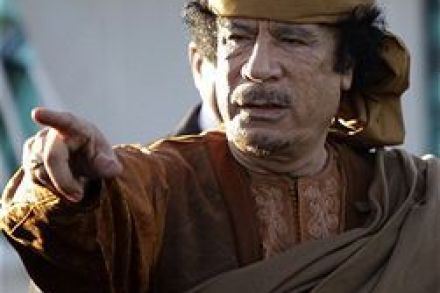
In the midst of an otherwise interesting and thoughtful piece arguing that David Cameron is "retreating" from his "radical" start, Ben Brogan lobs in this astonishing paragraph: Even on issues on which he has not found such obvious consensus, Mr Cameron has shown himself willing to take risks when politics would dictate prudence. Take Libya, where he led the international debate by being among the first to urge some kind of UN-approved action against Muammar Gaddafi. Events since have largely vindicated those who cautioned against the peril of a drawn-out, costly and unsustainable entanglement. But his critics recognised the confident way the Prime Minister defied American doubts and navigated Arab suspicions to produce a consensus for intervention.

The Law vs Gaddafi

From our UK edition

Luis Moreno-Ocampo of the International Criminal Court has said that Colonel Gaddafi, Saif al-Islam Gaddafi and spy chief Abdullah al-Sanussi have the greatest responsibility for the "widespread and systematic attacks" on civilians in Libya. The prosecutor has therefore asked the ICC to issue warrants for their arrest. The move comes as rebels claim they now have full control of Misrata and scored victories in Zintan, south-east of Tripoli. A senior officer told me he thought Colonel Gaddafi would be toppled in less than six months. But if he does not fall, the ICC move may become problematic. For if  warrants are issued, the Libyan dictator has little way out but to fight to the very end.

How to fix the National Security Council

From our UK edition

The National Security Council was a sound idea. But it has disappointed, both inside and outside Whitehall. The Ministry of Defence has complained that it "failed to give strategic direction". Among previous supporters in the media, Con Coughlin has commented sourly that “all it has achieved so far is the replacement of Blair’s much-derided ‘sofa government’ with a new, back-of-the-envelope approach”. James Kirkup was even driven to ask “What exactly is the point of it?” Where did things go wrong?

The Coffee House A-Z of the Coalition: T-Z

From our UK edition

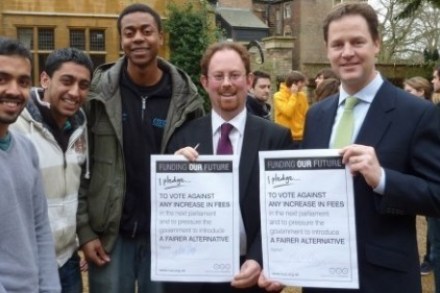
Here are letters T to Z in our A-Z guide the coalition's first year. A-F are here. G-M are here. And N-S are here. T is for Tuition fees "Broken promises, there have been too many in the last few years." So said Nick Clegg in a Liberal Democrat video during the last election campaign. It was favourite theme of his — and one that he deployed both during the TV debates and in signing a pledge to scrap tuition fees. This was to be a New Politics. Clegg was to be its champion. Shame it didn't quite work like that. The coalition agreement was damaging enough to Clegg's aura: it didn't guarantee that tuition fees wouldn't rise, only that the Lib Dems wouldn't have to vote for such a rise.

Libya: Bombing does not preclude preparing a Plan B

From our UK edition

The PM is looking to intensify the military campaign in Libya. Losing is not an option. Just think about it. The US gets its man; Britain gets angry, bombs a bit and then goes home. The dictator lives on in infamy: very Clintonesque. To avoid such an ignominious end, a delegation from Benghazi has been called to London in order to hatch a plan with Britain and her allies. But at the same time it may be prudent for someone in government – quietly and out of sight, of course – to look at a Plan B. Not for execution now, but ready in case the time comes. Why a Plan B? While the mission has protected Benghazi and is helping the rebels, questions are emerging about how long the UK can go on for? The operation has already cost close to half a billion pounds.

Meanwhile, in Libya…

From our UK edition

The death of Osama Bin Laden may be a very arresting punctuation mark in the conflict against tyranny — but the conflict continues nevertheless, not least in Libya. The latest news from the country is that the rebels are maintaining their fragile hold on the port town of Misrata, although Western agencies are still struggling to send in aid and relief supplies. "We have seven ICU beds and eleven cases," is how one hospital worker puts it to Channel 4's Alex Thomson. "What is Nato doing? What is the world doing? If any more people come here they will die.

The Gaddafi family should be regarded as legitimate targets

From our UK edition

David Cameron became most animated on the Andrew Marr show this morning when the subject of Libya came up. It was clear that he remains passionately convinced that the course he has taken is the right thing to have done. The Prime Minister refused to comment on the Gaddafi regime’s claim that one of Gaddafi’s children had been killed in a Nato airstrike and wouldn’t be drawn on the question of whether the government considers the Gaddafi family legitimate targets. But given that, as Cameron himself noted, the Gaddafi family is running the military operation and ordering moves against civilians then they surely are legitimate targets.

An honest plea? Or a cynical gambit?

From our UK edition

I was planning on collating today's sunny newspaper covers for Coffee House — but Tim Montgomerie has beaten me to it. So let's, instead, turn our attention away from the Royal Wedding, and on to Libya. A striking thing has happened there this morning: Gaddafi has called for a ceasefire, and for negotiations between his regime and NATO. Although the murderous leader's television address was shot through with the usual defiant rhetoric — "No one can force me to leave my country and no one can tell me not to fight for my country," he bellowed — it also included some concessionary passages. "Let us negotiate," was one of them. "We cannot fight each other," was another. Of course, we should treat this intervention with wholesale quantities of salt.

The government has a problem with lawyers

From our UK edition

The government’s strained relationship with the Civil Service is a recurring story at the moment. Much of the disquiet seems to be the normal tit for tat exchanges immortalised in Yes Minister. In the main, ministers and their advisors express high regard for their officials. But there are some resilient bones of contention between the government and its lawyers. Again, this is not unusual. When Gordon Brown was Chancellor, parliamentary counsel were exasperated by his inability to take decisions. Brown’s budgetary machinations were finalised in a predictably mad rush, which incensed those who had to amend the bill hours before it was put to parliament.

Obama’s Love of Cake

From our UK edition

Ryan Lizza's New Yorker article on the development of Barack Obama's approach to foreign policy is, as always, full of interestig stuff even if, perhaps unavoidably, I suspect it depends a little too heavily upon the Slaughter-Power approach. Nevertheless, Ryan gets to the heart of Obama's presidency - or at least the style of it - here: Obama’s instinct was to try to have it both ways. He wanted to position the United States on the side of the protesters: it’s always a good idea, politically, to support brave young men and women risking their lives for freedom, especially when their opponent is an eighty-two-year-old dictator with Swiss bank accounts.

The Arab League backs the protestors against al-Assad

From our UK edition

William Hague has chimed in on the situation in Syria, unsurprisingly condemning the horror and bloodshed being perpetrated by al-Assad's regime. But considerably more significant is the statement that has today been released by the Arab League. Although the text doesn't mention al-Assad by name, it clearly has the Syrian autocrat in mind when it calls on "Arab regimes and governments to commit to and speed up reforms, [and to] immediately stop using force against demonstrators and spare their citizens bloodshed." And it goes further, too, in defending the political — and moral — legitimacy of the protests, saying that the unrest blazing across the Middle East heralds "a new Arab era … led by youths seeking a better present and a brighter future.

Another one goes

From our UK edition

The scent of jasmine has just grown a little stronger in Arabia. The Yemeni President, Ali Abdullah Saleh, has agreed to stand down within 30 days, the Wall Street Journal reports. Saleh and his family will receive immunity in exchange for his momentous gesture. Saleh has been under growing pressure in recent months, as his government was attacked simultaneously by a pro-democracy movement and al-Qaeda sponsored terrorism. It is not clear if the groundswell of popular dissent that has forced his hand is inspired by jihad, but the speculation doesn’t seem unreasonable and western governments fear that they may lose a vital ally in the war on terror.

Reasons for optimism in the Middle East | 22 April 2011

From our UK edition

As the Libya crisis drags out, and Bashar al-Assad orders a crackdown in Syria, many have begun to doubt whether the changes seen in Tunisia and Egypt will actually spread to the rest of the Middle East. One former British ambassador recently suggested that perhaps the peoples of the Middle East preferred a mixture of authoritarianism and democracy — and that Britain should accept this; not impose its values and views.   But there is plenty of reason for optimism. The first is to look at the countries that have transformed themselves over the course of the last fifty years. Powerhouses like India and Brazil, but also smaller countries such as Vietnam, were mired in poverty, maladministration and the consequences of war.

The Libyan intervention needs to be stepped up

From our UK edition

The government is rightly proud of the Libya intervention. Not only did it save thousands of lives in Benghazi but it was conducted in way that learnt the lessons of the past. The Foreign Secretary took pains to get a UN resolution, making the mission legal, and kept the shape-shifting Arab League committed throughout. But unless the government is now  willing to unlearn the lessons of the past, and act both more unilaterally and even illegally, its multilateral, UN-sanctioned action may have been for nothing. For Misrata is now getting the punishment that had been planned for Benghazi. The town is being destroyed in a seige that looks like the shelling of Sarajevo.

Hague: advisors on the ground is not boots on the ground

From our UK edition

William Hague let the cat out of the bag on Sky News earlier, arguing that military advisors sent to aid the rebels in Libya did not constitute ‘British boots on the ground’. He said: "This is an expansion of the diplomatic presence we have in Benghazi...It's not boots on the ground. I stress it’s not training fighting forces...it is to help them organise themselves to protect civilian life." The reaction is fevered, with the sagacious Sir Menzies Campbell helpfully reminding everyone that Vietnam began when a President sent military advisors. But, one braided colonel does not an invasion make.

Is Syria next?

From our UK edition

I used to think that Syria was some way off a revolution. The protests were geographically limited; Bashar al-Assad was willing to use Libyan-style violence against them and the West seemed uncharacteristically mute. What's more, demands for the Syrian president to go were limited. And then there's the real fear that Syria, made up of so many different sectarian groups, would collapse into a vortex of internecine violence akin to the Lebanese civil war. But these arguments may be losing their weight. The current unrest is the most serious challenge facing Bashar al-Assad and his Alawite regime. And nothing the Syrian dictator has done so far has made a difference. Not lifting the emergency laws. Not shooting protesters.

Cameron: we’re looking at doing more for the Libyan rebels

From our UK edition

As James Kirkup says, David Cameron’s appearance on Sky News this morning was intriguing. In addition to trying to reassure the massing media doubters that the coalition “remains strong” despite its differences, the PM was keen to discuss the military mission in Libya. The letter that he authored with Sarkozy and Obama on Friday asserted that regime change was a necessity for peace. Since then, both Whitehall and the Elysee have insisted that Gaddafi cannot remain. How then might he go? Plainly, Gaddafi will not abdicate of his own volition. On the other hand, Cameron is adamant that there can be no ‘invasion or occupation’, and he reiterated the point this morning. Therefore the rebels will have to defeat Gaddafi.

Should the West negotiate with Gaddafi?

From our UK edition

This week, former Foreign Secretary David Miliband gave a speech in the United States about Afghanistan, proposing the hand over of responsibility for building a political solution to the UN, headed by a Muslim mediator capable of negotiating with the Taliban as well as partners throughout the region. Last week, also saw former US negotiator Daniel Serwer make an interesting parallel to his time negotiating peace in Bosnia: ‘In my experience, there is nothing like staring a military commander in the face, asking him what his war objective is, and discussing alternative means to achieve it.  I asked the commander of the Bosnian Army that question in 1995, having been told by both the State Department and the U.S.

The government should recall parliament

From our UK edition

Today’s declaration (£) by Barack Obama, David Cameron and Nicolas Sarkozy that Nato’s operation in Libya will continue until Gaddafi leaves power marks a shift in their rhetoric and makes explicit that regime change is the war aim. This has led to calls to recall parliament, most notably from David Davis on the World at One, to debate this change. Parliament merely voted to enforce the UN resolution which was not a mandate for regime change. The government would be well advised to heed these requests. It would be the best way of maintaining the necessary political support for the mission. Now that regime change is the explicit war aim, the allies must will the means. To do otherwise, would simply guarantee a humiliating and debilitating stalemate.

Oh what a lovely war

From our UK edition

The triumvirate of Obama, Cameron and Sarkozy have presented a united front to NATO and the Arab League and said there will be no respite in Libya. Writing to the Times (£), they say: ‘Britain, France and the United States will not rest until the United Nations Security Council resolutions have been implemented and the Libyan people can choose their own future.’ They also add that to leave Gaddafi in power would be an ‘unconscionable betrayal’, a marked shift in emphasis. It’s rousing stuff, designed to twist reluctant arms at the NATO summit in Berlin.