Libya

Obama backs Cameron on no-fly zone

From our UK edition

Everyone knows that a media narrative is a difficult thing to change. So No.10 must be annoyed that so many newspapers, from the Telegraph to the Independent, are suggesting that David Cameron’s response to the Libya crisis has been “embarrassing,” and rejected by the US. But the Prime Minister would do well to stay the course and ignore the media for a number of reasons. First, just because US Defence Secretary Robert Gates is sceptical about a policy does not mean it is wrong. Somehow, the US Defence Secretary’s words are now taken as gospel in the British media and the PM is meant to repent immediately. Why? So what if the Pentagon chief has a view? While Robert Gates is rightly respected, he is not infallible.
Harriet ‘shambolic’ Harman

From our UK edition

I've spent ten minutes reading the same passage and still don't understand what it means. It comes from Harriet Harman, quoted in the Independent, criticising the government's Libya strategy: "The response to the terrible events in Libya has been a shambles. The key to their shambolic response lies in their ideology. If your perspective is that government is a bad thing and you want less of it, you're not going to be on the front foot when the power of government is exactly what is needed." Do you get it? Is the Labour MP saying that her party would have harnessed the power of the state, principally the military, and ordered the bombing of Libya?

New World temporarily postponed

From our UK edition

We are meant to be living in a multi-polar world, one where US power is waning, and where countries reject the prying interference of the West. Except, erm, we aren't. Today's world looks exactly as it did yesterday. First, many of the 20th century issues people thought would disappear – dictators, repression and democracy – remain as prevalent now as then. The Iraq War has tempered people's appetite for humanitarian interventions without extinguishing it. The key difference seems to be that support is now minimal on the Left and still strong on the neo-con Right. Everyone is also still focused on what the US will or will not do, even in Britain.

Cameron’s Libyan Recklessness

From our UK edition

Is David Cameron a hawk or a dove? And how useful is that question anyway? I suspect the answers are "more of a hawk than not" and "not much". The Prime Minister has not, shall we say, been at his best vis a vis Libya. Then again, foreign policy is not his longest-suit as anyone who recalls his reckless - and pointless - response to the mini-crisis in South Ossettia. His Dash to Tbilisi was straight from the pages of the John McCain Foreign Policy Manual, substituting feel-good sloganising and photo ops for measured calculations of both the national interest and anything Britain could practically or usefully do. Something similar may be said of his call earlier this week for a No-Fly Zone across the skies above Libya.

Cameron caught in the middle

From our UK edition

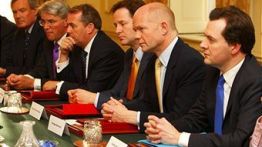
Need a bestiary to tell the hawks from the doves? Then this article (£) in the Times should serve your purpose. It's an account of Tuesday's Cabinet meeting on Libya, and the differences of opinion that transpired. Michael Gove, we are told, was "messianic" in his call for a tougher stance against Gaddafi. William Hague, for his part, was considerably more cautious. A graphic alongside the article puts George Osborne, Liam Fox and Andrew Mitchell in the Gove camp, and Nick Clegg and Danny Alexander with Hague. David Cameron, chairman of this diverse board, is said to be "caught in the middle". The government has since denied that the Cabinet is split.

Labour shuns aid choices

From our UK edition

Government is about choices. In opposition you can like anything, support any measure, back any proposal. But when in office you either make choices or invite dismissal. So when International Development Secretary Andrew Mitchell looked at Britain's development spending he was determined to make choices. Now that he has, some people don't like it. Not one bit. They like choices in general, much as they accept a theoretical form of cuts; but they recoil from real ones. Former Europe Minister Denis MacShane is one of the choice-avoiders. Writing in the New Statesman, he rails about cutting funds to the International Labour Organisation, seeing a Tory plot to undermine trade unionism.

Lessons from wars gone by

From our UK edition

As the situation deteriorates in Libya and the international community begins to look at various options, including military ones, policymakers would do well to remember a number of key lessons from the last 15 years of warfare. Like all history, they don't provide a guide to the future, but can be a warning nonetheless. The Bosnian experience of the mid '90s contains four key lessons. The first is that international handwringing costs lives. Many lives. (The same lesson emerges from the post-Gulf War I slaughter of the Kurds and Shia by Saddam Hussein). Wait, and the situation usually gets worse not better. The second lesson is that however great the humanitarian need may be, any military mission must not be framed as a humanitarian one.

Revolting Students Are Not Actually Freedom Fighters

From our UK edition

I think that nice Laurie Penny over at the New Statesman must actually be a conservative mole dedicated to undermining leftism from within. How else to explain this sort of stuff: The difference between Tahrir Square and Parliament Square is one of scale, but not of substance. Across the world, ordinary people are being denied a voice, shut out of work and education, having their dignity trashed. While armchair liberals express sympathy with protesters in the Middle East, workers and students in Britain have begun to express something far more powerful: solidarity. Solidarity, the watchword of this movement, hashtagged and chanted across the world, is not about pretending that there's no difference between a flashmob in London and a riot in Tripoli.

Blame Twitter for the increased oil prices

From our UK edition

The BBC are reporting that unleaded petrol has now reached 130p per litre and are blaming Libya. I¹m not convinced. Libya only accounts for about 2.3 percent of global oil production and even now the Arabian Gulf Oil Co¹s production in east Libya is around a third of normal levels. The real cause of the current price increase seems to be Twitter and Facebook. The social networking sites are allowing protestors to organise uprisings with a sophistication and speed which have taken analysts completely by surprise. Increased oil prices are the market¹s response to all this uncertainty and the possibility of this revolutionary fervour spreading. It's not unreasonable: after all, four of the top ten oil producing countries in the world are in the Middle East.

Dave ‘n’ Ed’s Flying Circus

From our UK edition

It was Monty Python without the jokes. The focus of PMQs today veered surreally between crisis in north Africa and early swimming pool closures in Leeds. The session opened in Security Council mode with Ed Miliband politely asking the PM to brief us on the humanitarian disaster evolving in Libya’s border-zone. Cameron went into his statesman-of-the-year routine and announced that HMS York had docked in Benghazi with medical supplies.   At such moments the imperial ghosts of the Commons seem momentarily reawakened. Ed Miliband sounds like some Victorian stooge asking the Foreign Secretary to reassure the nation that an uprising in a far-flung oriental possession is being energetically suppressed. Having dealt with Libya, Ed Miliband moved to Bromley.

The domestic politics of oil

From our UK edition

Developments in Libya continue to dominate the news, and rightly so. The view from Whitehall is that this stands off will continue for some time. There is even talk that we might be heading to a situation where Gaddafi holds onto Tripoli for months while the rest of the country is liberated from his rule. The longer this instability continues in the Middle East, the higher the price of oil is going to go. This will have two immediate domestic political consequences. First, the price of petrol at the pump will increase—making fuel duty an even bigger political issue. Second, higher oil prices will depress economic growth. Word is that the Saudis are prepared to pump more to keep prices down if necessary.

Toppling Mad Dog

From our UK edition

Should Gaddafi be pushed? That is the question diplomats and policy makers are beginning to ask. The UN has imposed travel restrictions and frozen Gaddafi’s assets. But Gaddafi is resisting the hangman’s noose; the loss of his Mayfair property empire is the merest of inconveniences. And still he fights on. There is now a growing humanitarian case for direct military intervention by Western powers. However, there are plenty of arguments against even introducing a no-fly zone. Gideon Rachman makes some of them in today’s FT: ‘A few of the problems are practical. Some military observers say that a no-fly zone would be of limited use in Libya, since Col Gaddafi seems to be mainly relying on ground forces.

British foreign policy needs to promote democracy

From our UK edition

After a week of hesitation and well-publicised problems evacuating British citizens from Libya, the government has led the international community's response to the crisis. The decision to move HMS Cumberland into position was astute, as was the authorisation to rescue the people stranded in the dessert. At the UN, British diplomats have been drafting most of the key resolutions and now David Cameron has out-hawked everyone by saying he'd be willing to contemplate a no-fly zone. US lawmakers have asked the Obama administration why they have not been as swift as the UK. As a Bosnian-born friend of mine said last night: "If only David Cameron and William Hague were around in 1992, so many of my friends would have been alive today!

Iranian regime moves against opposition leaders

From our UK edition

There are two significant developments in the Middle East to reflect on tonight. The New York Times is reporting that two Libyan air force jets conducted bombing raids on Monday. These raids appear to have been relatively ineffective. But they do suggest that there are still pilots prepared to carry out the regime’s orders, something that makes the issue of a no fly zone pertinent. But, perhaps, more important is that ground-level counter attacks by pro-Gaddafi forces have been repelled with relative ease by the rebels. Second, the Iranian government have, according to the BBC, removed Mir Hossein Mousavi, the ‘defeated’ 2009 presidential candidate, and Mehdi Karroub, the reformist politician, from their homes.

Cameron: military action not out of the question in Libya

From our UK edition

The government’s game of catch-up on Libya continues apace. David Cameron came to the Commons to update the House on the current situation. His main message was now that we have the vast majority of our citizens out, we can have a policy. Indeed, the government is today openly admitting that it was hamstrung last week by the continuing presence of a large number of British nationals in Tripoli. Cameron told the House that ‘we do not in any way rule out the use of military assets’; a dramatic shift from the tone of his entourage on last week’s trip. At the moment, the main military option on the table seems to be a no-fly zone and Cameron said he had asked the MoD and the chief of the defence staff to examine how this could be done.

The charge that the coalition should fear

From our UK edition

The greatest political, as opposed to strategic, threat to the coalition from the Libya evacuation crisis was that it would give the government a reputation for incompetence. As I say in the Mail on Sunday, Labour are looking to pin the incompetence charge to the coalition at every possible opportunity. The Miliband team knows that if the coalition comes to be seen as incompetent, then it is done for. Once a government comes to be seen as incompetent, then it is almost impossible for it to gain support for any of its proposals as even those who agree with the ideas don’t trust the government to implement them. Equally, any good news is seen to be fortuitous and not a consequence of the policies that the government has pursued.

Keep calm and carry on

From our UK edition

The Libya crisis looked like it would prove the critics of the government's Strategic Defence and Security Review right. Was it not the case that the HMS Cumberland, now seen as crucial for the evacuation of British nationals, would soon be decommissioned. And would the Harriers not prove useful in a potential intervention? Coupled with criticism that the government struggled to handle the evacuation of British nationals, it looked like the makings of a credibility-destroying theme: strategic misjudgement and tactical incompetence. But a week into the crisis, the government's handling of the evacuation – and response to the Libyan crisis overall – looks increasingly surefooted.

Corporatism is not an adequate foreign policy

From our UK edition

The events of the last two weeks have demonstrated that David Cameron needs a revamped foreign policy. This is not, in itself, a surprise. Foreign policies sketched out in opposition seldom survive contact with reality. Remember Bush saying he did “not do nation-building”? And who can forget the ignominious fate of Robin Cook’s “ethical foreign policy”? David Cameron sought to distinguish himself from the adventuring, idealistic Blair with what he regarded as a ‘pragmatic’ foreign policy – that is, promoting British exporters.

What difference will sanctions make?

From our UK edition

Slowly, haltingly, the West decides what to do about Gaddafi. The latest news is that, having broken his silence over Libya a few days ago, Barack Obama is now imposing sanctions against its despicable regime: freezing assets, blocking transactions, that sort of thing. It follows a package of sanctions, including an arms embargo, that Britain and France have proposed to the UN. Although these sanctions are better than nothing – the West shouldn't house Gaddafi's slush funds, nor transfer weapons in his direction – they are of limited actual worth. Yesterday, the Mad Dog was parading the parapets once again, promising death for the protestors. You suspect he is unlikely to be put off by restrictions to his and his country's finances.

The case for retaining Harrier in Afghanistan

From our UK edition

Lord Owen, among others, has responded to Colonel Gaddafi’s bloodcurdling lunacy by insisting that a no-fly zone be imposed over Libya. But, as Con Coughlin has suggested, it is unlikely that Britain could support such an operation without a fixed-wing attached to an aircraft carrier. The debate about the Strategic Defence Review and Britain’s military capability has reopened. The SDSR put Afghanistan first. As armed Forces Minister Nick Harvey explained in a recent speech to RUSI: ‘Throughout the next few years, the mission in Afghanistan remains our main effort. Having made this commitment in the SDSR, this shaped many of our other decisions: the proposed changes to the Army, for example; and the preference for Tornado over Harrier.