Libya

French planes take to the skies as Sarko talks tough

From our UK edition

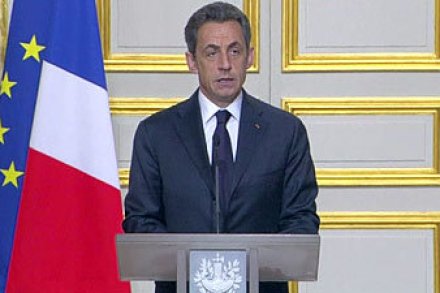
And so it starts. French News Channel BFM reports that French fighter jets are airborne over Libyan skies; al Jazeera corroborates the report, adding that these are reconnaissance missions. By the sounds of things, French military sources are briefing international agencies, adding to the sense that the domestically troubled President Sarkozy wants to capitalise on his sudden international prominence. Sarkozy has just been speaking outside the summit meeting in Paris, which he hosted as Chairman of the G20 and G8. His words were stern: "In Libya, a civilian population which is passive which requires nothing further than the right to choose itself its destiny finds itself in danger of life. We have a duty to respond to its angst-ridden call.
The winners and losers

From our UK edition

In English we have an odd expression: “to have a good war”. The phrase was originally used to describe someone who was decorated or otherwise distinguished themselves, usually during WW II. Allan Massie, for example, wrote that author William Golding “had a good war, first as an ordinary seaman, then as an officer in command of a Landing Craft Tank (Rocket) on D-Day”. Today, newspapers and blogs have been quick to use the phrase for politicians. So David Cameron and Nicolas Sarkozy are said to have had a “good war” over Libya, so far at least, with Barack Obama faring differently. Organisations also have good and bad wars - with their experience either confirming their stature or predicting their demise.

Regime Change is the Issue in Libya. Why Doesn’t Obama Understand That?

From our UK edition

Further to this item noting the differences between what David Cameron and Barack Obama are saying, a White House spokesman emails Ben Smith to say there's no contradiction between the American insistence that this is not about regime change and Cameron's suspicion that it's hard to see how Gaddafi can remain in power: This is very easily explained. We still believe that Qaddafi has lost his legitimacy to lead and must go. However the goal of this resolution is not regime change. Rather it authorizes the use of force with an explicit commitment to pursue all necessary measures to stop the killing. Those two things aren’t contradictory. Fine, the resolution may not authorise regime change but the logic of the policy surely insists upon it?

Allies’ statement on Libya demands more of Gaddafi than just a cease-fire

From our UK edition

A statement has just been issued by the sponsors of last night’s Security Council resolution, it reads: “Resolution 1973 lays out very clear conditions that must be met. The UK, US, France and Arab States agree that a cease fire must be implemented immediately. That means all attacks against civilians must stop. Gaddafi must stop his troops from advancing on Benghazi, pull back his troops from Ajdabiyah, Misratah, and Zawiyah, and re-establish water, electricity and gas supplies to all areas. Humanitarian assistance must be allowed to reach the people of Libya. These terms are not negotiable. If Gaddafi does not comply with the Resolution, the international community will impose consequences, and this Resolution will be enforced through military action.

Does Sarko deserve more credit than Cameron?

From our UK edition

Just as the British press is venerating David Cameron in the aftermath of last night’s UN resolution, so too the French press is praising President Sarkozy. In fact, the whole administration is basking in his reflected glory. Le Figaro describes Sarkozy’s and Prime Minister François Fillon’s roles in obtaining the UN Resolution and preparing the French military for action; the Defence minister also receives a hearty appraisal. Even the Presidency’s determined adversaries have expressed more than grudging respect. The left-wing newspaper Libération applauds Foreign Minister (and grand old man of Gaullism) Alain Juppé’s success in bringing the fractious United Nations to resolution.

Cameron vs Obama. They can’t both be right about Regime Change.

From our UK edition

This afternoon in Washington, Barack Obama was at pains to stress the limited nature of the planned action against Colonel Gaddafi. To wit: "We are not going to use force to go beyond a well-defined goal, specifically the protection of civilians in Libya," On the other side of the Atlantic, answering questions in the House of Commons, David Cameron said: The aim is clear: to put in place what has been required by the UN Security Council, which is a cessation of hostilities. It is the protection of lives and the protection of people. It is the prevention of a bloodbath in Benghazi. It is to make sure that arms do not get to Libya, that assets are frozen and that travel bans are imposed. It is all those things. Those are the aims, and they are what we must now pursue.

The way to cease fire

From our UK edition

Colonel Ghadaffi wants a cease fire. Fine, but Western governments should insist that the no-fly zone still comes into force; that a new UN resolution is drafted to specify cantoment areas for his forces; and that a UN-mandated Arab Leage but NATO-enabled interpositional force is deployed to ensure the ceasefire holds, perhaps with an Egyptian officer as the head working in tandem with the UN and EU envoys to kickstart a political process. Finally, the West should lend massive support to the "free republic" of Benghazi - economic, military and so on. That is the kind of ceasefire the West can accept. Not a ploy that aims to pick the weakest link of the coalition, the United States, away from the policy, but robust action that sees David Cameron's strategy through to the end.

In Defence of Germany

From our UK edition

Among the many odd things about the Libyan "debate" is the argument that Germany's decision to abstain during the Security Council vote is somehow disgraceful and proof that Germany still isn't ready to play its part on the international stage. (Obviously some of these objections come from the kind of rightists who fear or dislike German influence in other, more peaceful, areas of international politics and business. But never mind.) But Germany's vote seems qualitatively different from the BRIC-blog of abstentions. Brazil, India, China and Russia each have reasons to be wary of this kind of resolution and, indeed, this kind of precedent. Deep down, I suspect some of them would have liked to vote against the resolution.

Libya declares a ceasefire

From our UK edition

What to make of Libya’s declaration of a ceasefire and acceptance of the UN resolution Seen most cynically, it could just be seen as the Gaddafi regime playing for time, using the extra hours to make it more difficult in both military and political terms for action to be taken. Or, it could indicate a division within the regime, with more pragmatic elements trying to temper Gaddafi’s threats and avoid anything that brings the situation to a head.

Cameron’s sombre statement

From our UK edition

David Cameron was calm, measured and far from messianic as he delivered his statement to the House on the coming action against Libya. He was keen to stress that last night’s resolution ‘excludes an occupation force of any part of Libyan territory.’ However, he did, in answer to a question from James Arbuthnot, agree that regime change was likely to be necessary to achieve the aims of the resolution.   Cameron said there would be a statement later today from international leaders and it seems that this will be an ultimatum to Gaddafi. If military action does follow, Cameron said that he had ‘some guarantees’ from Arab leaders that they would play an active role in the operation.

Learning from recent history

From our UK edition

With a UN resolution now passed, Prime Minister David Cameron has displayed diplomatic skills his critics believed he did not possess. As NATO is planning to enforce an expansive no-fly zone over Libya, it is worth pausing for a moment to consider such a mission's aims and to learn the lessons from recent wars. The strategic aim of the mission cannot only be to protect Libyan civilians. Framed in this way, the international community will face the same problems it did Bosnia: for instance, the Srebrenica massacre happened while a no-fly zone was already in place. A no-fly zone will not force Colonel Ghadaffi from power.

A Leap into the Libyan Unknown

From our UK edition

So we're going to war again. This may be David Cameron's first conflict but it's the seventh time in just 21 years that a British Prime Minister has committed Her Majesty's forces to military action. Are we doing the right thing? I don't know and I'm mildly suspicious of those who seem too certain about anything Libyan right now, rehardless of which side of the argument their certainties lie. Now that it is beginning, however, let it at least be done properly and let us hope that, somehow or other, Gaddafi capitulates. But if he does not do not be fooled into thinking that this will be over soon. Like it or not we are now in it for the long-haul. The history of UN-mandated missions does not support the notion that this will be a quick or easy campaign.

Cameron’s persistent leadership on Libya was key to tonight’s resolution

From our UK edition

David Cameron deserves huge credit for tonight’s Security Council vote. He has kept plugging away for a no fly zone and has succeeded in moving the Obama administration’s position. Cameron’s decision to have Britain table with the French and the Lebanese a Security Council resolution without the support of the Americans or even having talked to the president was a bold move that has turned out to be a game changer. The Prime Minister has proved himself an effective and courageous actor on the world stage. The question now is how quickly and effectively military force can be deployed and how Gaddafi is to be ousted. It, obviously, would have been better if the no fly zone had been imposed when the rebels had the military momentum.

The UN decides to take “all necessary measures” against Gaddafi

From our UK edition

"There will be no mercy. Our troops will be coming to Benghazi tonight." Perhaps it was the murderous threat contained within Gaddafi's latest radio message that shocked the United Nations into action today — because shocked into action they have been. After sweating and toiling over the precise formulation of a resolution on Libya, the UN Security Council finally reached the voting stage this evening. And it has now voted 10-0 in favour of member states taking "all necessary measures … to protect civilian and populated areas, including Benghazi, while excluding an occupation force." Brazil, India, China, Russia and — staggeringly — Germany all abstained. What this means, in practice, is a no-fly zone — and more.

If we don’t help the Libyan rebels, then the extremists might

From our UK edition

The West's indifference towards Libya may create the very conditions for extremism that we normally seek to avoid. In today's Times, the war correspondent Anthony Loyd writes (£) from Benghazi about the dangers of an extremist backlash as the pro-democracy forces become disillusioned with the West: "The growing suspicion and anger towards the West offers an unsettling glimpse of the direction that the country's revolution may take." This has several potential implications inside and outside Libya.

Zelikow’s case for a no-drive zone

From our UK edition

Philip Zelikow, who served on the 9/11 Commission and in both Bush administrations, has a persuasive piece in today’s FT arguing that a no drive zone on the highway from Tripoli to eastern Libya could be as effective as a no fly zone and easier to implement. He says that it could be enforced from off-shore with the use of precision weapons. Legally, there would be issue with this scheme—as there would be with any intervention in Libya that is not based on a full Security Council resolution  under chapter 7. But there simply will not be enough time now to get full UN authorization before Gaddafi has reasserted full control. The Obama administration, though, seems content to let the clock run down.

An alternative PMQs

From our UK edition

With Libya in metaphorical meltdown and with Japan close to the real thing, it was remarkable how little foreign affairs impinged on PMQs today. Ed Miliband led on the NHS and facetiously asked if Cameron planned any amendments to his health bill following the LibDem spring conference. Cameron replied by accusing Labour of wasting £250m on phantom operations. Would he apologise for this scandalous blunder? Miliband, unsurprisingly, declined even to acknowledge the invitation. The session developed on these familiar, solipsistic lines. Keen to harry the PM on bureaucracy Miliband stumbled on a Cameron quote decrying ‘pointless topdown re-organisations’ of the NHS. He pulled it up by the roots, shook off the mud and flourished it in Cameron’s face.

The Limits of British Influence

From our UK edition

To be fair to Gary Gibbon, he's not the only member of the lobby to have lost the plot when it comes to David Cameron, Libya and Washington. Ben Brogan has a sadly-fatuous piece today asking "Does Anyone in Washington Listen to David Cameron?" He writes: Robert Gates was far from flattering when he dismissed the PM’s initial no-fly suggestion as ‘loose talk’. The Coalition made a virtue of putting the US-UK relationship on a more low-key footing. There was to be none of the cosyness of Blair-Bush or the neediness of Brown-Obama. But Britain’s post-war strategic interest relied in part on its position as the one ally with the clout to influence the White House. At some point Mr Cameron will have to explain if that has changed.

UN Security Council Resolution proposing a no fly zone over Libya is tabled

From our UK edition

Britain, France and Lebanon’s decision to table a UN Security Council resolution proposing a no fly zone and a bar on flights in and out of Gaddafi’s Libya is an honourable effort to push the international community to move before the window for action closes entirely. Yet as the French Foreign Minister Alain Juppe acknowledged yesterday,  "If we had used military force last week to neutralize some airstrips and the several dozen planes that they have, perhaps the reversal taking place to the detriment of the opposition wouldn't have happened," Juppe told Europe-1 radio. "But that's the past." "What is happening today shows us that we may have let slip by a chance," he added.