Libya

Libya diary: Tobruk

From our UK edition

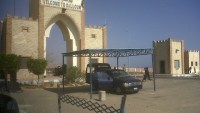
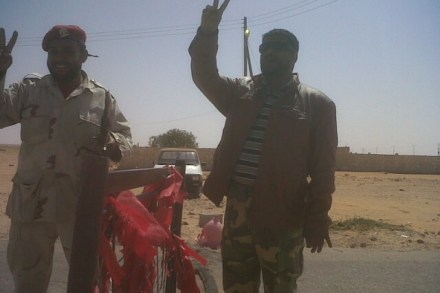
Twelve different checks later and I'm in Free Libya, hurling down the road to Tobruk at 100 mph, with Arabic music blasting away. This place is firmly held rebel territory and most journalists have moved towards the battlefields further west. A pair of beautiful American relief workers tell me just to keep going "to see real action". They've just from Benghazi and are headed back to Egypt. They grab my driver. Tobruk, though, has plenty of action for me; and I need to get back to my programme in Cairo. After all, I'm a think-tanker, not a war correspondent. I stop by the oil refinery which is beginning to run again, as is the pipeline. Next week exports will begin.
Another Libyan question

From our UK edition

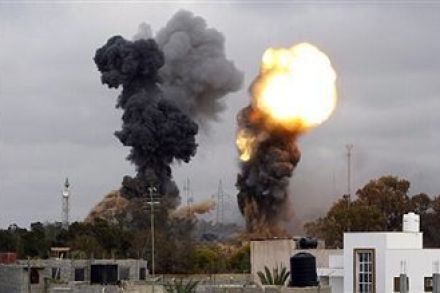
Far from quiet on Libya's shifting battlefront. The latest reports are that the rebel advance has stalled, and is now moving backwards in the face of Gaddafi's overwhelming firepower. Yet as disheartening as this development may be, it is hardly unexpected: America's General Ham all but described it as an inevitability only a couple of days ago. And so the rebels' representatives have now made an equally inevitable demand of the politicians congregating in London: arm us, and we can make progress once again. In which case, there's another question for the pile: to arm, or not to arm? And it is not clear-cut, either way.

Cairo Diary: Libyan transit

From our UK edition

The road from Cairo to Salloum, Egypt's Wild West town on the border with Libya, stretches out into the desert until the patched-up, grey and black cement blurs into the yellow dunes. Throughout the journey, well-kept electricity pylons line the road, while the occasional shepherd looks out from a desolate shed-like house. Otherwise there is nothing to see.  This is the road to war, or away from it. I expected to see more people fleeing the conflict; but at the last roadside café, life seems to be following its normal routine. Bedouin waiters mingle quietly with smugglers, relief workers and the occasional journalist. In the background, President Obama's speech is on TV but only one person is watching. Fava beans with fried liver is the best choice for breakfast.

What to do with Gaddafi?

From our UK edition

The charge sheet against Colonel Gaddafi in any trial would be a long one. There are his crimes against his own people, his support of terrorism overseas and his wars in Chad. But, however morally right it would be to make Gaddafi face justice, the door should be left open to him to go into exile. Gaddafi and his family leaving Libya would make possible an end to this conflict and prevent huge bloodshed as Gaddafi attempts to cling on to power street by street. The unpleasant truth is that if dictators are left only with the choice between fighting to the bitter end and a trial in the Hague, they will pick the former option as they have little to lose.     This war in Libya can only be ended by Gaddafi’s departure from power.

Obama sketches out the limits to American involvement in Libya

From our UK edition

There was one aspect of Barack Obama's Big Speech on Libya last night that was particularly curious: for a President who is trying to downplay American involvement in this conflict, he sure went in for good bit of self-aggrandisement. The amount of references to his and his government's "leadership" — as in, "At my direction, America led an effort with our allies at the United Nations Security Council to pass an historic Resolution" — was really quite striking, at least to these ears. I suppose it's all about mollifying those voices who argue that the US Pres hasn't done enough, quickly enough. But it's hardly going to endear him to some of his more proactive partners in this fight.

Cameron’s Libyan double standard

From our UK edition

After the Libyan blood money scandal at the LSE, inquiries were bound to be made about other universities. Robert Halfon, the Conservative MP for Harlow, has exposed how Liverpool John Moores University (LJMU) agreed to contracts with Gaddafi’s Libya worth at least £1,272,000.00. (He has since been threatened with a defamation suit for pointing this out, but that’s for another time.) He raised the issue in parliament and the Prime Minister replied: ‘I think that there are lessons to be learned. As I have said, I think that it was right (of the previous government) to respond to what Libya did in terms of weapons of mass destruction, but I do not think that the way in which that response was handled was right.

Cairo Diary: will Egypt help in Libya?

From our UK edition

Nothing would help the international campaign against Colonel Gaddafi as much as the Egyptian military — and therefore Egypt — swinging in behind the UN-authorised effort. It would be one of the few things that would make the Libyan dictator worry and could push fence-sitting loyalists towards the rebel cause. Materially, it could also be important; with the Libyan resistance reluctant to receive Nato help, Egypt could be very helpful as a conduit for weapons, intelligence and even on-the-ground military support. A post-combat mission would also be greatly aided by Egyptian involvement or leadership.

The rebels press on in Libya, but questions remain

From our UK edition

As Nato takes full military responsibility in Libya, the rebels surge onwards in the direction of Tripoli. According to one of the group's spokesmen, Gaddafi's hometown of Sirte — some 280 miles east of the capital — fell to their attacks last night; although there are reports, still, of explosions there this morning. In any case, the tidal shift that took hold at the beginning of the weekend is continuing. The rebels are now seizing ground, rather than ceding it. All this is, if not vindication for the Western leaders who pressed for a no-fly zone, then at least encouragement. It suggests that the one-two combination of Nato air support and rebel ground attacks can leave Gaddafi reeling.

Cairo Diary: curfew

From our UK edition

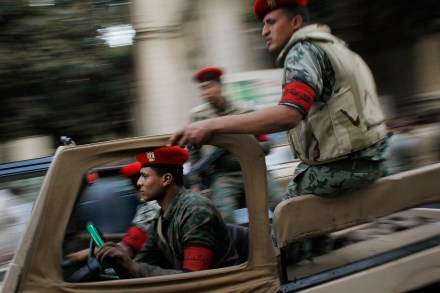
Driving through post-revolution Cairo at night is eerie. The normally busy streets are deserted, most of the city's  squares and roads are blocked by military checkpoints, and dark clad figures slip in and out of the shadows. Breaking the curfew may result in a six month sentence, or worse. Come dawn, however, the city springs to life, looking like it has done for millennia — busy, noisy, lively. This tale of two cities — one cowered, quiet and run by the military, and another that is lively, chaotic and civilian — is perhaps a tale not only of Cairo, but of Egypt in the midst of an ongoing transition. For though Hosni Mubarak has gone, the military underpinnings of his 30-odd year regime are more powerful than ever before.

The government should acknowledge Israeli restraint

From our UK edition

With NATO planes circling above Libya, Saudi troops quashing protests in Bahrain, and troops killing civilians in Syria and Yemen, there has been little attention paid to Israel. But Israel has recently been the victim of a series of violent attacks. More than 30 people were injured in a bombing in Jerusalem, and Islamic Jihad's military wing, the Al-Quds Brigade, has fired mortars and rockets into Israel for days on end. The attacks suggest that Hamas is, once again, struggling to rein in other terrorist groups like Islamic Jihad. Some IDF commanders fear a descent into chaos in Gaza. In the face of the onslaught, however, the Israeli government has shown amazing restraint.

The Libyan resistance is on the front foot

From our UK edition

The fight between Colonel Gaddafi's forces and the resistance to his rule will clearly take some time, but the rebels have had a good 24 hours.  In Brega, Gaddafi's forces deserted in large numbers, handing 10 vehicles over to rebels. A loyalist brigadier was killed and in Ajdabiya government forces withdrew overnight, while rebels also made progress in Zintan.   The RAF made a key a contribution: its aggressive supported the rebels holding out in Misrata, taking out a number of APCs and a loyalist tank.  Best of all, however, is the news that a Brazilian plastic surgeon has told Gulf News how he took fat out of Colonel Gaddafi's bottom in 1995 to smooth wrinkles in his face, and gave him hair plugs.

The joy of diversion

From our UK edition

“We should have more history on the programme,” said Evan Davis at the end of yesterday’s episode of R4’s Today. “I learned a lot from that.” He had just been interviewing Peter Jones (listen here) about a piece in this week’s Spectator about the two Libyas — a split which may emerge as a result of the fly zone. Tripoli and Benghazi were originally part of two different worlds: Roman and Greek. For these coastal towns, north-south sea routes were more important than east-west road routes (which 500 miles of desert made pretty much impossible). Just as the Kurds managed independence in the north of Iraq after the 1992 No Fly Zone, so the ancient Cyrenaica may re-emerge now. Peter explains all this beautifully in this week’s magazine.

From the archive: the consequences of Nato bombing Kosovo

From our UK edition

There are two reasons to return to the Kosovo Conflict for this week's hit from the archives. First, of course, the surface parallels with Libya: Nato involvement, bombing raids, all that. Second, that yesterday was the 12th anniversary of Nato's first operation in Kosovo. Here's Bruce Anderson's take from the time: Milosevic has Kosovo, Nato has no idea, Bruce Anderson, The Spectator, 3 April 1999 There is a precedent for Kosovan conflict: Suez. Then, as now, our indignation was inflamed by misleading historical analogies; Milosevic is not Hitler, any more than Nasser was. Then, as now, we were afflicted by geopolitical tunnel vision, and lost all contact with the wider strategic realities.

A Half-Cocked Operation in Pursuit of Half-Formed Goals. What Could Possibly Go Wrong?

From our UK edition

So NATO will now "lead" the Libyan intervention. That makes everything fine and dandy, right? Well, no. There's no need for anyone unpersuaded by the wisdom of this operation to make a case against it. Not when its supporters do such a good job pointing out its shortcomings. Take my friend Brother Korski, for instance. Yesterday he wrote: The Libya intervention goes on, with as many question marks hanging over the operation as airplanes in the sky. What is the aim? Who will run it? Can the United States, Britain and France keep allies such as Turkey on board? Good questions! There's more too: Realistically, the UK should in the first instance work towards establishing a stalemate between loyalists and rebels.

Libya has shown the government the virtue of a multilateral approach

From our UK edition

The Libya intervention has already turned the international kaleidoscope, showing new and remarkable patterns. It has seen China acquiesce to a no-fly zone, and the West in alliance with the Arab League. Nobody thought that was likely 6 months ago. It has also changed reputations. Nicolas Sarkozy may win re-election on the back of the war. William Hague, who had a bad revolution, is having a good war.   The government has become more multilateralist, as opposed to the kind of bilateralism it espoused when it took office. Nearly a year ago, it sent a clear message to the FCO — bilateral ties would matter, multilateral ties less so.

Now the questions are Nato’s to answer

From our UK edition

Now, at least, we know: Nato will be taking charge of the no-fly zone that has been erected around Libya. And we might even welcome the news. As soon as the Americans made it clear that this was not their conflict to command, a new leadership arrangement was always going to be required — and Nato were the obvious choice. The only real barriers to their assumption of power have been French enthusiasm and Turkish reluctance, but they now appear to have been reconciled. In so far as this has clarified the next steps in Libya, it is a good thing. But confusion remains, and in wholesale quantities.

Agreement in principle reached for Nato to take command of operations over Libya 

From our UK edition

I understand that agreement in principle has now been reached to pass command of the Libya operation to Nato. The United States has been keen to relinquish control for days now--the Obama administration has no desire for Libya to turn into another American responsibility--but agreement within Nato about the alliance taking over command of the mission could not be reached. This has led to an embarrassing situation where no one appears to want to actually be in charge of the operation. The blockage, up to now, to transferring control to Nato has been Turkey. Ankara is not keen on the whole intervention and is furious about not having been invited by Nicolas Sarkozy to the summit in Paris last weekend.

Libya: next steps

From our UK edition

The Libya intervention goes on, with as many question marks hanging over the operation as airplanes in the sky. What is the aim? Who will run it? Can the United States, Britain and France keep allies such as Turkey on board? Behind the scenes, officials are said to be looking at various options, including if and how to support the rebels. But the hand-wringing is now even audible across St James Park. Realistically, the UK should in the first instance work towards establishing a stalemate between loyalists and rebels. From such a stalemate a political process can then begin, which, though it may take many years and continue during the fighting, can help create the foundations for a new Libya.

Libya operation will take months not weeks

From our UK edition

With the Budget over, attention is beginning to shift back to the situation in Libya. A government source tells me that they expect the mission in Libya now to run for months not weeks. The challenge is that while the allies can stop Gaddafi’s forces from advancing from the sky, they can’t make the poorly organised and poorly armed rebels advance. There’s also an arms embargo in place on the whole of Libya and while some small arms are moving across the border with Egypt into the rebel-held east, the Gaddafi regime still remains far-better armed. This conflict could be over very quickly if those inside the regime turn against Gaddafi. But if they do not, this could go on for far longer than most people expect.