Labour party

Graph of the day

From our UK edition

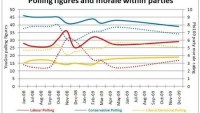
Here's a neat little graph from PoliticsHome, which plots the three main parties' opinion poll ratings alongside their "party morale rating" from the PHI100 tracker.  As PolHome put it, it kind of tells us what we know already: that party morale more or less correlates with poll position.

Etonians and Bolsheviks

From our UK edition

A terrific PMQs today. This exchange had it all. Noise, laughter, rhetoric, anger, humiliation, jokes, and dramatic swings in the balance of advantage. We even had a sighting of that great Westminster rarity – a fact.  Cameron’s first question elicited simple information. Would our troops start returning from Afghanistan in 2010 or 2011? Brown didn’t quite answer it but said that by 2011 the combined forces, including Afghans, would number 300,000, by which point the military burden ‘will start to change’. Cameron clarified. ‘That sounds more like 2011.’ Brown didn’t demur.   Turning to the economy Cameron asked why Britain is the last G20 country to come out of recession.Brown: We aren’t. What about Spain?

The case for NHS reform

From our UK edition

Britain remains the sick man of Europe. Professor Sir Mike Richards’s report finds that although progress has been made on cancer treatments, diagnosis rates, and therefore the chances of survival, lag behind European standards. A deluge of statistical analysis supports Richards's findings. The European Journal of Cancer’s recent research into solid cancers, such as breast cancer and melanoma, demonstrated that the speed of diagnosis and survival rates in the UK were “20% below” the European average. Additionally, the table below, which is taken from 2009’s OECD health data, illustrates that the gap between the number of cancer deaths per 100,000 population in Europe and the UK has widened.

Burnham enters the fray

From our UK edition

Oh dear.  The Labour leadership speculation is back in full effect, thanks to Paul Waugh's scoop in the Standard.  According to Paul, Andy Burnham is "prepared to throw his hat into the ring" to succeed Gordon Brown, should it all go wrong for Labour in the next election.  Apparently, he's even lined up Tessa Jowell as his campaign manager – although, naturally, the Health Minister is downplaying the claims. One thing's for sure: this story is badly timed for Labour – with their recent progress in the polls – and Brown could well do without another bout of leadership wrangling to undermine his premiership.  But what about Burnham – has he got what he takes to become Labour leader?

The good and/or bad news for the Tories is that there hasn’t been a Brown Bounce

From our UK edition

If you're still scratching your head over the latest opinion polls, then I'd recommend you read Anthony Wells' latest post over at UK Polling report.  In it, he outlines four potential reasons for the diminishing gap between the Tories and Labour: Cameron's "reverse" over the Lisbon Treaty; increased economic optimism; Labour performing better; and the absence of positive feeling towards the Tories.  To my mind, it's probably a case of "all of the above," to varying degrees – but, as Anthony concludes, "we can't tell for sure." One further point that's worth making is that the reduced gap between the parties isn't due to a "Brown bounce".

Why are the Tories so Miserable?

From our UK edition

My excellent chum Iain Martin observes that seven of the ten most recent polls have put the Tories below the "magic figure" of 40% support. The latest ComRes survey has them on 37%. Perhaps, he wonders, some of the core vote has been scunnered by the Lisbon Treaty shenanigans or perhaps some floating voters are concerned by a perceived Tory zeal for cutting public spending and, hence, they feel, services. A bit of both, I'd hazard. But, as I've argued before, there's something more than just these elements. Frankly, if you were to take Tory rhetoric at face value the only sensible course, for those with the means to take it, would be emigration. In a variation of Tony Blair's "masochism strategy" David Cameron seems intent upon following a "misery strategy".

Labour’s free for all

From our UK edition

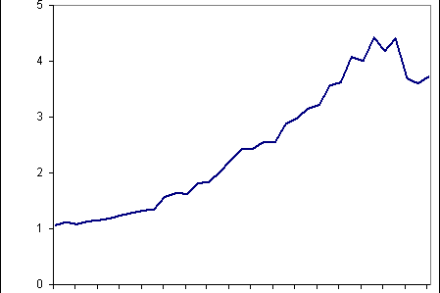
The potentially huge exposure of UK banks in Dubai, depreciating some UK bank share prices again this morning, is a reminder of just how much UK bank lending grew in recent years. The above chart shows the growth in external claims of the UK owned banks around the world over the past decade. The sums lent almost quadrupled to nearly $4 trillion in 8 years.  Anyone interested in discovering which bubbles the UK banks (and now taxpayers) have funded can find the data on the Bank of England website - $1.2 trillion in the United States, $125 billion in Spain, $183 billion in Ireland, $50 billion to the UAE/Dubai. Bank profits soared, and the “New North Sea Oil” of booming bonus pools was taxed to fund ever growing government spending.

PBR 2008 and PBR 2009: a difference which may not make much difference

From our UK edition

Yep, it's that time of the year again: the run-up to the Pre-Budget Report, when we hear tales of splits between Number 10 and the Treasury on how they should approach the fiscal mess we're in.  According to today's Sunday Telegraph, and going off rumblings on Whitehall, Darling is pushing for a more expansive package of cuts.  Whereas Brown – and Ed Balls, natch – would prefer to emphasise all that investment, investment, investment. In which case, I was tempted to just copy-and-paste a post I wrote last year, on a similar subject, and at almost exactly the same time in the political cycle.  Its point was that stories about tension between Brown and Darling could work to undermine Labour's overall economic message.  As it happens, that's still the case.

Tory government should be manoeuvrist government

From our UK edition

The greatest challenge facing a new government may be that Britain’s national security institutions are not fit for purpose. They were built for a different era and focused on a set of now obselete threats. Notwithstanding a few exceptions, like the Cuban Missile Crisis, the threats during the Cold War were slow-moving and predictable. Even in the immediate Cold War period, threats were nasty, but rarely novel.   Now, however, Britain faces all manner of fast-moving, asymmetric threats. Terrorists and insurgents can get inside our decision-making loop. In Helmand, the Taliban stage attacks around their media strategy, not the other way around as we do it. Countries like Russia and China can bring a range of assets to bear, many of which are not even governmental.

Dodgy doings in the desert

From our UK edition

Of all the lunacy engendered by this financial crisis, Dubai’s decision to call a six-month creditor standstill on its chief holding company is the most pronounced. Dubai’s successful but hideous entrepot model depends on the confidence capital markets, and as a rule markets don’t react to nasty shocks with a shake of the head and a song and dance routine. It’s as if plague has descended on every stock exchange in the world; investors are fleeing for safety. Overnight, shares in Asia collapsed between 3 and 5 percent, and the FTSE, Dax and Cac40 have opened around one percent down. Prepare for another black day. Will this blip develop into a crisis?

Johnson: the Tories aren’t the “nasty party” when it comes to immigration

From our UK edition

There are plenty of noteworthy snippets in Mehdi Hasan and James Macintyre's interview with Alan Johnson today, but it's this passage which jumped out at me: "Johnson even chooses to defend the Tories on immigration, saying they represent a 'mainstream, centre-right' party engaging in a 'decent, centre-ground debate on immigration'. This, despite the Tories having stuck to the 2005 pledge, under Michael Howard, for an immigration 'cap', which - along with campaign posters asking 'Are you thinking what we're thinking?' - led to accusations of 'dog-whistle' politics." It's a truism that in order to have a sensible debate, you've got to be willing to actually have a debate – so it's encouraging that Johnson is taking this more conciliatory approach to the question of immigration.

Broken Britain: The Reality

From our UK edition

I was hugely impressed by a long article by my former colleague Rob Yates, in this weekend's Observer magazine. Rob went back to his roots in Walton, Liverpool, one of the most deprived parts of the country on any indicator, to examine the reality of the "broken Britain" rhetoric of the Conservative Party. It was about as far from a liberal whinge as you can imagine, but Rob recognised that not everything New Labour has done to alleviate the lot of the worst off has been disastrous. In particular he points to the popularity of the Sure Start programme for mothers and young children and improvements to school buildings and municipal space in general.

Byrne draws a dividing line over decentralisation

From our UK edition

Good work by the Guardian, who have got their hands on leaked sections of a government report into downscaling Whitehall.  At first glance, it all looks kinda promising.  There are provisions to reduce the cost of senior civil servants, to cut the numbers of quangos, and to make it more difficult to establish new quangos.  Surely, these are measures which will be necessary to fix our broken public finances. But it's the headline idea which could give you cause for concern: namely, that the government "wants a review" into relocating around 200,000 civil servants and other public sector workers away from London and the South-East.  It's meant to strengthen localism and reduce costs - which is nice, if it works.

The man who hopes to unseat Harman

From our UK edition

The papers have been stuffed with articles recently about the current crop of Tory party candidates – but few have been as readable, or as encouraging, as Rachel Williams' profile of Andy Stranack in today's Guardian.  Stranack is the Tory PPC in Camberwell and Peckham – Harriet Harman's seat – and his background is really quite remarkable: "In 2001, Stranack ignored the concerns of his family ('They thought I was mad'), gave up his £30,000 a year council policy officer job in Croydon, south London, sold his maisonette, and moved to the borough's deprived Monks Hill estate. He stayed there, living on the poverty line and doing church-backed community work, for six years.

Saving the world | 25 November 2009

From our UK edition

Today’s revised GDP data confirms that the UK remained alone of the world’s major economies in recession in the third quarter of this year*. The fact that the UK remains mired in recession long after most economies have recovered makes clear how uniquely badly positioned the UK economy was to handle a downturn.  While some investment banks continue to argue that this performance reflects the inability of the Office of National Statistics to calculate the data correctly, there is good reason to believe that this huge underperformance is grounded in reality. Economic history teaches that bank crises are amongst the worst things that can ever hit an economy. The collapse in credit availability and soaring bank margins have posed very substantial risks to economic growth.

Missing the point | 25 November 2009

From our UK edition

The Today programme really let Paul Myners off the hook this morning. The interviewer obsessed with why the loans had remained secret for so long. It’s a fair question, and it seems bizarre that we only learn of them ten months after the borrowing was repaid in full. However, there are more important questions. As I wrote yesterday, these disclosure’s most potentially volatile revelation is that Gordon Brown was propping up HBOS whilst urging Lloyds to purchase the ailing giant. Was this issue examined in any depth? No, though it must be determined whether the Lloyds’ board understood HBOS’s predicament in its horrific entirety. The equally crucial question of how the government is addressing the banking system’s continued frailties received scant attention.

Yet another poll for the mix

From our UK edition

After the Ipsos MORI hullabaloo, it's tempting to treat the YouGov/Telegraph poll on Westminster voting intentions in Scotland with extreme caution.  But, for the record, here are the headline figures, and a hefty rise for Labour: Labour --- 39 percent (up 9 points from August) SNP --- 24 percent (down 2) Conservatives --- 18 percent (down 2) Lib Dems --- 12 percent (down 6) As this fits in with another recent poll, it's safe to say that Labour have solidified their support in Scotland during and after the Glasgow North by-election.  And there's more discouraging news for the SNP: at 29 percent, support for Scottish independence is hardly overwhelming – even if it's practically unchanged since the last poll on the issue.

Mandelson downplays Van Rompuy and Ashton – and bigs up the EU’s financial influence

From our UK edition

To my eyes, there's more than a little dose of mischief in Peter Mandelson's article for the FT today.  Discussing the recent EU jobs grab, he seems to suggest that the new economic and financial commissioners may have a more important role to play than either Herman Van Rompuy or Lady Ashton, the EU’s president and high representative, respectively: "Some commentators felt that the EU’s choices for its new president and high representative for foreign affairs lacked this kind of continental ambition. Herman Van Rompuy and Lady Ashton will no doubt aim to prove them wrong. But Europe’s dilemma is not just one of influence projection. Europe’s influence will inevitably be tied to its economic strength.

A poll taken at the same time as the Ipsos-Mori poll had the Tories 14 points ahead

From our UK edition

The Observer’s Ipsos-Mori poll has dominated political discussion since its publication on Sunday. But two things that I have heard tonight have increased my scepticism that it marks a dramatic shift in public opinion. First, I hear that another of the big pollsters had a survey in the field at the same time and it showed a fourteen point Tory lead. Second, a new poll for Political Betting has Labour down on 22, only a point ahead of the Lib Dems. With polls it is the ones that are surprising that make waves; I’m sure we’ll all run down a few more rabbit holes before election day. The odd surprsingly tight poll is not all bad for the Tories. It helps, as one candidate in a marginal seat said to me yesterday, get the activists out and deals with any sense of complacency.

Gordon Brown is a Rescue Donkey

From our UK edition

Brother Liddle asks "Why is it unravelling for Dave?" and, while this may be a mild exaggeration, it's true that, in as much as he can ever look jaunty, there's a spring in Gordon's step right now. Perhaps, Labourites dare to dream, the worst is over? Maybe. One poll showing the Tory lead cut to just six points is a pretty shoogly nail upon which to hang your hopes. Nevertheless, the story of the day is this alleged mini-revival. In the end it may be no more than a dead cat bounce, but, just for a moment, let's assume it's not. So, how to explain it? Firstly, Labour's core vote may be firming up. Some waverers have returned to the comfort of the fold. Secondly, this mini-revival, if it even exists, is a proof of Gordon's predicament, not proof that the worst is past.