Labour party

Ringfence-a-rama

From our UK edition

Just watching Newsnight, and the show's economics editor, Paul Mason, has said we can expect several budgets to be ringfenced from spending cuts in tomorrow's PBR – hospitals, schools and perhaps even the social security budget.  If so, it's another sign of how political the document is set to be.  Ringfenced budgets are the other side of the soak-the-rich coin: sending out the twin message that Labour will batter the "City fat cats," while also "investing" in public services "for the many".  Just a shame that it's all insufficient to the scale of the debt crisis.

Clocking on

From our UK edition

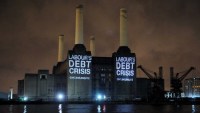
As publicity stunts go, the debt clock the Tories beamed onto Battersea Power Station this evening is quite a decent idea.  Their thinking's pretty clear – get some coverage in tomorrow's papers, and increase the likelihood that the horrendous state of the public finances becomes the story of the PBR – but it's probably no less effective for it.  Anyway, here are some pictures so you can judge for yourself: P.S. Yes, I know it's out of sync with the Coffee House debt counter. We're going to update our numbers on the back of tomorrow's PBR.

How long until the plug is pulled?<br />

From our UK edition

Moody’s AAA sovereign monitor was published today, and whilst the UK’s AAA status remains ‘resilient’ the situation is far from rosy. The report states: ‘The UK economy entered the crisis in a vulnerable position, owing to the (overly) large size of its banking sector and the high level of household indebtedness. Both continue to weigh on economic performance. Net bank lending to the UK business sector has continued to contract through Q3 2009, and repairs to household balance sheets (i.e. the rising savings ratio) may weigh on demand for some time to come. The depth of the crisis has been mirrored by the ongoing deterioration of public finances (with gross debt/GDP having risen from 44% at the end of 2007 to an estimated 69% at the end of 2009).

Darling contra Brown, Part 573

From our UK edition

Ok, so tomorrow's Pre-Budget Report is shaping up to be a horrendously political affair.  But, rest assured, it could have been so much worse.  In what is, by now, a familiar Budget-time story, Alistair Darling is fighting the good fight against some of Brown's most inharmonious fiscal brainwaves.  According to Rachel Sylvester's column today, here are just some of the measures that the Chancellor has resisted: -- A long-term windfall tax on bankers' bonuses (Darling favours a temporary, one-year tax). -- A call to lower the 50p tax threshold from £150,000 to £100,000. -- A reversal of the plan to make it easier for couples to pool their inheritance tax allowances. -- A, ahem, "more optimistic picture of the British economy".

The Lib Dems’ hunt for an issue may lead them to an Afghan pull-out

From our UK edition

As Anthony Wells says over at his UK Polling Report, there are plenty of reasons to doubt whether Labour could convert a third of Lib Dem voters over to their cause.  But the article in today's Times on Labour's new strategy will still give Team Clegg pause for thought. The problem for the Lib Dems is that they haven't yet managed to hit on an attention-grabbing issue to make their own – their favourite, perhaps only, election strategy.  The cause of Parliamentary reform could have done the trick, but – beyond Nick Clegg's call to prevent MPs from taking their summer holiday – very few of the Lib Dem proposals have received much coverage.  Likewise, electoral reform, which Labour now seem to be comandeering for their own manifesto.

This week’s PBR looks set to be Brown’s most political Budget yet

From our UK edition

Ok, so all Brown Budgets are political – but signs are that this week's PBR could be his most blatantly partisan yet.  I mean, just look at his speech this morning on improving efficiency in the public sector.  Some of its measures are welcome – for instance, pledging to cut the pay of senior servants, and the general idea of using technology more effectively in government.  But, as other folk have pointed out (see Guido and Iain Dale), the measures are insufficient to the scale of the debt crisis, and many are old news.  All in all, the signs are as we expected: Brown is paying only lip service to cuts. Instead, Brown is going to go heavy on soak-the-rich measures; thereby strengthening what Labour see as two dividing lines.

The politics of distraction

From our UK edition

If everyone concentrates on the actual numbers in the PBR then it will be a disaster for Labour. So, instead Labour will try and distract us all with small but eye-catching measures — a new rate of inheritance tax for estates worth more than £5 million, that kind of thing. The aim will be to move the debate from the grim reality of the country’s fiscal situation to Labour’s dividing lines. There will be a lot of pressure on Cameron and Osborne to denounce Labour’s soak the rich measures. But the most important thing for them to do is to get the debate back to the state of the public finances and that is inevitably going to involve side-stepping the arguments that Brown wants to pick.

Cameron and Ashcroft should come clean

From our UK edition

David Cameron’s ‘nothing to do with me guv’ response to the Ashcroft tax question on yesterday’s Politics Show has not put the issue to bed. In fact, his obfuscation has the reverse effect. The Independent runs an article today describing how little is known about individuals and authorities. ‘The House of Lords Appointments Commission says that it does not know whether Lord Ashcroft is UK resident. The Cabinet Office and HM Customs and Revenue have declined to answer questions about his status, on grounds of privacy.

A tax Blitz that reveals Labour’s mistakes in full

From our UK edition

The rumour mill is pulling 24/7 shifts. In recent days, newspapers and newswires have turned into gossip columns devoted exclusively to Alistair Darling’s Pre-Budget Report. If the rumours are true, which is a huge assumption, Darling will not offer the taxpayer a pre-election lolly-pop besides deferring the Age of Austerity until 2011, by which time he will probably be out of office. If Labour’s 1992 manifesto was a tax bombshell, then by all accounts this PBR will be like Dresden. Everyone, both rich and poor, is in the firing line, and there is no space here to analyse every alleged proposal.   Darling looks likely to prolong the VAT cut until at least February, but Smith and Williamson expect VAT to rise to 20 percent in 2011.

Brown waits to strike

From our UK edition

Things are shaping up nicely for Gordon Brown ahead of the Pre-Budget Report next week. The Tories were 17 points ahead on ICM in October – now it’s 11. Cameron would have a narrow majority on this basis but, given the margin of error, we’re back into hung parliament territory. And this has a self-reinforcing effect on the Tories. A shrinking opinion poll means they tend to get paralysed, avoid arguments, play it safe, wait for Labour to screw up again. As I say in my News of the World column today, the voters who are looking for leadership then don’t really see it. This, of course, softens the Tory vote further. So the stage is set for Labour to get away with murder next week.

The correct decision but a tactical blunder

From our UK edition

The Telegraph reports that Alistair Darling will allow married couples to continue to pool their inheritance tax allowances. Downing Street has pressed the Treasury to abolish pooled allowances in order to demarcate between Labour, the party that promotes fairness, and the Tories, the party that entrenches privilege.   For all the recent polls and bravado, the near-bankrupt Labour party is still fighting an intensive rearguard. If it is avoid annihilation, the party has to hold on in Scotland, Wales and urban Northern England. Darling’s pledge illustrates that there is more than one way to fight a defensive battle.

Balls: ‘I have resisted moving’

From our UK edition

Ed Balls has given an interview to The Times Educational Supplement which contains a comically audacious attempt to rewrite history. When asked about whether he really wants to be in his current job, Balls tells the interviewer, “I have resisted moving”. Now, I suspect this will come as a bit of a shock to Alistair Darling who fought off an effort by Balls to take his job.

Could Brown go for a March 25th election?

From our UK edition

The conventional wisdom in Westminster is that the election will be on May 6th. But a few shadow Cabinet members have told me that they think Brown will actually go in March, an idea that they have been pushing for a while. Their argument is that this quarter’s GDP figures will be quite good, boosted by the Christmas rush, and Brown would want to go to the country before, another more disappointing set of numbers came out. Second, Brown will want to avoid people seeing the effects of the new tax arranegements which will come into force in April. Finally, if the election was on May 6th, the first week of the campaign would be lost to the school holidays.

How will Labour try to soak the rich?

From our UK edition

Brace yourselves.  According to today's Daily Express, Alistair Darling is under pressure to introduce a new 70 percent tax rate for high-earners in next week's Pre-Budget Report.  I repeat: s-e-v-e-n-t-y percent. To be honest, I can't see the Chancellor doing it.  Leaping from 50p to 70p would be regarded as far too incendiary, not to mention fiscally insane, even for this government.  But I can still see them introducing a fair handful of soak-the-rich measures, if only to strengthen their reinvigorated attack line against the Tories. In which case, I refer you to Polly Toynbee's column from a few months ago, in which she recommended that the 50p rate start at £100,000 instead of £150,000.

Risky business | 3 December 2009

From our UK edition

With the largest transfer of liabilities in British history – the insurance of the risk of loss on £240 billion of toxic RBS assets by taxpayers – proceeding, there is worryingly little information being given about either what these assets may be or what risks there are to the taxpayer. Rather than the parliamentary enquiry and detailed disclosure Swiss parliamentarians demanded when UBS needed similar assistance, a small press release noting such exotics as “structured credit assets “ has been issued. The spin continues to be that there is nothing to worry about and all this money will come back fine. Bank of England data shows that UK bank exposure to the US increased increased by over half a trillion dollars between 2004 and 2007 to 1.2 trillion.

The choice facing the Tories

From our UK edition

If you'd like a step-by-step preview of Labour's next election campaign, then do read Alastair Campbell's latest blog post.  All of Brown's attacks from PMQs are in there, and then some: "tax cuts for the rich"; a lack of "policy heavy lifting" on Cameron's part; the Tories "haven't really changed", etc. etc.  The spinmeister has been in closer contact with Downing Street recently, and it shows.  It's all gone a bit bar-brawling. The Tories now face a choice between, broadly speaking, three different responses: i) Ignore Campbell.

The New Class War

From our UK edition

James argues, quite correctly in my view, that it is now clear that Gordon Brown is preparing to run a campaign arguing that, as Brother Forsyth puts it, "a Cameron government will be a government of the rich, by the rich, for the rich." Ben Brogan makes the same point in his column today:  In a fight to the death, there is no longer any point pretending to govern in the national interest. As it was in the beginning for Labour, so shall it be in the end: class war, plain and simple. Soak the rich, crow about it, and damn the consequences. It's true that this is red meat for the Labour base - precisely the constituency Brown must rally first - and it's also true that it dovetails with a classic Shrumian narrative of "the people against the powerful" and "the many, not the few".

Might there be some fight left in the class war after all?

From our UK edition

The Tories are in mild shock following PMQs, they never expected Cameron to get clunked like that. Brown is clearly going to try and use Tory inheritance tax policy to ram home the message that a Cameron government will be a government of the rich, by the rich, for the rich. But the Tories are taking comfort from their belief that Brown’s ugly class war politics won’t work, pointing to how they failed in Crewe and Nantwich. But the attacks on Edward Timpson backfired, at least in part, because Timpson was a bad target. It is hard to portray someone as an out of touch, uncaring toff when their family have fostered 80 odd children and have a long history of local philanthropy.

Politicking on the backs of the poorest

From our UK edition

This afternoon Jim Knight MP, the minister for welfare reform, proclaimed that the Government wants to turn the Jobcentre Plus network into a careers service for everyone. He said that welfare advisers, who currently try to help get people on benefits back into work, will start to “provide opportunities for progression” for anyone in a job – no matter whether the person is a banker or a bin man. This is a bad idea for a simple reason: it is far more important to help the unemployed back into work than give assistance to people who already have a job. The longer that someone is out of work, the worse their chances of getting back into it.