The Queen’s Speech: complete footage
From our UK edition
From our UK edition
From our UK edition
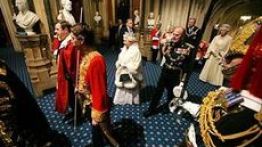
Blink and you missed it. After seven minutes, the Queen had rattled through the Government's legislative agenda for the next few months. It was all pretty much as expected – although it’s worth noting the “council of financial stability,” made up of the Treasury, the Bank of England and FSA, chaired by the Chancellor, and which was first mooted back in July. The question is whether any of this will connect with the public. I rather doubt it. We’ll put footage on Coffee House as soon as it’s available.
From our UK edition
So what to make of today's Queen's Speech? Myself, I'm finding it hard to drum up much excitement. After all, we already know most of its contents (if you want a primer, then check out this excellent Guardian summary article here), and much of it is either underwhelming, unworkable or – as everyone from David Cameron to Michael White has pointed out – self-servingly political on Labour's part. Tory peers are saying that they'll block the proposals, but you've got to doubt whether they'll be enacted before the next election anyway. All in all, Danny Finkelstein's analysis is attractive. As he puts it: "who cares?" But there is one sense in which this Queen's Speech matters.
From our UK edition
Steve Richards writes a stirring defence for what is likely to be Labour’s last legislative programme. Richards argues that if you suspend your disbelief and ignore everything you have read about current political situation and you will see not a tired, regressive government but a radical political force. ‘Perhaps none of the proposals will be implemented by the election. Maybe they will all turn into dust, but they mark a departure from cautious incremental approaches usually adopted by the Government. The Conservatives' equivalent proposals have an echo with the mid 1990s, while their Euro-scepticism takes us further back, and their plans for spending cuts to 1981.
From our UK edition
The public's judgement on Gordon Brown will probably come with the general election, but CoffeeHousers may have fun with this webpage in the meantime. It has been created by the clean-up-politics organisation Power 2010, and will let you grade Gordon Brown in the aftermath of tomorrow's Queen's speech. Naturally, the grades run from A ("Top of the class") to F ("Brown fail"); you can leave comments; and Gordon will receive a school report in December. I suppose it's meant to help close the democratic deficit between Downing St and the rest of the country – but it could just help some folk let off a little steam...

From our UK edition
David Cameron has written an apoplectic editorial in the Times condemning Gordon Brown’s partisan hijacking of the Queen’s Speech. Here is the key section: ‘We are mired in the deepest and longest recession since the Second World War, with deep social problems and a political system that is held in contempt. The State Opening of Parliament tomorrow ought to be about radical ideas to deal with this triple crisis. Instead, by all accounts, the Queen’s Speech will be little more than a Labour press release on palace parchment. Don’t take my word for it. As The Times reported yesterday, a Cabinet minister has been boasting about the contents of the speech. What was said? That it was the most ambitious since Labour had come to power?

From our UK edition
Things never seem to go smoothly for Gordon. On a day when the Telegraph carries details of his Whitehall savings programme, the FT has news that one of his closest allies, Ed Balls, is calling for relatively hefty spending increases elsewhere. Apparently, Balls has asked the Treasury to grant his department – the Department for Children, Schools and Families – real-terms spending increases of 1.4 percent until 2014. That's an extra £2.6 billion in total – and goes beyond previous Labour commitments to "protect" schools spending. It's a brassy move by Balls and one which is sure to aggravate his colleagues.
From our UK edition
Over at his blog, Nick Robinson has put together a useful digest of the different attitudes towards Brown's premiership inside the Labour party. Putting it briefly, he thinks Labour MPs fit into three distinct "camps": 1) The plotters: "...believe that Mr Brown is taking their party to certain oblivion and are still desperately searching for ways to remove him and to install a new leader by January." 2) The quitters: "...agree with [the plotters'] analysis but have given up hope of installing a new leader who just might do better." 3) The fighters: "...are beginning to hope that a recovery might just be possible." It's a neat outline, albeit one which is pretty intuitive.
From our UK edition
The Times has a fascinating story on how Labour’s lack of cash is forcing it to give up on seats and groups of voters. The paper reports that seats with a majority of less than 3,000 have been effectively written off. So even before the campaign has begun, Labour is basically forfeiting 60 seats. By contrast, the Tory marginal seat operation — funded by Lord Ashcroft’s cash — is pushing further and further up the Tory list of target seats. (I was talking to one Tory candidate recently who thought that the resources poured into her seat — currently held by Labour — in the last 18 months or so had made it an almost certain gain for the party, barring disaster during the campaign).
From our UK edition
Over at his New Statesman blog, James Macintyre reveals that Labour's next election broadcast will be the sentimental, two-and-half minute history of the Labour party shown before Brown's speech at the last party conference. We've embedded it below, for the – ahem – benefit of CoffeeHousers; so I'll repeat the question I asked during our live blog of Brown's speech: "This is clearly a Labour crowd-pleaser, but will it make any difference outside the conference hall?
From our UK edition
The parties are limbering up for the longest, and possibly the bitterest, election campaign in living memory. Recent asides and statements indicate that Wednesday’s Queen's Speech will be the most political that New Labour has delivered. This morning’s Times and FT give an amuse bouche of the package with which Labour intend to “smoke out the Tories”. The FSA will be furnished with powers to punish those dastardly bankers, including the power to rip up contracts that encourage excessive risk. Also, Labour will provide free home care for 350,000 people; NHS patients will receive free private care if they are not treated within 18 weeks; and pupils will have the opportunity to take free on-to-one home tuition.
From our UK edition
That Gordon Brown is still the prime minister proves that it isn’t only Peter Mandelson who is a fighter not a quitter. It became clear this week that Brown will fight to the bitter end, and that Labour’s election strategy has emerged through him. Labour depicts the Tories as Bullingdon boy toffs and crazed Thatcherite cutters; Brown is the stern, serious figurehead, the still small voice of calm at the vanguard of Labour’s arguments on immigration and the economy. Matthew d’Ancona’s Sunday Telegraph column details how Brown has returned to the fore this week and delivered policy statements aimed exclusively at maintaining Labour’s core support.
From our UK edition
So, what is The Spectator coming to? Dishing out trophies to Harman and all these Labour types? Has the editor's chair made me crawl up to people like Harman and Darling? Am I angling for a political seat? The comments to my earlier blog post raise some excellent points - about politics, polemic and The Spectator itself. I thought they deserved a response in a post rather than a comment. The Spectator's tradition of honouring talent on all sides of the political divide in its annual awards is a long one: La Harman was our 24th Parliamentarian of the Year. While Harman was speaking, Boris and I were holding her trophy and looking at the names that hers would be engaved next to.

From our UK edition
That Labour held one of its safest seats is newsworthy either indicates how desperate the party’s predicament is or that it is a very slow news day. Anything other than a Labour win, and a substantial one at that, was unthinkable; even the resolutely fanciful SNP must have acknowledged that privately. However, this by-election raises some interesting points nonetheless. As Alex Massie notes, the gloss has come of the hubristic SNP. Salmond’s Braveheart act about winning 20 seats and seeing Westminster “hanging from a Scottish rope” looked optimistic-to-mad when first performed; now it just looks mad.
From our UK edition
The result hasn't been officially announced yet but it's clear that Labour have won a handsome victory in the Glasgow North-East by-election. That's no surprise. I don't think the SNP ever really expected to prevail though, of course, they hoped they might be able to repeat the Miracle of Glasgow East. Still, they thought they'd be more competitive than they have been. Then again, this seat has been Labour for 74 years so a loss in Springburn might have done for poor old Gordon Brown. Happily for Labour the party was able to run as an opposition party, protesting against the SNP's alleged parsimonious attitude towards Glasgow. The (surprising) cancellation of the Glasgow airport rail-link didn't help the Nationalists; nor, frankly, did their pretty hapless, shambolic campaign.
From our UK edition
Further to Alan Johnson’s immigration statement on Monday, Gordon Brown will give a speech on the topic. The intention is to re-engage with core voters who have defected to the BNP. In an interview with the Mail, Brown acknowledged that the public were right to be concerned, especially in times of economic uncertainty and hardship. Brown is expected to tighten migrant employment controls so that migrants are only used where there are labour shortages. He will strengthen the ‘Labour Market Test’ by extending vacancy exclusivity for UK citizens from 2 weeks to a month, and pledges to retrain British workers. The proposals are welcome and the rhetoric is tough, giving some weight to the maligned call of ‘British jobs for British workers’.
From our UK edition
Brother Blackburn's suggestion that David Miliband risks, perhaps, being something of a Labour version of William Hague should he succeed Gordon Brown. And Danny Finkelstein's column arguing that Miliband should change his mind and put himself forward for the post of EU High Representative is, in many, many ways, compellingly persuasive. But if Miliband were to go to Brussels he might find himself all alone. His enemies in the Labour Party are unlikely to look kindly on Miliband serving a term as High Representative before returning to Britain, finding safe seat, and strolling into Westminster to become the next-but-one leader of the Labour Party.
From our UK edition
The One Nation sentiments that David Cameron expressed at last night’s Hugo Young lecture have been almost uniformly applauded. Labour’s sneers about Cameron being an uber-Thatcherite are isolated from mainstream. Only Johann Hari dissents, suggesting that because Cameron is an OE and comfortably off it follows that ‘he has never known’ a poor person. Of course, if Cameron were the re-incarnation of Lord Salisbury, then Dave would have ample understanding of, and who knows perhaps even intimacy with, the various retainers, ostlers, scullery maids and farriers in his employ. Patricians have long since retired to enjoy what’s left of their estates, and Cameron’s sentiments are genuine and inflect his politics, simple as that.
From our UK edition
David Miliband’s decision not to be a candidate for EU Foreign Minister has inspired an almost vociferous article from Daniel Finkelstein. He writes: ‘The Lisbon treaty is your work as much as anyone’s. You pushed it through and you told everyone that it really mattered. You’ve been making speeches on the importance of the new job as EU foreign minister. You’ve said it is an essential tool of influence. Yet now — now — you tell me that you don’t actually want to do it yourself.’ Clearly Miliband wants a crack at the leadership, and the thrust of Finkelstein’s argument is that Miliband isn’t up to leading the opposition. ‘One other thing you need to think about.
From our UK edition
David Cameron received a standing ovation after he proclaimed “Don’t dare lecture us about poverty”, illustrating that compassionate conservatism is a central issue to the Conservative party. Today, David Cameron will set out his blueprint to eradicate poverty, which, together with education reform and the promotion of the family, form the compassionate case. Cameron is expected to say: “Our alternative to big government is not no government. Our alternative to big government is the big society, but we understand that the big society is not just going to spring to life on its own: we need strong and concerted government action to make it happen. We need to use the state to remake society.