Labour party

Things the Speaker shouldn’t discuss in public

From our UK edition

As Andrew Sparrow says, it's well worth reading Iain Dale's interview with John Bercow in the latest issue Total Politics.  It's a fun read, mostly because the Speaker is remarkably candid – a quality that's normally to be admired in a politician.  But I can't help thinking that he made a mistake in admitting this:   "I received various approaches from various senior people in the Labour party saying: 'Aw, you know, we'd love to have you on board. We think you're being discarded by the Conservatives. We think you'd be quite at home with us.' Senior people, not in a formal setting, but people sidling up to you – ex-ministers, current ministers, backbenchers, whatever.

Balls beats the drum for investment

From our UK edition

Oh, look, Ed Balls is talking about "investment" again.  This time it's an address on the Government's Children's Plan, and, judging by the preview in today's Independent, it's all going to be about how much more money his department is spending.  I doubt Alistair Darling will be impresssed - especially as much of that money was strong-armed out of the Treasury in the early hours of Wednesday morning last week.  And I doubt that some of Balls's other colleagues will be too amused either.  Their departments will be subject to even deeper cuts thanks to his brinksmanship. But you suspect that Balls isn't just hoping to rile his fellow ministers - he'll probably want to divert some attention away from the important u-turn which he outlined on Marr yesterday.

Labour Now Managing the Scale of the Defeat

From our UK edition

I was struggling towards an analysis of the true meaning of the PBR in Friday's post, but a couple of the Sunday commentators were a little closer to the mark. John Rentoul, in an article with the provocative headline Labour is Unelectable Again the Independent on Sunday's chief political commentator has finally announced the death of New Labour. For him, Labour's latest pronouncement on the bankers' bonuses is the final death rattle. Labour sorely needs to move beyond the philosophy that made it so attractive to the electorate for a decade but at the moment it is finding it difficult to put one foot in front of the other. Matthew D'Ancona gets it about right in the Sunday Telegraph when he says that the PBR was about managing defeat.

Playing politics with the public finances

From our UK edition

It has started. The Labour attack unit is out today talking about a "Tory VAT rise" - as per Paddy Hennessy’s scoop. Osborne stated his (to me, relatively paltry) position on the deficit: that he’d reduce it faster than Labour but can’t say how much. The Labour attack unit keeps partying like its 1999 with the "Tory cuts" line, now augmented with a "Tory tax rise." Here are the words which the attack unit has crafted for Stephen Timms, chief secretary to the Treasury: "George Osborne refuses to say what services he would cut or what taxes he would increase in order to cut the deficit 'further and faster' than Labour.

The Ed Balls approach to fiscal management

From our UK edition

Considering the fiscal crisis we face, this revelation in Andrew Rawnsley's column is particularly dispiriting: "[Gordon Brown] has been egged on by Ed Balls [to make more spending promises], partly because the schools secretary is also obsessed with that old dividing line, partly because he wanted to be able to boast that he had won more money for his department. I am reliably told that the wrangling between the schools secretary and the chancellor went on into the early hours of the morning on the day of the PBR itself. The result was that some of the extra spending beaten out of Mr Darling by Mr Balls did not get into the document because it was already printed.

Labour fell between two stools this week

From our UK edition

There were two possible strategic approaches Labour could have taken to the PBR. One option was to surprise everyone by actually making cuts. They then could have said, "we've made all the cuts we can. Anything else would really hurt frontline services". This would have put them in position to challenge the Tories as to what they would cut to reduce the deficit faster. The other was to be really populist. They could have carried on spending, bashed the bankers, soaked the rich, and hope that they could get away without a crisis in the markets until the election. Instead, they’ve fallen between two stools.

Has Mandelson given up on Brown?

From our UK edition

For any Kremlinologists among us, Peter Oborne's latest column in the Mail sure is a juicy read.  It claims that Mandelson and Brown are "at war again" – only, this time, insiders say the damage to their relationship is "irreparable".  The Business Secretary is said to be "bitterly unhappy" with Labour's class war strategy, and with Brown's reluctance to deal with the fiscal crisis.  And – as Martin highlighted the other day – he wants out. None of this is too surprising.  Indeed, Mandelson has been conspicuous by his absence from the government's PBR media drive, fuelling more than a few Westminster mumblings about his commitment to the Brownite cause.

Why not just scrap ID cards, then?

From our UK edition

So the protracted, wheezing death of ID cards continues, with Alistair Darling admitting in today's Telegraph that: "Most of the expenditure is on biometric passports which you and I are going to require shortly to get into the US. Do we need to go further than that? Well, probably not." The government are letting it be known that this doesn't contradict their existing policy, but their shifting rhetoric remains striking.  Last year, we had the then Home Secretary, Jacqui Smith, proposing that British citizens should be able to choose between a card and a biometric passport.  Earlier this year, Alan Johnson said that ID cards wouldn't be compulsory for British nationals, after all.

Why class wars don’t work

From our UK edition

Well, it seems like Paul Richards – a former aide to Hazel Blears – wants to corner the market in quietly persuasive demolitions of his own party's strategy.  If you remember, he wrote a perceptive piece on Labour's shortcomings in the aftermath of the Norwich North by-election, which we highlighted here on Coffee House.  And, today, he's at it again, with a very readable article in PR Week on why the class war won't work.  His three reasons why are worth noting down: "First, it is hypocritical. The Labour Party has a disproportionately far higher number of former public schoolboys and schoolgirls in parliament and in the government than a random sample of the public they serve.

Another PBR, Please

From our UK edition

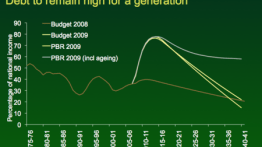
That would be a Pabst Blue Ribbon, of course, though another, better, Pre-Budget Report would be welcome too. As Fraser says, the public finances are ruined and will not be rebuilt for many years. Bill Jamieson's piece in the Scotsman framed the matter rather well and explained why the level of debt matters more than, I suspect, many people think it does: But why should debt figures matter so much? This is why: Next year, we will be paying £44.4bn in debt interest alone – never mind debt falling due for repayment.

Those hidden cuts in full

From our UK edition

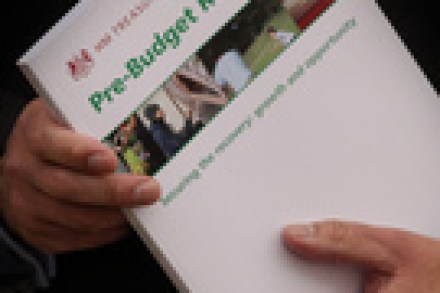
The truth about the Pre-Budget Report was revealed today by the Institute for Fiscal Studies: the new National Insurance tax will hit everyone on £14k or over, not £20k - and there are implied 19 per cent cuts of some £40 billion in the “non-protected” areas. The event was sold out, because it now has the reputation as the only place you learn the truth about Budgets passed by this government. Yet again, Gemma Tetlow from the IFS has unearthed the cuts which the Chancellor felt he had to conceal from the public (and – unwittingly, I hope - lied about this morning on the radio).

The cuts unveiled

From our UK edition

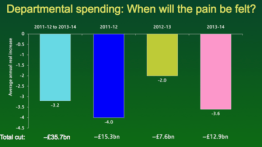
Well, as expected, the IFS have put the lie to Darling's claim that the budgets of non-ringfenced departments would be "pretty much flat".  Here's how Nick Robinson reports it: "The Institute for Fiscal Studies says that government plans imply £36bn of cuts in departmental spending ie over 19% from 2011-2014 in order to protect schools, hospitals and increase overseas aid. They say the police pledge is meaningless. They also say that defence, higher education, transport and housing are most likely to be hit.   The cost of paying back the debt over the next eight years is equivalent to £2,400 per family in taxes or cuts over that period." UPDATE: The relevant IFS presentation has now been uploaded on their website – you can read it here.

The Darling deception

From our UK edition

Alistair Darling normally strikes us as an honest man dropped into an impossible situation. But whether he misspoke, or whether he set out to mislead, he told a lie on the Today Programme this morning which needs to be highlighted. So what was it?  That non-ringfenced departmental budgets would remain "pretty much flat" rather than receiving significant, if not sufficient, cuts.  As Fraser demonstrated yesterday, there were spending cuts hidden in the Budget   and we'll see the full extent of those as soon as the IFS processes the numbers later today.  Last time around, after April's Budget, they calculated cuts of 7 percent across three years.  Thanks to a few more ringfenced budgets here and there, those cuts could even be deeper this time around.

Last orders in the last chance saloon?

From our UK edition

It's the set of headlines which Labour must have dreaded after their recent progress in the polls.  The Times: "The axeman dithereth ... but the taxman cometh".  The Guardian: "Darling soaks the rich ... and the rest of us too".  The Mail: "The Buck Passer's Budget".  And so on and so on.  It doesn't look too good inside the papers either.  The FT rails against a  "lack of clarity on public spending plans", while the Independent says that "rarely has a pre-Budget report promised so much and delivered so little".  The Sun's opposition may not be too surprising, but it's there in bucketfuls: "Britain is staring into the abyss. After yesterday's performance that abyss has got deeper.

The Tories should attack the national insurance increase

From our UK edition

After a tricky few weeks for the Tories, the PBR has come of a bit of a relief for them. It is generating far more bad headlines for the government than good ones.  The Standard’s splash on the national insurance hike is a taste of what the coverage is going to be like for Labour tomorrow. One point the Tories should be hammering home is that the national insurance hike is a far more significant tax rise than the tax on bank bonuses. The one-off tax on banks that pay sizable bonuses will only raise £550 million while in 2010-11 the various national insurance changes will cost taxpayers more than £3 billion and will hit 10 million people, all those who earn more than 20k a year.

Bad news for the country, bad news for Labour

From our UK edition

Abandon hope all ye who enter here.  While we mostly knew what to expect from Darling's PBR, it's still surprising just how uninspiring, how thin and how insufficient it is in the flesh.  It's pretty much a bad news budget for anyone you could mention.  Bad news, of course, for the bankers who will be hit by the hazily outlined bonus tax.  Bad news for public sector workers, who are already smarting at the frozen pay rise they'll have to accept in a few years time.  Bad news for anyone who cares about the state of the public finances, which look just as grim, if not worse, as they did back in April, with no significant plan for recovery.

One thing to remember today

From our UK edition

As you can probably imagine, plenty of Labour folk are getting excited about the PBR today.  They regard it as a chance for their party to harden their rise in the polls, and hasten the Tories' descent.  But Danny Finkelstein strikes a necessary note of calm over at Comment Central.  As he puts it, a Budget in which the government has to 'fess up to the horrible state of the public finances is hardly going to do much good for them.   To Danny's analysis I'd add one supporting fact: that rarely, if ever, in recent times, has the government received a significant poll bounce on the back of a Budget.  I blogged about this back in April, and Anthony Wells followed it up with an excellent post here.

Brown’s bonus smokescreen

From our UK edition

If today ends up with the government in a row with the City over plans to tax bank bonus pots with bankers threatening to take the government to court, then it will be mission accomplished for the Labour party. The same goes if we end up in a debate over the merits of a Tobin-style tax. For obvious reasons, Labour would rather talk about anything other than the state of the public finances so anything that distracts attention from that central question is, to use the word of the morning, a bonus for Brown. The Tories know this and will try and turn the debate back to the public finances and the fact that Britain was the first major economy into recession and is going to be the last out. It is imperative for them that they succeed.

Darling carves up the spending pie

From our UK edition

It’s the eve of the Pre-Budget Report, and the lunacy has already begun. Tomorrow's FT says that Darling will copy the Tories’ plans to protect the NHS budget – and throw police and schools in to the protected status as well. This is introduced as "the biggest squeeze in pubic spending for a generation," with the headline figure of 14 percent cuts. How to make sense of that? My guide: 1. Any sentence that starts “A Labour government would...” can be ignored. Darling can promise to fund free beer for everyone after 2011 – he won't be in office. These are decoys for the media: the wilder his claims, the worse he expects to lose. 2.