Labour party

Turnbull savages chancellor Brown

Andrew Turnbull, who was permanent secretary at the Treasury from 1998 to 2002 and Cabinet Secretary from 2003 to 2005, has previous when it comes to criticising Gordon Brown. But his recent piece in the FT — ‘Six steps to salvage the Treasury’ — is one long barely coded attack on the PM. Take this line: “First and perhaps foremost, it [the Treasury] needs a strong ministerial team – a chancellor who wants to be chancellor for the full term rather than coveting the prime minister’s job.” Interestingly, Turnbull comes out in favour of the Tories’ plans to create an Office of Budgetary Responsibility. I know this is derided by

The Iraq Inquiry should call Gordon Brown now

Alastair Campbell is before the Iraq Inquiry. As one of Blair’s closest aides, Campbell’s role in the run-up to the Iraq war was key. But I suspect the spinner-in-chief will be doing what he was originally hired to do: namely, protect his master by attracting the incoming fire. In this case, though, he will be helping Gordon Brown, not Tony Blair.   Because it is Brown’s role in the Iraq War, not that of Blair, that is the most obscure part of Britain’s modern history. As chancellor, Brown was the second most powerful man in government. He held the purse strings. If he had opposed the Iraq War, it is hard

Strange and Getting Stranger

It is just plain bizarre that Gordon Brown has announced that he will serve a full term if Labour wins the next election. He should be playing down his role in the forthcoming election (difficult I know, when he is Prime Minister) not reminding people that he will be around for another four years. It is also strange that he has written off the Hewitt-Hoon coup attempt as silly. This is the one thing it is not. It may have been unwise, badly organised and poorly timed. But the idea of giving the Parliamentary Labour Party the opportunity to save Gordon or the party was perfectly sound. Indeed, they were

James Purnell’s third way

Guess who’s back.  Yes, James Purnell, the man who tried his best to topple Gordon Brown last year, has emerged from the relative obscurity of the backbenches and Think-Tank World to set out a new prospectus for the Labour party in today’s Guardian.  David nodded towards it earlier, but it’s worth looking at in a little more detail.  Why?  Well, because it’s an indication of how things could go for the post-election Labour party. The first thing that strikes you is how Purnell tries to defuse the controversy of his resignation last year.  “What?” you might think, “resigning from Brown’s government is controversial? Sane, more like.”  And, yes, I see

Ed Balls says the same stuff, differently

The road to Damascus has nothing on this.  Ed Balls – in interview with the FT – has condemned the class war strategy, called for an end to Labour figures briefing against each other, and suggested that the government should be more “upfront” about spending cuts.  Hallelujah!  What a difference an attempted coup makes!  And so on and so on. But wait a minute.  What does the Schools Secretary actually say?  Worth looking at, that – because Balls hasn’t so much changed his arguments as changed the way he makes them.  Take, for instance, what he says about class war: “‘I’m totally against a class war strategy,’ he says. But

It is immaterial who fronts Labour’s campaign

Divide and conquer, that is what preoccupies the Prime Minister. Later today, Gordon Brown will address the Parliamentary Labour Party to reassure them of the strength of his leadership and to invigorate the party by setting it on an election footing. How he achieves the former is anyone’s guess but he will realise the latter by investing Labour’s three election supremos: Mandelson, Harman and Douglas Alexander. In typical Brown style, these lieutenants’ roles are deliberately ill-defined. Who has ultimate authority? Who will be the attack dog? What is the difference between day to day running and managing an overall strategy? And which takes precedence? A pastmaster at internal intrigue, Brown

Hoon may strike again

David Miliband lacks the gumption to play Brutus, but does Geoff Hoon? The Sunday Times has obtained correspondence between Hoon, Brown and Blair illustrating that the then Chancellor overturned Treasury assurances that the MoD would receive additional funds for helicopters in Iraq and Afghanistan. Brown wrote: “I must disallow immediately any flexibility for the Ministry of Defence to move resources between cash and non-cash.” Once again we see the (supposedly) miserly Chancellor holding Blair to ransom at any opportunity, regardless of the consequences. Whilst Brown is a spectre of a Prime Minister, he was anything but as Chancellor. Blair set the war in motion but Brown is partly responsible for Britain’s

What’s Ed Miliband playing at?

There’s that prism I mentioned: Ed Miliband writes an article for the Observer, which ostensibly backs Gordon Brown in the first paragraph, and it’s written up as the first, tentative step on his own leadership campaign.  Thing is, that’s probably also true.  The clue is in how far he steps off his ministerial beat*, to deliver an overall prospectus for the Labour Party: “Let’s start, as our manifesto will, with what the country needs in the coming five years. It can’t be about business as usual. We need to rebuild our economy in a different way from the past, with more jobs in real engineering not just financial engineering. This

Our Dismal Politics: Charlatanry and Deceit All Around

Fraser rightly draws our attention to the highly entertaining extracts from Peter Watt’s book published by the Mail on Sunday. Granted the whole enterprise is accompanied, as is traditional in these matters, by the sound of many an axe being ground and some of the details – to say nothing of the quotations – are close too being in the too-good-to-be-quite-true camp. Nonetheless, the general spirit of the thing seems persuasive. So it’s worth highlighting another, minor, passage that actually doesn’t have anything to do with Gordon Brown at all: Some of our politicians could be touchingly naive. During the 2001 General Election campaign, some bright spark came up with

Inside the Brown operation: the loathing, the cluelessness and the sulks

Remember Peter Watt? No one in Team Brown did either –and that, it now turns out, was a big mistake. As general secretary of the Labour Party when the Blair-Brown handover happened (and cash-for-honours was in the air) he was in a brilliant position to know what went on. And, after being abandoned by all of them, he has a motive to tell. His revelations are pretty explosive, but this jumps out at me the most – from Douglas Alexander, the man everyone thought was Brown’s little Mowgli raised by a fellow son-of-the-manse in the jungle of politics. This is what Alexander (the would-be co-ordinator in the election that never

Darling’s honesty is good news for the country – but tricky news for Labour

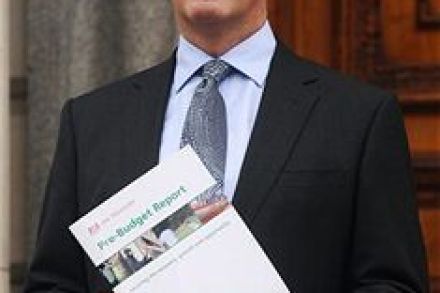
Well, well, well – Darling’s Times interview, which James reported earlier, sure is a significant moment, and one which more than deserves a place on the spending cut timeline which I put together last week.  In fact, let’s see what it would look like alongside a few of the most recent entries: 9 December 2009: Pre-Budget Report 2009 forecasts Public Sector Net Borrowing of £176 billion, and Public Sector Net Debt of £986 billion, in 2010-11. 10 December 2009: Alistair Darling puts in a bizarre performance on the Today programme, claiming that the PBR implies that departmental budgets would remain “pretty much flat.” 10 December 2009: The IFS works out

Overestimating the Labour Party

I am forced to admit that I misjudged the nature of the Hoon-Hewitt plot. I credited them with having lined up some sort of serious Cabinet-level support (I have to say I assumed they had squared it with Mandelson). Whatever flaws you might attribute to the pair, they were once serious players in the New Labour world. But such is the collapse of confidence in the party that no one looks like they know what they are doing any more. I made the mistake of thinking that because Hoon and Hewitt were once part of a finely honed Labour machine, they were still at the top of their game. Daft

Gordon Brown on fighting and winning…

Ok, I know Labour circulars will always fly the party flag – but the email that’s just gone out in Gordon Brown’s name has to win some sort of prize for sheer party political effrontery.  With the subject line “When we fight we win,” here’s how it begins: “If there’s one thing that our recent by-election successes and this week’s coverage about the £34 billion credibility gap in the Tories’ spending plans shows us, it’s that when we fight, we win. I know that despite the icy conditions, so many of you are preparing to go out campaigning this weekend. That, for me, says it all about the spirit of

Is it the leadership or nothing for David Miliband?

A cracking post from Paul Waugh on the prospect of shadow cabinet elections for Labour.  For those who can’t remember the last time they took place (14 years ago), they’re the annual elections which Labour MPs hold, when in Opposition, to help determine who gets to sit on the front bench.  The party leader and deputy are immune from the process, but everyone else is subject to the whims, fancies and dispositions of all those backbenchers. In which case, Paul’s observation about David Miliband is worth noting down: “Word is that David Miliband and Douglas Alexander would do disastrously, given their reputation for aloofness and failure to gladhand in the

Brown’s only strength is the weakness of his rivals

So who got what? Today’s Times has a great summary of the concessions and promises that Brown has had to make to keep his Cabinet colleagues on side, including: “In a series of negotiations: — Harriet Harman demanded and received a promise to have more day-to-day control over the election campaign. Labour’s deputy leader also demanded to be treated with more respect from Mr Brown’s staff. — Jack Straw told Mr Brown that he must not rely solely on a “core vote” strategy aimed at shoring up Labour’s heartland support. — Alistair Darling urged the Prime Minister to be more honest about the cuts in public spending needed to pay

The plot’s gunpowder is extinguished

The atmosphere is flat in Westminster today. The plot finally fizzled out this morning but not before having highlighted how little support in the Cabinet Brown has. It was telling that it was Shaun Woodward, not anyone more high profile, who turned up on the Today Programme to defend the PM. Plots that wound but do not kill Brown are perfect for the Tories. They make the voters see Labour as divided and add to the mood that it is time for a change. This one also had the benefit of being ideally timed from a Tory perspective, obscuring a week which had seen Cameron make a rare blunder. YouGov’s

Compare and contrast | 7 January 2010

After June’s rebellion, it’s thought that Brown made a promise to his Cabinet colleagues: “…that cabinet ministers such as Alistair Darling will not again find themselves briefed against. There was deep anger in cabinet when Darling found himself being referred to in the past tense by Brown earlier in the week.” But in today’s Guardian: “The Downing Street spin machine knew something bad was afoot on Tuesday, but did not know precisely what was coming. So like any good media management operation, they tried to flush out enemies by briefing that Tessa Jowell, the Cabinet Office minister, was set to quit.” If I were Jowell – and if that’s what

Brown has survived, for the moment

Whatever took place yesterday – and there was certainly more to this plot than met the eye – the immediate danger to Gordon Brown seems to have fizzled out this morning.  Here’s what David Miliband has just told the cameras: “No member of the government was involved in the letter – we are all determined to win the election under Gordon’s leadership.” Which is a good deal less ambiguous than the message he put out yesterday.   Now, there are two ways of looking at all this.  First, that there’s enough Cabinet disatisfaction with Brown that another coup attempt has to be on the cards; that the revelations we’ve heard

Brown weakened by friend who became foe

Intriguing post from Iain Martin, who is well sourced in the Darling camp, about what might have been said between the Prime Minister and the Chancellor yesterday: “I’ve heard from two Labour sources now that the conversation was very difficult and that Darling raised the possibility of Brown going, but the PM resisted. It would be taking it too far, says a well-placed MP, to say that the mild-mannered Darling told his old friend turned foe to call it a day. He said it was more that Darling floated the possibility of a swift departure for the sake of the party.” Whatever was said between the two men yesterday, the