Labour party

Labour’s spending cuts exposed

From our UK edition

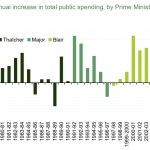
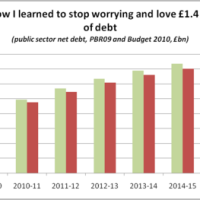
Darling has now exposed as false the Brown/Balls dividing line of "investment vs cuts". If Labour were to win, he said, the cuts would be worse than anything seen under Thatcher in the 1980s. This is Darling's problem: he's a dreadful liar. The IFS today laid out the scale of the cuts that would happen whoever wins the election, and the below graph is worth reprinting. Overall spending falls 12 percent (once dole and debt interest are taken into account). So when Darling says this is worse than anything in the 1980s, he is simply stating a fact. You'd never catch Balls or Brown doing that, by the way, and I hope that, when either pop up for interview, they will be asked if they agree with their Chancellor's assessment.

Labour’s plans require non-ringfenced Budgets to be cut by 25 percent in the next parliament

From our UK edition

At lunchtime, the press headed off to hear the referee's verdict on the Budget. The Institute for Fiscal Studies is now so respected that its view of the Budget largely determines the news agenda. Its briefings are now so popular that they can no longer be held in their basement. So, journalists, economists and accountants piled into a room at the University of London Union which is normally used for battle of the bands contests rather than Budget analysis. The most striking number the IFS presented was that if Labour ringfences the already protected areas of spending for the whole parliament, other departmental budgets will have to be cut by more than 25 percent. One dreads to think what the consequences of slicing a quarter off the defence Budget would be.

How to foil a Dispatches sting

From our UK edition

The producer and director behind the Dispatches lobbying sting, Philip Clothier, has a snappy article over at Prospect, in which he basically asks the question: how could MPs have been so stupid?  But it's his suggestion that some former ministers may have got off lightly which really caught my eye: "Meanwhile, one former Labour cabinet minister was interviewed, but the sound was so poor that we could only hear appetising phrases. He had the good fortune to be sitting in front of a brightly lit window, over-exposing the shot. And we just couldn't understand much of what another former minister said because of his thick accent." Cue all MPs adopting impenetrable accents, and sitting in front of windows, from now on.

Osborne’s weak response

From our UK edition

I was all set up to Fisk the post-Budget analysis which Darling normally gives to the Today programme after the Budget - but he wasn’t there. The Treasury refused to have him debate with Osborne which is what Today (unusually) seems to have assumed. Well, we’d best get used to hearing Osborne post-Budget day. At first, I thought it was a coup for the Tories - but as Evan Davis sharpened his claws, it soon appeared to have been a net negative. Osborne just didn’t sound confident. A series of exchanges left him looking unprepared. His line - that he will eliminate ‘the bulk’ of the annual overspend over the lifetime of the parliament - was challenged: what does it mean?

Darling and Brown get away with it

From our UK edition

Strange days, indeed.  While most of the frontpages today are unflattering for Labour – particularly, and unsurprisingly, those of the Telegraph and the Sun – I imagine that Brown & Co. will be quite pleased with the general tone of the Budget coverage.  Much of it mirrors the Independent's view that Darling "played a weak hand well".  Or, elsewhere, there's a kind of detached indifference about what is described as a "boring" Budget. Yes, if you like, you can take that as proof that the Darling-and-Mandelson approach to the public finances is less politically toxic, and a good degree more sensible, than the Balls-and-Brown approach.

Darling’s nothing budget puts the ball in the Tories’ court

From our UK edition

This year’s Budget was never going to win the election for Labour but it could have lost it. If the markets had reacted really badly to it, warnings about how Britain is in danger of going Greek would have suddenly gained traction. But Darling avoided that fate with a Budget that did little. Listening to it, it was clear that those inside Labour who argued that the strategic imperatives for this Budget had to be appearing credible and not risking an adverse market reaction had prevailed. The mood music was very different from the PBR, with its emphasis on investment versus cuts.

Fiscal drag

From our UK edition

It is good to see the Tories calling fiscal drag what it is, a tax rise by another name. Fiscal drag is a result of holding income tax thresholds steady while both prices and earnings are increasing. This means that more people have to pay more of their income in tax. Gordon Brown indulging in this ploy so often as Chancellor was one of the main reasons that the number of people paying the 40p rate pretty much doubled between 1997 and 2008. One other good thing about the Tory line on fiscal drag today, is that it will put pressure on them to raise personal allowances and income tax thresholds in line with inflation every year. If they don’t, they will be—by their own definition—raising taxes.

In defence of Alistair Darling

From our UK edition

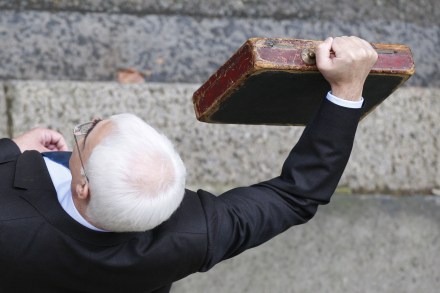
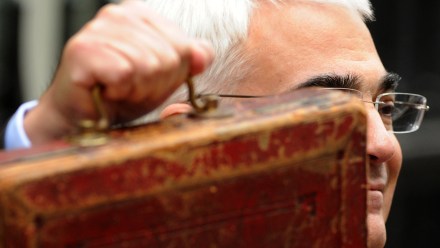
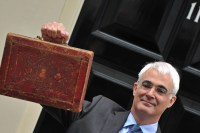
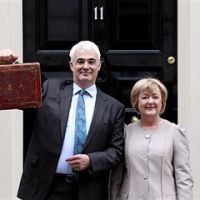
It's unusual for Chancellors to stand with their wives on the steps of the Treasury on budget day, and to see the Darlings together this morning gives an indication of what they have been through. Brown doubtless thought him an automaton when he appointed him to the job - but I was wrong to say that he would be "no more a Chancellor than Captain Scarlett was an actor". He has defied Brown, bringing moderation and much-needed dullness to the worst fiscal crisis in Britain's peacetime history. In James's political column last week he suggested that Darling calls his autobiography "the forces of hell" - that he would defy Brown like that takes some guts. It felt strange to praise Darling in the editorial of tomorrow's magazine, given that he has presided over this fiscal collapse.

This budget penalises employment

From our UK edition

Supporting jobs and small businesses - "the backbone of future economic growth", in Alistair Darling's words - was seen as a priority in today's Budget. In his statement the Chancellor highlighted the following measures: •         Extending the young person's guarantee for one year after March 2011 (providing a job, training or work experience for young people who cannot find work). •         Extending the time to pay scheme, which allows businesses to spread tax payments over a timetable they can afford, for the whole of the next Parliament. •         Cutting the business rates facing small businesses for one year from October.

A reassuringly dull budget

From our UK edition

This was a surprisingly subdued Budget, and for that Alistair Darling is to be commended. He must have resisted all manner of pressure from Brown to put in pre-election pyrotechnics. But the budget was what it should be: a punctuation mark on the sentence of the national economy. That sentence says "our finances are going to hell," and the Budget's high point is that we are doing so fractionally slower than we were expecting to last November. Personally, I forgive Darling all the partisan stuff in his speech - this is a pre-election Budget after all. There is no act of wanton vandalism, like the 50p tax. Stamp duty on properties over 1m is rising from 4 percent to 5 percent, but does anyone seriously think this would not have happened under the Tories?

Darling’s phoney Budget doesn’t change anything

From our UK edition

Was that a Budget sufficient to the fiscal nightmare that we face?  Well, I think we all could have answered that question before Alistair Darling stood up at the dispatch box, but now we can at least be sure: no, it wasn't.  The government's overall spending plans remain roughly the same as they were in the PBR, there aren't many tax increases to raise much money for the Treasury, and we're meant to be all excited that borrowing is £11bn lower this year than previously forecast – at £167bn.  It's a shame that Darling increased alcohol duty, or we'd all be be out celebrating that particular success, I'm sure. If you're feeling charitable to the government, you could say that if might have been worse.

All quiet on the Westminster front

From our UK edition

If there's one thing distinguishing this morning, then it's just how placid everything feels.  The clouds are moving sluggishly across the sky; there's little excitement about the measures expected in the Budget; and there are no stories about rifts between the Prime Minister and the Chancellor.  Indeed, Downing St insiders tell the FT that relations between Gordon Brown and Alistair Darling have been "pretty good" in the run up to the Budget, because both are "broadly agreed on the strategy of halving the deficit in four years while backing growth initiatives." Many are taking this as a sign that Darling and Peter Mandelson have won out in their efforts to coax Brown away from the crude "investment vs cuts" thinking of yesteryear.

Does America Point to a Future for the British Left?

From our UK edition

I have had the pleasure of meeting two major figures of the American intellectual left over the past two weeks: Washington Post columnist EJ Dionne and Michael Kazin, co-editor of Dissent magazine. I'm sure there are as many differences as similarities in the politics of these two men, but what struck me about meeting them was how complacent and flabby we have become in Britain with our progressive politics. The relative strength of the Labour Party and the trade unions make us believe our radical traditions are safe here. But last night's Dispatches made me realise just how fragile a principled left-wing politics has become.  It is as well not to get over-romantic about other intellectual cultures.

Two things to bear in mind tomorrow

From our UK edition

If, as expected, Alistair Darling reduces his borrowing forecasts tomorrow, it's worth keeping two particular points in mind: 1) This government has always tended to underestimate its borrowing levels.  Ok, so you might argue that the government couldn't have foreseen that public sector net borrowing would rise to £178 billion in 2009/10 when it predicted £38 billion in Budget 2008.  A recession has bitten, banks have collapsed, since then – that kind of thing.  But Brown & Co. certainly have a track record when it comes to underestimating borrowing totals.  In Budget 1999, they thought that borrowing would be at £3 billion in 2002-03 – it turned out to be £23 billion.

Alistair Darling needs to tell us that frontline services will be affected by cuts

From our UK edition

The credibility of the Chancellor’s Budget tomorrow depends on the policy changes that he announces for the public sector.  It won’t be enough for him just to announce a series of public spending totals that decline gracefully in the years to come.  Within some broad limits, anyone can do that.  What counts is whether he backs it up with practical ideas to target the big government costs, which lie in two places - benefits and the public sector workforce. In retrospect, the general election has fallen at the wrong time for the UK public finances.  Since early last year, the prospect of an early election has allowed the Government to put off the date of publication of its full plan to address the deficit.

The Budget is a bigger opportunity for the Tories than for Labour

From our UK edition

Last night's Dispatches programme was a concentrated double blow for Labour.  Not only did the limelight burn more unflatteringly on their party, but it has also undermined their careful Budget operation.  For the next few days, at least, it's possible that broken politics may trump the broken economy in the public mind.  And Alistair Darling is going to have a difficult, if not impossible, task in bridging that chasm of "distrust and disbelief" with his prescriptions tomorrow.