Labour party

The killer poster

From our UK edition

So, as Daniel Korski wrote earlier, a vote for Nick Clegg keeps Labour in office - surely fertile territory for a killer poster? Here's a selection of CoffeeHousers'  'Vote Nick Get Gordon' posters. Remember him?

A bumpy ride for Brown on Radio One

From our UK edition

Gordon, meet disillusionment.  Disillusionment, the Prime Minister.  Ask him questions on whatever you want: the economy, jobs, immigration, expenses - the ball is in your court.  Make him squirm, if you like.  Confront him.  He is, after all, here at your pleasure. For that was the set-up of Radio One Newsbeat's interview with Gordon Brown earlier this afternoon.  It was one of those impossible situations for the PM.  He could hardly decline to be quizzed by a group of first time voters, aged between 18 and 28.  But it put him at the mercy of some pretty disgruntled members of the public.  And they took full advantage. The questions were direct and drew blood.  On the economy: "Where are the cuts going to come from?

Brown’s leadership back under the spotlight

From our UK edition

Things have clearly moved on since I wrote this back in March.  From Rachel Sylvester's column today: "...those close to Mr Clegg have made it clear to senior Labour figures that it would be difficult for the Liberal Democrats to do a deal with a Labour Party led by Mr Brown. 'The whole notion of change is so important to Clegg and Gordon doesn’t represent change,' says one Labour strategist. 'It’s hard to see how they could prop up Brown in a hung Parliament.' With Cabinet ministers openly discussing the prospect of coalition, the question of the Labour leadership is back on the agenda.

Is Nick Clegg really Robert Redford?

From our UK edition

And not in a Cleggover* or Rentoul-bait sense either. No, you remember The Candidate? Of course you do for you enjoy political movies as much as we do. Which means you'll also remember the movie's strapline: Too Handsome. Too Young. Too Liberal. Doesn't have a chance. He's PERFECT! And you'll also recall the movie's final line, delivered after Redford's character wins an unlikely victory: What do we do now? It was never clear that Redford had an answer to this and nor, frankly, is it obvious that Nick Clegg does either. Again and at the risk of repeating myself, how can Clegg be the "Agent of Change" if, once the election hurly-burly is done with he pivots to support a minority Labour ministry?

Towards a Tory-Lib Dem Future?

From our UK edition

I don't really know if the Tories "Vote Clegg, get Brown" argument will work but if I had to bet on it I'd guess that it won't. There's a large enough constituency out there that doesn't want either the Tories or Labour. Nevertheless, the post-election environment now becomes very interesting. Suppose, just for now, that Labour come third in the popular vote but actually win the most seats. What happens then? And this could happen. Consider this scenario: Tories 33%, Labour 28%, Lib Dems 29% - according to Electoral Calculus and, admittedly, on a crude national and uniform swing, this could produce a result something like Tories 258, Labour 265, Liberals 95.

The Land That Time Forgot

From our UK edition

That would be Scotland, of course. Dear old Scotia, meek and mild and quiet as a well-nursed child. There was another YouGov poll released at the weekend and this Scotland on Sunday survey had its own startling findings. To wit: Labour - 40% SNP - 20% Lib Dems - 19% Tories - 16% Others - 5% You read that correctly. After 13 years and the worst fiscal apocalypse in 70 years 40% of my compatriots will still, like so many zombies, endorse the Labour party just as their faither did before them and, god knows, perhaps his faither before him too. True, this poll may slightly under-estimate currrent levels of Lib Dem support since half of it was conducted before last week's debate.

And so to Brown…

From our UK edition

Haven't we been here before?  Investment versus cuts, I mean.  Because that appears to be the main message of Labour's press conference this moring.  Gordon Brown set about the Tories' Big Society, claiming that it "means big cuts in public services".  Hm. It's certainly a punchier, if similar, message to the "agenda of abandonment" one that Labour roadtested last week.  But will voters listen?  Well, amid all the excitement about Clegg and the Lib Dems, it's easy to forget that Labour are now polling third – with a vote share which recalls the days of Michael Foot's leadership.  They seem to be in a pretty desperate position themselves. This may suit Labour, so far as the chances of a hung parliament are concerned.

Can the Tories turn things from personality to policy?

From our UK edition

If the Lib Dem surge shows anything, then it's the growing power of personality politics in this country.  A few days ago, they're languishing in third place with around 20 percent of the vote.  One dose of TV razzmatazz later, and they're topping the polls on over 30 percent.  Yes, even though I admire much of what Nick Clegg has done with his party, there's little doubt that all this has been catalysed by simply putting him in front of the cameras.  Like someone with an okay singing voice reaching the X-Factor final, the Lib Dem leader triumphed in what was essentially a clash of personalities.

YouGov have the Lib Dems on top

From our UK edition

Tonight's YouGov tracker has the Lib Dems on 33 percent (up 4), the Tories on 32 percent (down 1) and Labour on 26 percent (down 4).  So the topsy-turviness continues – but for how long?

How Whelan & Co. exploit Britain’s libel laws

From our UK edition

The Charlie Whelan problem is intensifying for Labour, with more revelations in the Mail on Sunday today taking on from our cover story in this week’s magazine. Whelan’s behaviour may be no worse than that of Ed Balls and Gordon Brown – but he is more careless. Like McBride, he was actually caught: and his tactics documented in a formal seven-page report. Not the sort of document you want surfacing during a campaign. So it's little wonder why Whelan used Carter-Ruck to try and deter The Spectator from any further investigation in the bullying case: it threatens to expose Gordon Brown’s entire modus operandi and the methods which he uses to control the party. And, for that matter, run the country.

Brown’s mindset on full display

From our UK edition

Labour high command will be very satisfied with Brown’s performance on Marr this morning. There was far less of the tetchiness that we usually see from Brown in interviews and by being invited to talk about the ash cloud and the government’s response to it at the beginning, Brown was able to assume some of the aura of his office as Prime Minister. The interview saw the debut of Brown’s latest rewriting of history. Apparently he has always been for bringing in the liberals (exact quote to follow when the BBC release the transcript) and a ‘progressive consensus’. This will come as a shock to anyone who has read Paddy Ashdown’s diaries or talked to those involved in the discussions between the two parties in the mid to late nineties.

Mandelson contra Cameron

From our UK edition

So far as the Tories are concerned, Peter Mandelson is the political equivalent of an itch that you can't scratch: irritating, elusive and impossible to ignore.  And he's at it again today, with an article in the Independent on Sunday chiding the Tories' over their Big Society agenda.   It's not the "agenda of abandoment" attack that Mandelson made a few days ago.  But, rather, a return to the "cross-dressing" territory of last year.  As Mandelson puts it, "[Cameron's] tightly knit group of associates has simply pinched a few ideas from our campaign manual, rather than fundamentally reforming the party to make it fit for office.

The Enthusiasm Gap

From our UK edition

As James says, we're going to need to wait a few days before we can be sure if the Lib Dem surge has legs but, yes, right now something is happening. The headline figures for the three polls we've seen since Clegg's coming-out party are: ComRes: Con: 31 (-4) Lab: 27 (-2) Lib: 29 (+8) ICM: Con: 34 (-3) Lab: 29 (-2) Lib: 27 (+7) YouGov: Con: 33 (-4) Lab: 28 (-3) Lib: 30 (+8) That's all striking enough but so too is this finding from the Independent on Sunday's ComRes poll: Only 53% of self-proclaimed Labour voters say their preferred election outcome is a Labour majority. By contrast 67% of Conservative voters say they want Cameron to win a majority.

The impediment to a Lib-Lab coalition

From our UK edition

Certainly, the Lib Dems’ current joy will prove transient; but for the first time since 1983 this is a three party race. As Pete notes, Labour see Nick Clegg as the surest means to keep the Tories out of office. Even before the debate, the normally cerebral Andrew Adonis was penning passionate articles appealing to Lib Dem support. Since the debate, the love-bombing campaign has become indiscriminate .   Love isn’t all you need. Labour will need nous to make the most of the opportunity Clegg has presented.

Responding to the Lib Dem surge

From our UK edition

We've had the insta-polls and that eyectaching YouGov poll, and now we get the political reaction to Thursday's TV debate.  Interviewed in the Times, Alan Johnson plays up what Labour and the Lib Dems have "in common," and opens the door on a potential coalition.  While, in the Telegraph, David Cameron sets about Lib Dems policies – attacking, for instance, the "flimsy backing" to their plan for making the first £10,000 of income tax-free These different responses to the Lib Dem surge are stiking, if predictable.  Labour see Clegg as an opportunity: an opportunity to whitewash Brown's mechanical performance in the TV debate, and to keep the Tories out of government.

So what’s changed?

From our UK edition

The question is: how much has really changed after last night?  And the answer is hard to pin down.  There are the plastic, surface changes, of course.  Nick Clegg may now be recognised by more that one-third of the nation.  His party will probably come under greater scrutiny from the media and his opponents.  And the leaders' debate is here to stay; a defining feature of this election which will become a standard feature of future contests. But what about deeper change?  Well, I can understand the argument – made punchily by Gideon Rachman here – that this will increase the likelihood of a hung Parliament.  That's probably true.  But there's also a chance that it might help the Tories pull clear of their opponents.

The novelty of Clegg wins it for him

From our UK edition

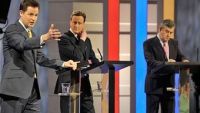
“I agree with Nick”, said Brown – and, as it turned out, so did most of the people YouGov polled. Brown lived right down to expectations, Cameron lived up to them (but didn’t exceed them). Few would have had any expectations from Clegg: what we political pundits know to be his clichés will be heard for the first time in many living rooms tonight. Each used tactics we’re familiar with. Brown opened his verbal machine gun, and sought to mow down the audience (they surrendered early on). David Cameron was fluent, articulate – as anyone who has followed politics had come to expect. But dazzling? No. He was subdued, seemed to be biting his tongue at times. He didn’t attack Brown, which seemed to be deliberate.

Nick Clegg triumphs – and Cameron gains – in the first TV debate

From our UK edition

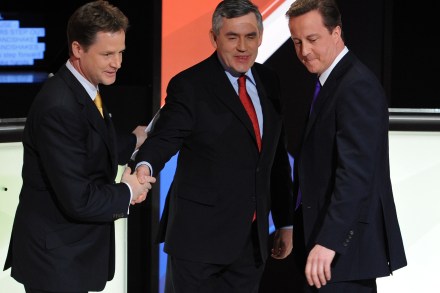
So, who won?  Well, hold your horses, dear CoffeeHouser.  First, it's worth noting that that was a good shade more compelling than I thought it would be.  There were moments of heat, drama and political tension, of course.  But there was also a sprinkling of light as well.  I suspect anyone watching that would have picked up a working sense of the differences and similarities between the parties and their leaders. So, who won?  Well, it depends what you mean by "won".  Nick Clegg certainly gained most from the evening.  He was confident, coherent and had a strong line on almost every policy area, whether you agreed with those lines or not.

Eddie Izzard – Brilliant Britain

From our UK edition

I'd watch anything over a party political broadcast, anything except Piers Morgan. But Eddie Izzard’s Labour broadcast (below) promised to be different. What a letdown it proved to be, just like any other bland effort. The jokes are marginally funnier than an aneurism, and the message is negative, despite the 'brilliant Britain' theme. The ad is a manifestation of Labour's problem. Izzard offers nothing beyond morbid fear of Tories, Thatcher and money. (Incidentally, I recall a chummy Brown cosying up to the Handbag on the steps of No 10 not so long ago. Did she bite him?) Because Labour cannot represent change, it must guard its record.