Labour party

Labour’s Catch 22

From our UK edition

The sole current political certainty is that Nick Clegg will not prop-up Gordon Brown. Clegg holds Brown personally responsible for 13 years of failure and not even political marriages can be built on enmity.  Labour’s choice is clear: remove Brown to accommodate Clegg. The Sunday Times reports plots are afoot to kill Gordon ‘with dignity’. But euthanasia is messy. Two options are being discussed. First, Brown would be given a year to make a final indelible mark on Britain before shipping himself off to Westminster’s version of Dignitas. I think we can all see the problem with that cunning scheme, and Nick Clegg certainly will.

Just whom will the Lib Dems work with, then?

From our UK edition

Two noteworthy entries, today, in the will-they-won't-they game of coalition government.  The first from Nick Clegg in the Sunday Times: "You can’t have Gordon Brown squatting in No 10 just because of the irrational idiosyncrasies of our electoral system." And the second from Paddy Ashdown speaking to the People: "Nick Clegg cannot work with David Cameron ... We could not go into a coalition with the Tories, it wouldn't work." So, assuming both are true, it sounds as though Clegg would only work with a Labour party headed by someone other than Brown.  But don't count on it.

Brown Must Manage the Next Twelve Days With Dignity

From our UK edition

Let's not forget that the Labour Party should not have been able to lose this election. I am still convinced that Cameron came to the Tory leadership with a two-election strategy. The swing needed to win a clear majority was always huge. Part of the reason that the party leadership has found it so difficult to retain the lead in the polls is that they could never quite belive their luck at the collapse of Labour support.  Likewise, the Lib Dem surge has happened partly because no one is quite convinced that the Tories are ready for government. But the real story of the next week and a half will be how Gordon Brown deals with the draining away of Labour support.

When the going gets weird, the weird hire an Elvis impersonator

From our UK edition

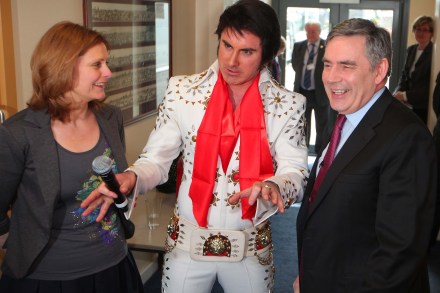
Really, what's happened to the Labour campaign?  You know things are taking a turn for the worse when you read that Gordon Brown is taking a more high profile role to save his party from a third-place finish.  But then you see that high profile role in action, and, well ... First there was an event which incorporated some deliciously ironic innuendo about the Tories' spending cuts.  The PM lamented the fact that Jeremy Paxman didn't press the Tory leader on claims that there is "too much" public spending in Northern Ireland and the North East, concluding that "there is no part of the United Kingdom that is safe from what the Conservative party would do.

In This Election Every Vote Counts: Even in Safe Seats

From our UK edition

Jonathan Freedland is surely right: Labour's best hope, now that the electorate appears to have decided that "change" matters* and dismissed Labour's pretensions to offer that change, is to maximise its core vote in the hope of avoiding an electoral meltdown that would, say, leave them with fewer than 200 seats in the new parliament. If Labour aren't quite the walking dead the Tories were in 1997 that's because of the current constituency boundaries, not because there's any more life in the Labour campaign.

No, Gordon, this recession hasn’t been milder than others

From our UK edition

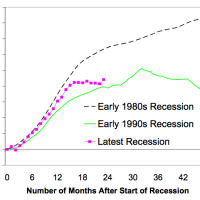
Today’s new economic data gives a handy piece of ammo to the Conservatives.  It is untrue that, as Gordon Brown says, this recession was somehow milder than others. The economy contracted by 6.3 percent this time – it was 3.8 percent in the 1980s recession and just 2.4 percent in the early 1990s recession. I feel confident that the Conservatives will get this point across clearly, next time that Brown boasts that this recession has been somehow milder, thanks to his decision to “intervene” (ie, double our national debt).

A culture of intimidation and a conspiracy to silence

From our UK edition

On the afternoon of 4 June 2009, John Hutton, then Secretary of State for Defence, told the House of Commons: ‘Every one of our servicemen and women has the right to know that we are doing everything possible to ensure that every pound of investment in our equipment programme goes towards the front line and is not wasted in inefficient or weak processes of acquisition. That is why I asked Bernard Gray in December last year to conduct a detailed examination of progress in implementing the MOD’s acquisition change programme, as I hope right hon. and hon. Members will recall. I have to be satisfied that the current programme of change is sufficient to meet the challenges of the new combat environment that we now face. To date, I am not.

GDP grows by 0.2 percent in first quarter of 2010

From our UK edition

Now we know: the official preliminary estimate says that GDP grew by 0.2 percent in the first quarter of the year. So the double dip looks to have been averted (for now) – but not by much. The figure is at the low end of economists' estimates and lower than the growth experienced in the final quarter of 2009. Labour, of course, will spin this as further proof that we can't risk the recovery by voting for those dastardly Tories.  And the Tories will say that it shows just how damaging Gordon Brown has been for our economy.  But I wonder whether voters will choose between the two messages, or come to see a hung parliament as a decent compromise between them.  If it's the latter, then fasten your seatbelts, etc.

The morning after the debate before

From our UK edition

So, like last week: what's changed?  And, like last week, it's probably too early to judge.  The insta-polls may have Cameron and Clegg on level footing, but, really, we need to wait for voting intention polls before coming to any firm conclusions.  As we saw the day after the first debate, they can work in quite surprising ways. My instinct, though, is that things will remain relatively steady.  The Clegg surge of last week was, at root, a cry for change from the electorate – any change.  So it will probably take more than a solid Cameron victory in one TV debate to have voters flooding back to the Tories.  And it will probably take worse than a decent enough performance from Nick Clegg to shoot down the yellow bird of liberty.

Cameron starts to pull the Tory campaign out of the fire

From our UK edition

The headlines will be "score draw", but I’d say Cameron won – and comfortably. I write this as someone who could have happily have sunk a few pins into a voodoo doll of David Cameron earlier on this evening – for taking the Conservatives (and Britain) to this appalling point where he may yet lose the election. But he raised his game, substantially. At best, he spoke with passion and authenticity. This time, he looked like he was fighting for his political life, which (of course) he is. Things are looking up. Here’s my participant-by-participant verdict: Brown Brown was his normal automaton self. He does tend to mangle his words, and his attempts at simplification backfire.

Cameron is much improved – but the Lib Dem bubble hasn’t burst

From our UK edition

It seems that the general election of 2010 will turn on 90 minutes next Thursday. David Cameron was far better tonight than he was last week. This time he managed to bracket Brown and Clegg together and had the moment of the debate when he called Brown out on Labour’s leaflets claiming the Tories would scrap various things that pensioners currently get free. If there was a YouTube moment in the debate, it was that exchange when Brown said he didn’t authorise the leaflets making these claims. The Tory press team then delighted in pointing to a Labour party political broadcast where they had suggested the Tories would take away these things. Nick Clegg came under far more fire than he did in Manchester.

Cameron’s evening – as he and Brown fight back against the Clegg surge

From our UK edition

Well, one thing was clear: Brown and Cameron have both been at the textbooks, staying behind for extra classes, and learning the lessons of last week.  They came into this TV debate prepared.  Not just for the very fact of Nick Clegg, but with strategies and soundbites to slow his advance.  The result was a more passionate and confrontational show than I expected. Brown was the biggest surprise on the night.  Sure, you have to apply the usual caveats and parameters: he is Gordon Brown, and being disingenuous and deluded is what he does.  But, all that considered, he was uncharacteristically sprightly, I thought.

Team Brown playing the same old tunes

From our UK edition

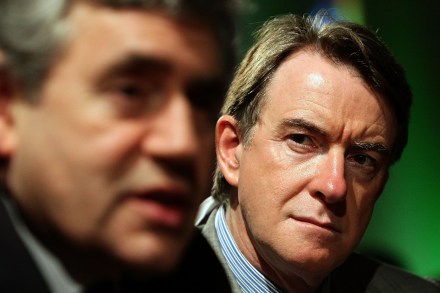
The strange thing about last week's TV debate is that, for all its transformative power, it doesn't seem to have changed Labour's campaign strategy in any fundamental way.  Team Brown were hoping for a hung Parliament, and courting the Lib Dems, before last week.  And, as Peter Mandelson demonstrated earlier, they're still doing the same now.  The only difference is that it's more likely their wishes will come true. But this creates problems for Brown so far as tonight's TV debate and the rest of the election are concerned.  His instinct may well be to repeat the "I agree with Nick" positioning of last week.  But this has already been heavily lampooned - and was batted away quite comprehensively by Clegg the last time he tried it.

Is Europe a Con-Lib deal-breaker?

From our UK edition

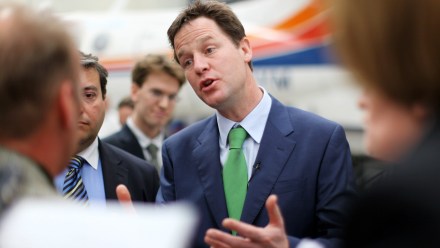
Europe is likely to play a big role in tonight’s debate. It is probably the one issue that divides the Liberal Democrats and the Tories as much as electoral reform. Nick Clegg, a former MEP and adviser to then-EU Commissioner Leon Brittan, is a euro-enthusiast who would like Britain to join the Euro, even if it takes time. David Cameron is a euro-skeptic (though not, to the chagrin of many CoffeHouse readers, obsessed about the issue).   But neither wants a confrontation with the EU and other European governments over the next four years - and the Liberal Democrats have become quieter over time about their pro-EU tendencies.

A Tory-Liberal Coalition is Easier than a Lib-Lab Pact?

From our UK edition

I'm glad to see that more people - Iain Dale, John Rentoul, Iain Martin among them - are paying attention to Labour's eclipse. At present Labour could finish third in the popular vote for the first time since 1922 and yet many people seem to assume that a Labour-Liberal Democrat coalition or arrangement of some sort is the most likely, even inevitable, outcome of a hung parliament. I don't believe this is the case and not only because of Nick Clegg's attack on "desperate" Gordon Brown this morning. The Liberal Democrats have based their campaign for proportional representation on the grounds that it is unfair that, as they did in 2005, you could win 22% of the votes cast but only 9% of the parliamentary seats. There is some merit to this argument too.

The Tories need to get economical

From our UK edition

Nick Clegg handed Gordon Brown a lifeline in one respect: the economy’s old hat compared to the Clegg frenzy. Not any more. The news that unemployment rose by 43,000 between December and February, together with yesterday’s dramatic inflation rise, has dumped the economy back onto the front pages. The Tories must keep it there; this election should be about the economy and nothing else. Obviously, these figures, which are worse than expected, lend weight to the argument that Brown’s policies impair recovery. Also, they demolish Brown’s claim that he ran up a deficit in the boom years to protect employment: unemployment is now higher than it was 16 years ago.

What happens if this is the result?

From our UK edition

Tonight’s YouGov poll has the Lib Dems three point ahead. They are on 34, the Tories on 31 and Labour on 26. In terms of working out what this would mean in seats, I doubt that uniform national swing is that useful. But for the sake of argument, let’s imagine that did occur. These poll numbers would leave Labour as the largest party in the Commons and the Lib Dems as the third party. One wonders what on earth happens then.   The Palace would pretty much have to summon Brown, he’s the sitting Prime Minister and would be the leader of the party with the most seats. But I can hardly imagine the Lib Dems, if they had the most votes, agreeing to serve as junior partners in anyone’s coalition let alone Brown’s.

Clegg Helps Cameron, Not Brown

From our UK edition

Oh, sure, the rise of the Liberal Democrats is a problem for the Conservatives too and it doesn't help their chances of securing an overall majority. But it may be an even bigger problem for Gordon Brown. Can anyone really remember anything Labour have said since Thursday's debate? Not really. It's as though Labour have been erased from the campaign entirely, leaving the field to the Conservatives and the Liberals. The Cleggathon has had another effect: it reinforces the case for change and strengthens and deepens the media narrative about change. This too must cost Labour dear. The media has constructed a campaign story that accepts that change is a given and all that we're doing now is haggling over the details.