Labour party

The IDS plan approaches consensus status

From our UK edition

Plenty of attention for Nick Clegg's listening, reading and smoking habits this morning, as well as his appearance on the Andrew Marr show. But it is another of Marr's guests who has made perhaps the most important intervention of the day: the shadow work and pensions secretary, Douglas Alexander. Here's how the Beeb website reports it: "Mr Alexander also said he backed 'in principle' the coalition's plan to replace all out-of-work benefits with a single 'universal credit' payment. He said such a move was 'sensible' but he would be 'scrutinising' the government 'very carefully' over its £2bn start-up costs." If true, then it leaves the the parties in a surprisingly similar position on welfare.

Simpson and Bayliss are reading the Miliband creed

From our UK edition

Derek Simpson has had a Damascene conversion. The gnarled bruiser, famous for telling Alistair Darling to ‘tax the bankers out of existence’, has backed Les Bayliss, the moderate candidate in the race to lead Unite. According to Sophy Ridge at the News of the World, Simpson added: 'Ranting and raving from the side lines will only keep Labour in opposition for a generation. The cuts announced this week are the tip of a very nasty iceberg but the task of opposing them will be complex. Only one candidate standing in the Unite general secretary election has in my mind the skills for this difficult job.

Not good enough

From our UK edition

Tony Blair gave his record in government ten out of ten, though an ungrateful electorate scored rather less well and his Cabinet colleagues performed even worse. Sadly, they were ill-equipped to grasp his unique qualities of leadership. Milord Peter Mandelson reached broadly similar conclusions. Their instant apologia are meant to be the last word on the subject, living obituaries on 13 years in power. So what are we to make of the verdict of New Labour’s two most respectable cheerleaders, who offer a ‘not good enough’ six out of ten for their government’s performance? Toynbee and Walker (they sound like an old-established firm of country solicitors — ‘very reliable, y’know’) are not persuaded.

The Islamic Republic of Tower Hamlets

From our UK edition

Andrew Gilligan explains why Lutfur Rahman’s victory in Tower Hamlets is a potentially alarming development. Obviously, this is a humiliation for Ed Miliband. The victory of a de-selected Labour councillor is bad enough, but what does he say about Ken Livingstone’s involvement in Rahman’s campaign? Widening those imploring eyes, offering an apologetic shrug and saying "Ken will be Ken" probably won’t cut the mustard this time. Perversely, Livingstone might benefit from Rahman’s victory, as it has allowed him to resuscitate his ‘Red Ken the insurgent’ pose – and you can’t get much more cynically subversive than this latest stunt.

Labour’s Kill Clegg strategy

From our UK edition

One question swirling through the sea of British politics is this: how will Ed Miliband act towards the Lib Dems? The Labour leader certainly didn't flinch from attacking the yellow brigade during the leadership contest, at one point calling them a "disgrace to the traditions of liberalism." But surely he'll have to soften that rhetoric in case the next election delivers another bout of frenzied coalition negotiations. Which is why Andy Burnham's article in the Guardian today is worth noting down. In making his point – that the Lib Dems haven't won the pupil premium they sought – he does all he can to force a wedge between Nick Clegg and his party. It's "Clegg's failure". It's "Clegg's ideological journey". It's a "problem for Clegg," and so on.

From the archives: The birth of the NHS

From our UK edition

File this double shot from the Spectator archives in the folder marked 'For historical interest'. Our leading article on the creation of the National Health Service in 1948, and an essay by Lord Moran from one week after: Health and security, The Spectator, 2 July, 1948 July 5th, 1948, will be a notable date in British social history, marking as it does the entry into operation of the National Health Service and the National Insurance Acts.

Labour loses the last semblance of its economic credibility

From our UK edition

A quiet but important change to Britain’s political landscape took place in Brussels on Wednesday. The European Parliament passed a motion to increase the EU Budget by 5.9 percent, dashing, for the moment, government hopes that the EU might share in its citizens’ austerity. Labour’s MEPs were central to the motion’s success – 10 (one of whom glories in the name Michael Cashman) out of 13 voted against the Conservative-backed amendment to freeze the EU Budget.      As Alan Johnson took his feet and, like a gamey slim-line Falstaff, began to condemn public sector cuts, Labour MEPs saddled the over-stretched taxpayer with £900m in extra contributions – more than the odd nurse could have been saved with that tidy little sum.

Balls fires a warning shot at May

From our UK edition

It has taken Ed Balls 24 hours to steam into action. He says: “The government’s deep cuts of twenty per cent to policing could mean up to 20,000 fewer police officers, according to the Police Federation. And I’m particularly worried that specialist policing units, such as those to tackle organised crime, domestic violence or child abuse which the government no longer considers to be part of the frontline, could be the first to be cut.” This comes as the latest crime figures suggest that crime has fallen, thanks in part to the last government’s massive recruitment drive in policing and its increase of the prison population.

Cameron’s warm-up act for Boy George

From our UK edition

Cameron was a mere warm-up man at PMQs today. With Osborne’s statement due at 12.30 the session felt like a friendly knock-up rather than the main fixture. Ed Miliband rose to thunderous cheers from his backbenches and he tried to capitalise on their support by opening up an ancient Tory wound – heartless attitudes to unemployment. Spotting Cameron chinwagging with Osborne instead of listening, Miliband chided the PM for not paying attention. ‘Well, it’s a novel concept,’ said Dave smoothly ‘but in this government the prime minister and the chancellor speak to each other.’   Ed’s problem was that the OBR has predicted rising employment for the next three years. Bad news for the opposition leader.

PMQs live blog | 20 October 2010

From our UK edition

QUICK VERDICT: More heat than light today, but Cameron easily got the better of Ed Miliband. Now to the Spending Review live blog. 1230: Cameron says that as cuts are made, the government will have to reform the way it does criminal justice. This is a prelude for the deep cuts that the Home Office and Justice department are expected to face in the spending review. 1228: The Lib Dem MP asks whether Cameron believes that better-off graduates should bear more for their university costs. Cameron says that he agrees on principle, and claims that "everyone in the House" wants the "same thing": a fair and well-funded university system. 1226: Cameron says that the spending review will contain answers on social housing - but hints that the results may be better than expected.

How we got here – and where we’re going

From our UK edition

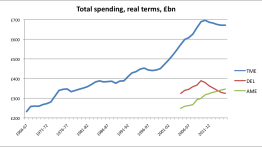
With the Spending Review less than two hours away, I thought CoffeeHousers might like to be armed with a few graphs that set the scene. What follows is by no means the complete picture of the fiscal landscape, but these are certainly some of most prominent landmarks. First up, real terms spending (aka Total Managed Expenditure) from 1966 to 2015: So, yes, all the fuss is about that small dip at the end of the blue line – a dip, as it happens, of about four percent. But don't think that the fuss is entirely unwarranted. What the government is trying to do here is curb a trend of ever-increasing spending that has persisted over decades, and which rocketed during the New Labour years.

The slog starts today

From our UK edition

Welcome to Stage Two of the government's life. The first stage was the Budget, which established the size of the fiscal mountain looming over the coalition. The third stage will be the difficult, four-year slog up to the top. But today – the Spending Review – is all about determining the route for that ascent. In just a few hours we will know when, where and why the pain will come. Don't forget to pack sandwiches. Of course, with this roadmap being drawn out in Westminster, we already know some of the details. This morning's papers major on the fact – snapped from Danny Alexander's hands yesterday – that almost 500,000 public sector jobs will be lost over the next four to five years. And then there are the actual departmental settlements.

Alan Johnson’s economic gamble

From our UK edition

The most shameless line of Alan Johnson's big speech came at the beginning. "Being in opposition does not mean pretending to be in government," he averred, "we will not be producting a shadow spending review." Which would be fair enough, were it not for one simple fact: the Brown government didn't produce a spending review when one was due, last year, either. In which case, Labour's new economic policy is much like their old one. They are sticking by the Alistair Darling plan to halve the deficit over this Parliament, which is encouraging given some of the alternatives. Yet there is still not much detail about how this might actually be achieved. As he has done over the past few days, Johnson riffed on about increasing the taxes on banks.

The presentational battle begins in earnest – as the double-dip warnings wind down

From our UK edition

Rule 97 in the Practitioner's Guide to Westminster Politics: if you want to get a message out pronto, then corral a bunch of impressive names into writing a letter to a national newspaper. We saw the tactic used by both Labour and the Tories before the election. And we see it again today, with a letter in the Telegraph, drafted by the Tory peer Lord Wolfson and signed by 35 business leaders, pushing George Osborne to "press ahead with his plans to reduce the deficit". And you know what? He may just do that. In truth, these kinds of letters are hardly a bad thing for the government, however stage-managed they might be. As the week of the spending review kicks in, the headline that people will see is: "Cut now or pay later, say business leaders".

Why the Tories didn’t win

From our UK edition

Courtesy of John Rentoul, Tim Bale, professor of politics at the University of Sussex, offers this appraisal of the 2010 election: 'For all the talk in opposition of decontaminating the Tory brand, of making the party more tolerant and inclusive and less ‘nasty’, the key task facing Cameron when he took over in late 2005 was reassuring voters that the Conservatives could be trusted on welfare and public services.  All the market research suggested that this was the sine qua non — a necessary if not a sufficient condition — of a return to office. When the global financial crisis hit and Britain’s budget deficit ballooned, however, this task remained unfinished and work on it practically ceased.

Labour to propose raising the top rate of income tax?

From our UK edition

Peter Hain is wizened counsellor to young king Ed, or gives that impression at least. The two are close, which makes Hain’s recent comments on tax noteworthy. Hain describes universal benefit as ‘non-negotiable’, adding: "If you start driving a coach and horses through universality you're effectively saying to middle Britain, 'you've got no stake in the welfare state.' I think the Tories and Liberals are making a very big mistake on child benefit. There's an answer to people on higher incomes and that's they pay higher taxes. And that is the answer to squaring that circle.

Left out

From our UK edition

New Labour Islington is no more – it is now an area for Tory-voting bankers When I grew up in Islington in the 1980s and 90s, there was a reliable election ritual: the bigger the Georgian villa, the more likely the resident barrister was to put up a Labour poster in his sash window. If they weren’t barristers, they were senior Labour politicians. Some were both. The poster in the window in the rambling terraced house in Canonbury belonged to Charlie Falconer, later lord chancellor. Nearby was Malvern Terrace, home to Brenda Dean, later Lady Dean, former general secretary of the print union Sogat. Next door was Margaret Hodge. A few doors down, at 1 Richmond Crescent, was the spiritual king of fashionable Islington, Tony Blair.

Labour’s economic credibility goes on tour to Brussels

From our UK edition

Bill Cash’s amendment to the EU budget bill may not have been the victory that the signatories to Douglas Carswell’s more incendiary effort hoped for, but it is significant. It is exactly in line with government policy that seeks to cap the EU budget and search for cuts. As Treasury Minister Justine Greening put it in the debate last night: ‘I will not hide from the House the Government's frustration that some of our partners - and those in EU institutions - do not seem to understand how bizarre it is, when national budgets are under such extraordinary pressure, that the EU should be immune from that.’ The EU Commission proposes a rise of 6 percent, well above inflation, whilst the EU parliament's budget committee called for a 2.