Labour party

PMQs live blog | 3 November 2010

From our UK edition

VERDICT: Perhaps the snappiest exchange between Cameron and Miliband so far, with both men on combative form. Miliband's charge was that, from tuition fees to child benefit, the coalition is breaking promises that it made before the election. And Cameron's counter was that he has had to take tough action to deal with the mess that Labour left behind, and that Ed Miliband has nothing to offer to that process other than kneejerk opposition. As exchanges across the dispatch box go, that's pretty standard stuff – but at least it was packaged with some wit (although little real insight) today. A score draw. 1232: And that's it. My short verdict coming up.

Why is Hopi Sen a Free Man?

From our UK edition

By which I mean why isn't he cooped up inside Ed Miliband's office, working as a strategy-comms chap? Maybe he wouldn't want the gig but it's a good thing for us (in both a blogging and an anti-Labour sense) that he's still a free man. Take this latest bout of good sense, for instance: Our nation has significant challenges – from deficit reduction to welfare policy to job growth. As an opposition we must have opinions on all of these, but lack the power to act on them. That is an exposed, vulnerable position. We already know how the Tories want to define us.  They want to spend the next four years painting us as wasteful in the public services, over-generous with welfare at the price of higher taxes for working families.

Cameron emerges unscathed

From our UK edition

David Cameron’s statement on the European summit just now was an opportunity for pro-European politicians to tweak the Conservative party’s tail about the coalition’s stance on Europe. Ed Miliband told the PM that on Europe ‘we’re here to help him’ and ‘we’re prepared to ignore his previous convictions if he is too.’ Charles Kennedy welcomed the PM as a new pro-European. While Denis MacShane, the very communitaire former Europe Minister, said that there was nothing in Cameron’s statement he disagreed with. There was some grumbling from the Tory benches. Sir Peter Tapsell asked why if Merkel can get a Treaty amended can’t Cameron do the same and allow the country the referendum it was promised.

All is not quiet of the welfare front

From our UK edition

Welfare is fast becoming this parliament’s Ypres Salient - strategically critical, it is constantly contested. £20bn on social housing, £100bn on out of work benefits and £billions on universal benefits: welfare reform is where spending cuts are most conspicuous. A rhetorical confrontation is building and various tactical dispositions are being made. The Staggers’ George Eaton has an analysis that assumes that Labour’s current wedge-strategy (which I critiqued here) is not working because it is avowedly sectional, privileging those who might be caricatured as ‘undeserving’. Eaton argues that Labour must ‘launch a defence of the hard pressed majority’; those who work but still stand to lose, particularly families.

Labour’s Housing Benefit U-Turn

From our UK edition

Hats off to Tom Harris for pointing out the obvious: comparing the coalition's canges to housing benefit to Balkan ethnic cleansing or Auschwitz is neither big nor clever. Points too for reminding us that the Labour manifesto this year included this passage: Our goal is to make responsibility the cornerstone of our welfare state. Housing Benefit will be reformed to ensure that we do not subsidise people to live in the private sector on rents that other ordinary working families could not afford. How many "ordinary working families" (however they may be categorised) can afford to pay £25,000 in rent each year? Precious few, I submit.

Return of the Gord

From our UK edition

Oh look, the Old Crowd are moving in on the New Generation's patch. Not only has David Miliband broken his post-defeat silence with an engaging little article in the Mail on Sunday, but we also have news that Gordon Brown is to make his first Commons speech since the general election. That's right, after 174 paid days of, erm, indiscernible activity, Gordon will tomorrow insist that maintenance on Britain's two new aircraft carriers should be carried out on a Scottish shipyard, rather than in France. Everyone else is surprised that he didn't get that written into the contracts already. The return of the Gord throws up some questions for Ed Miliband. It's not just the speech tomorrow, but rather the release of our former Prime Minister's book on 7 December.

The Tories rally after the Spending Review

From our UK edition

It's just one poll, but today's YouGov effort for the Sunday Times seems to underline many of the themes of recent weeks. It has the Tories on 42 percent, 5 points ahead of Labour on 37 percent, and with the Lib Dems on 13 percent. So the Spending Review – accompanied, as it has been, by rows over housing and child benefits – has not yet had a precipitous effect on the Tories' poll rating. If anything, YouGov have had the blue vote rallying since 20 October. As always we should be wary of drawing too many conclusions from the shifting landscape of opinion polls and surveys, but some of YouGov's subsidiary findings could help explain the Tories' position. First up, 72 percent of respondents back the coalition's plan to impose a cap on housing benefit.

The ginger rodent

From our UK edition

I wonder what they'll come up with for Uncle Vince? Nick Clegg is a closet Tory (nice homophobic overtone there), and Danny Alexander reminds anti-persecution supremo Harriet Harman of a ginger rodent. Alexander deigned to respond, saying:  'I am proud to be ginger and rodents do valuable work cleaning up the mess others lead behind. Red Squirrel deserves to survive, unlike Labour.'   Aside from being witless, the problem with Labour's assault  on senior Lib Dem politicians is that each one makes a future Lib-Lab pact ever more unlikely. After all, there aren't so many Lib Dems to insult.

The Miliband deception

From our UK edition

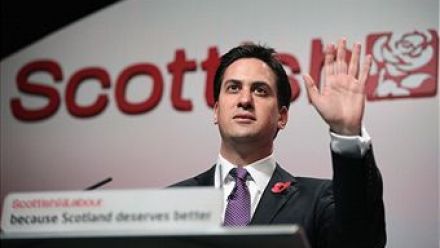
Ed Miliband's speech in Scotland this afternoon was a strange beast. So much of it was typical of the new Labour leader: for instance, the incessant stream of words like "optimism," "new" and "change". Some of it was rather surprising, such as the lengthy and warm tribute he paid to Gordon Brown at the start. One passage on the flaws of the Big Society (from a Labour perspective, natch) set out a philosophically intriguing dividing line. And his challenge over housing benefit was quite swashbuckling, in a Westminster-ish kind of way. But there's one line I'd like to focus on, because I'm sure it will come up again and again. Namely, this one: "Remember, our government paid down the debt before the crisis hit." Really?

Voters think the new generations look old and tired

From our UK edition

There’s an intriguing detail in the latest YouGov poll. The number of people seeing Labour as old and tired is back up to 44 percent, which is where it was before Ed Miliband became leader.   The concern for Labour must be that the youthful, vigorous optimism that Ed Miliband is trying to promote hasn’t cut through to the public yet. Admittedly it is early days. But first impressions do matter in politics. Indeed, I must admit to being slightly surprised that the Tories are still generally ahead in the polls. I thought that the spending review would push Labour into the lead.   Something that, contrary to the media perception, might be helping the Tories is the ongoing rows over housing benefit and child benefit.

More perspective on housing benefit

From our UK edition

A useful reminder of the opinion polls on housing benefit from ConservativeHome's Harry Phibbs: "...in coming out with such hyperbole Labour show themselves to be out of touch with the voters. An ICM poll in June asked: "Do you support or oppose imposing a maximum weekly limit of £400 on Housing Benefit." Support was 68% with 23% opposed. Even among Labour voters there was strong support - by 57% to 35%. A YouGov poll in August asked: "Here are some policies the coalition government have announced in their first hundred days. For each one please say if you oppose or support it?" Among them was: "Putting a limit on housing benefit." 72% expressed support. 17% said they were opposed.

Labour’s hypocrisy on the EU budget

From our UK edition

Labour’s Shadow Europe Minister, Wayne David, has been busy castigating David Cameron for his apparent failure to secure an EU Budget freeze. He says, ‘It is imperative that we do have a freeze on the EU budget’. Quite so, why then did Labour MEPs vote against an amendement to freeze it?

Labour’s Augustinian Approach to Welfare Reform

From our UK edition

Sometimes you wonder why government ministers ever speak to journalists. Exhibit A: the fool who told Ben Brogan that the coalition's changes to Housing Benefit amount to a modern version of "the Highland Clearances*". Sure enough, Jon Cruddas picks up on this in the New Statesman this week. Reading Cruddas you'd think that capping rent allowances and subsidies will bring about the End of Britain As We Know And Love It. For reals: This brutal social engineering will have profound effects on families across the country.

Another fine mess | 28 October 2010

From our UK edition

You know that child benefit cut for higher-rate taxpayers? Yeah, well, it may not be quite as straightforward as the government have hitherto indicated. In an important post on his Wall Street Journal blog, Iain Martin sets out a problem that is exercising nerves and minds in the Treasury: simply put, there's no existing method for establishing whether mothers (who receive child benefit) are living in a household which pays tax at the higher rate.

PMQs live blog | 27 October 2010

From our UK edition

VERDICT: The housing benefit cuts inspired Ed Miliband's chosen attack – and he deployed it quite effectively, with none of the unclarity that we saw last week. For the most part, though, Cameron stood firm – leaning on his favourite rhetorical stick, What Would Labour Do? – and his final flurry against Ed Miliband was enough, I think, to win him this encounter on points. But don't expect this housing benefit issue to dissipate quickly. Bob Russell's question was evidence enough of how tricky this could be for the coalition. 1232: And that's it. My quick verdict shortly. 1231: Bob Russell, a Lib Dem, says that housing benefit cuts are "not a laughing matter," and urges the PM to reconsider the coalition's position.

Miliband’s stage directions

From our UK edition

Labour have sprung a leak, and it's furnishing the Times with some high-grade copy. Yesterday, the paper got their hands on an internal party memo about economic policy. Today, it's one on how Ed Miliband should deal with PMQs (£). With this week's bout only an hour-and-a-half away, here are some of the key snippets: 1. The Big Prize. "The big prize is usually to provoke the PM into appearing evasive by repeatedly failing to answer a simple question, often one that requires a simple Yes or No." 2. Cheer lines. "It's important to have a cheer line that goes down well in the chamber and can be clipped easily by the broadcasters. Mocking humour us especially useful here, especially if it strikes a chord with Tory backbenchers to silence them." 3.

Clegg holds no punches

From our UK edition

Third time's the charm? Not when it comes it Deputy Prime Minister's Questions it’s not. Nick Clegg put in an effective performance this afternoon, but – just like the previous two sessions – there was rather more heat generated than light. So far as Labour are concerned, this monthly Q&A is little more than an opportunity to barrack the Lib Dem leader – and they set about the task with undisguised relish. Unfortunately for them, though, Nick Clegg bites back. Hard.

Stronger than expected growth

From our UK edition

The growth figures for the third quarter of the year have just been released, and it's better than we thought: 0.8 percent, twice the 0.4 percent figure that was expected, but down on the 1.2 percent achieved in the spring. In any case, it should play well for Osborne & Co. We've just witnessed the fastest third-quarter expansion of the economy for a decade. Double speed, rather than double dip. Really, though, these figures throw up more questions than conclusions. By far the most important is: where next? The coalition would have been untroubled by an even larger reduction in growth now (caused by weak consumer spending, among other variables), so long as we get stronger growth in future.

Which side are you on? | 26 October 2010

From our UK edition

At last, The Guardian is reporting the grassroots rebellion in education. It has picked up on the story of Fiona Murphy who blogged on Coffee House yesterday about her trouble with the Tory-run council in Bromley. But hang on... the "grassroots revolt" of which the Guardian speaks is the councils, trying to protect their monopoly control over state schools. Here is the extract: "A flagship government policy has provoked a grassroots revolt against the coalition, with senior Conservative and Liberal Democrat councillors lining up to attack the introduction of free schools, one of education secretary Michael Gove's most cherished projects...

Reading between Laws’ lines

From our UK edition

In The Guardian today, David Laws argues for increasing funding for the pupil premium to £5 billion in the next parliament. But, revealingly, rather than talking about achieving this through the Liberal Democrat manifesto, Laws want to secure the increase this side of the next election and so writes about how it relies on persuading George Osborne of the premiums’ worth. Laws appears to be putting down a marker that increased funding for the premium needs to be part of Osborne’s pre-election spending review which should be in autumn 2014. If everything goes according to the coalition’s economic plan, the coalition will be able to announce plans to cut taxes and increase spending in the months before the next election.