Labour party

Ed Miliband: “Yes, I am a socialist”

From our UK edition

Ed Miliband was doing the interview rounds today, and CoffeeHouses may be interested in the below – an edited version of his exchange with Nicky Campbell on Five Live. NC: Is the problem union power?  MPs and the constituencies clearly voted for your brother, Alan Johnson’s favourite candidate.  He was a clear winner in those two parts of the party, and many people say union influence has to be limited.  Now this is a real test of your guts, isn’t it?  Is it the right thing to do? EM: I see it a different way, Nicky, to be honest.  I see that politics as a whole, in every party, is massively disconnected from people up and down this country.

Tory and Labour grandees unite against AV

From our UK edition

The NOtoAV campaign has unveiled its patrons. It’s an impressive list. Margaret Beckett is the President, supported by Blunkett, Falconer, Prescott, Reid and Emily Thornberry on one side and Ken Clarke, Micheal Gove, William Hague, Steve Norris and Baroness Warsi on the other. The squeeze is on. The YEStoAV campaign has Labour supporters, but they aren’t quite so august. Iain Martin reckons that the YES team are faced with a cross-party opposition that can get these diverse big beasts working together. Iain calls it a pincer movement on the Lib Dems. The strategy is to characterise electoral reform as aan exclusively sectional interest: Clegg’s fixation.

The Big Society is a threat to Labour

From our UK edition

If you think there really is a big idea behind the Big Society, then you agree with the unlikely pairing of Jon Cruddas (Lab, Dagenham) and Jesse Norman (Con, Hereford). The latter's new book, The Big Society: The Anatomy of the New Politics, attempts the seemingly impossible task of providing a grand philosophical narrative to underscore David Cameron's often amorphous rhetoric. Cruddas and Norman debated at the Institute of Economic Affairs last night, alongside the IEA’s Professor Philip Booth and Dr Steve Davies. The ninety minute discussion did more to expose the philosophical fault lines in modern British politics than any public event I’ve attended since the General Election.

Five things the student unions didn’t protest against in the last 13 years…

From our UK edition

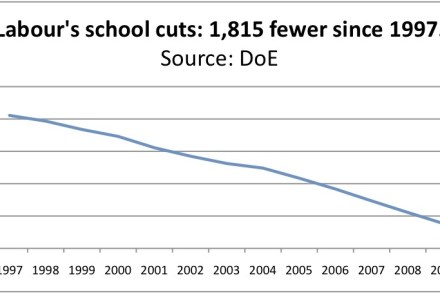
1)    That Labour cut the number of schools each year. 2)    That pupils were shepherded into ever-larger schools. 3)    That, although the budget trebled, class sizes hardly moved. 4)    That the attainment gap between private and public schools grew to become the largest of any country except Brazil (Source: OECD ) 5)    And all at a time when the supposed funding per pupil was soaring… Moral: cash doesn’t help schools. Reform does.

Gove starts the revolution

From our UK edition

The Spectator has been a long-term fan of Michael Gove – indeed, we named him the single best reason to vote Tory at the last election. His ‘free school’ reforms are laudable and the emphasis on improving standards is imperative. Under the previous government, Britain slid down the international rankings of educational attainment. A tide of politically correct initiatives robbed teachers of their classrooms and discipline suffered. The post code lottery under which state education operates sentences the poorest and most vulnerable in society to rot in under-funded sink schools. Reform is both a moral crusade and a necessity if Britain is to continuing punching above its weight in the future.

Time for the real Ed Miliband to speak up

From our UK edition

There is talk of Ed Miliband’s ‘New Generation’, but no indication of what it stands for. It has no clear views on the economy, student finance, defence and electoral reform. Despite his party’s lead in the polls, Ed Miliband is an inert political entity (and it did not help him that the party peaked in his absence). Tim Montgomerie has rightly diagnosed a leadership vacuum. Miliband is timid before a parliamentary party that did not select him, and is struggling to acclimatise to a political discourse that the coalition government is moving beyond the terse liturgy of left and right. So far, Miliband's banal default tactic has been to seek consensus.

Miliband should re-examine Cameron’s playbook for the real lessons

From our UK edition

Ed Miliband has come roaring back from his paternity leave, keen to silence the growing chorus of criticism that he is not in control of his party and has let the Coalition determine the agenda.     To do so, he has come out in favour of a permanent top rate of income tax at 50 percent, but is otherwise taking a leaf out of the Cameron playbook - by establishing a number of policy reviews. But he might want to take another look at Cameron's experience. Reviews are a great tactical ploy - they show a willingness to "think big", allow a leader to reach out to a range party factions, aid front bench spokesmen to understand their portfolios and, perhaps most importantly, punts any serious policy discussions into the future.

From The Annals of the Gord

From our UK edition

This snippet from Anthony Seldon and Guy Lodge’s latest book merits repeating: ‘As Barack Obama waited in a cavernous building in London, he suddenly noticed Gordon Brown stomping towards him down a corridor, with a flurry of aides in his wake. Unfortunately — probably because he has a glass eye as the result of a rugby injury — the Prime Minister didn’t see the President. To the surprise of Obama and his entourage, the British premier was doing a passable impression of an erupting volcano. He was clearly furious about something his aides had or hadn’t done. It was hardly the behaviour anyone would expect of a G20 summit host, and the American President watched with growing disbelief.

Labour’s terror u-turn doesn’t lessen its authoritarianism

From our UK edition

It is a day for about turns. First, the Pope has taken a historic decision to approve the use of condoms to fight AIDS; second, Labour has vowed to change its position on terror legislation and law and order. The party feels its record in government has damaged its reputation as a guarantor of liberty. Generation Ed wants to make another break from the past. Ed Balls has masterminded a cunning sleight of hand. The proposal is nowhere near as dramatic as headlines suggest. Labour will support the government’s proposed reduction of detention periods from 28 days to 14, provided the police and security services are not impeded by the change. Balls also indicated that he could support the abolition of control orders if an alternative was found.

Miliband’s New Generation draws the line under donor peers

From our UK edition

Patronage remains a strong statement of leadership, and an indication of a leader's competence. As James noted yesterday, Ed Miliband chose the occasion to play one of his few picture cards: Maurice Glassman’s accession into red ermine is a major PR coup for Labour in the battle to be ‘progressive’ and community-focused. But Miliband’s list is also noteworthy for those it excluded. The Times has the details (£): ‘He decided against handing seats in the House of Lords to Nigel Doughty and Sir Ronald Cohen — who have given more than £6 million to the party since 2005 — as well as Jon Mendelsohn, Labour’s fundraising chief.

Full list of peerages

From our UK edition

Number 10 has published the full list of new peerages. There are 27 new Conservative peers, including Sir Patrick Cormack, Richard Spring, Julian Fellowes, Howard Flight, Michael Grade and Patience Wheatcroft. The Lib Dems and the Labour party have acquired15 and 10 respectively. General Dannatt is also to be ennobled, but will sit on the crossbenches, confirming his break-up from the Tory machine. Expect his strident voice to be a constant feature of the debate growing from the troubled strategic defence review.

You’ve never had it so good

From our UK edition

As Michael Gove said at the launch of the Conservative Party manifesto: “Britain in 2010 is a great place to live in many ways” (4:12 in on this video). Lord Young, The Spectator’s Peer of the Year, agrees: for many of us, we’ve never had it so good. He told the Telegraph: ‘For the vast majority of people in the country today, they have never had it so good ever since this recession - this so-called recession - started…Most people with a mortgage who were paying a lot of money each month, suddenly started paying very little each month. That could make three, four, five, six hundred pounds a month difference, free of tax. That is why the retail sales have kept very good all the way through.

Ed Miliband needs to make some noise

From our UK edition

Today’s press will not have made happy reading for Ed Miliband and his supporters. Alan Johnson’s comments to The Times about the need to change the way Labour elects its leader has revived the debate about the legitimacy of Ed Miliband’s victory. Meanwhile in the New Statesman there’s a piece setting out the internal tensions within the party. Intriguingly, Lisa Tremble, who was David Miliband’s press chief during his leadership campaign, has put what could be considered a rather provocative quote on the record. She tells the magazine, ‘David’s rediscovered his excitement in politics…He’s looking forward to the new challenges. He’s not going anywhere.

Ed Miliband has a choice to make about the unions

From our UK edition

On the surface, there are one or two baubles to delight a Labour supporter: their party leader has just had a second son, of course; they are pushing ahead of the Tories in a number of polls; and the coalition will surely come under sustained and heavy attack as the cuts make themselves felt. But strip back the gloss veneer, and Labour has some agonising problems to worry about. Chief among those problems – as I've written before – is their uncertain message on the economy, stretching into an uncertain policy prospectus overall. Just what do Labour stand for? Then there's the simmering resentments between teams Ed and David, with the Balls axis looking to capitalise in between.

Phil Woolas, four investigations and a funeral wreath

From our UK edition

It may take another week to discover if Phil Woolas has the right to challenge the election court ruling that destroyed his career. To the delight of his cadre of supporters in the House, judges have said there are "difficult questions to resolve" - not about the evidence of Woolas' campaign making "false statements", but about the specific application of the Representation of the People Act (RPA). Before the last die is cast, here are two quick contextual points. First, it is not just Harriet Harman who is keen to shut down this episode - many folks on all sides of the House of Commons would like to pretend skulduggery of this kind is exceptional. It is not - Phil Woolas' behaviour is far from untypical of northern politics.

A day off for Dave

From our UK edition

The giraffe was back. Hattie Harman came to PMQs today wearing That Frock with its eccentric pattern of burnt umber pentagonals framed by light squiggly outlines. A great colour scheme for camouflaging giraffes in Africa. And an even better one for attracting attention in the house. Why does Hattie feel herself particularly giraffic? Her noble breeding naturally aligns her sympathies with an animal that has evolved upwards over many generations and can enjoy the lush topmost leaves not available to lowlier creatures. Or perhaps it’s her unsteady gait as she lumbers through her questions. Or perhaps it’s the fact that if she leans forwards and touches her knees with her chin she’ll fall over.

The Harman bounce

From our UK edition

I kid, I kid – but it's still striking that Labour are pushing ahead in the polls as soon as Ed Miliband takes his paternity leave. According to today's YouGov poll, they are now 5 points ahead of the Tories: their biggest lead since 2007, and an escalation of the 2-point advantage they recorded in a couple of polls earlier this week. The question, of course, is whether this is a momentary blip, or representative of wider discontent over tuition fee rises and the like.

PMQs live blog | 17 November 2010

From our UK edition

VERDICT: Harriet Harman's questions must have looked quite clever on paper: a heavy emphasis on police cuts, followed by a quick dose of indigation over the vanity photographers. But, in reality, they were breezily repelled by Cameron. All he had to do was cite the words of Alan Johnson and refer to a list of Labour's own dodgy hires. By the time Harman attacked the cost of elected police commissioners, leaving Cameron to stand up for greater local democracy and accountability, it was clear who had won this bout: the Prime Minister, by some distance. Although, as Andrew Neil and Tim Montgomerie have noted, the absence of any talk about an Irish bailout was unsettling, to say the least. 1233: Labour are persistently talking down the economy, claims Cameron.

A royal wedding bounce?

From our UK edition

Slap all kinds of health warnings on this, but – in view of speculation that the Wills and Kate nuptials might work in the coalition's favour – I thought CoffeeHousers might like to see what happened to the the Tory government's poll rating in 1981, around when Prince Charles married Diana. So here's a graph I've put together from Ipsos MORI's figures. The dotted line represents the date of the wedding: PoliticsHome suggests that the "royal wedding worked wonders for Thatcher" – but, on the basis of the above, I'm not so sure. It's worth nothing, though, that the Tories surged ahead of Labour as soon as the Falklands War flared up in 1982. By June 1982, Thatcher's party were 27 points ahead of their rivals. P.S.