Labour party

Len McCluskey leaves Miliband floating

From our UK edition

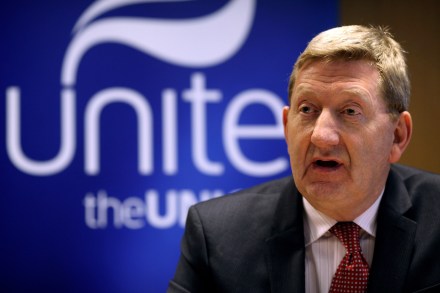
You can stuff your beer and sandwiches, Prime Minister – the unions want war. That's the broad sentiment of Unite's new leader, Len McCluskey, writing in the Guardian today. The union capo urges his brothers to rally behind the protesting students, and prepare to militate against the coalition. Or as he puts it, with nary a hint of self-awareness: "While it is easy to dismiss 'general strike now' rhetoric from the usual quarters, we have to be preparing for battle." Which, reading on, seems pretty similar to, erm ... general strike now. Putting aside the prospect of industrial unrest, this will be as nectar for the Tories.

Miliband the Monk has more bleak poll numbers to contemplate

From our UK edition

And the award for quotation of the day goes to the unnamed Labour MP who says, in the Sunday Times (£), of Ed Miliband: "We've got a new nickname for him: the monk, because he wants two years of quiet contemplation to work out what he's going to do."  And second prize goes to another Labour MP, quoted in the same article, for this: "I give him 18 months. Tops." Words alone may not hurt Miliband, however acidic they are – but throw in another set of poor poll ratings for the Labour leader, and he is rather limping towards next month's 100 day milestone. Today's YouGov poll has a 29-44 split between those who think he is doing well and those who think he is doing badly.

Dissecting operation Coulson

From our UK edition

Tom Baldwin's inaugeration as Labour spin guru occasions Tim Montgomerie to appraise Andy Coulson. For many, Coulson has committed the spin doctor’s cardinal sin and become the story, and not just his more voluble opponents on the left. Tim rejects that analysis, but concedes that Coulson may drift to pastures new in 2011. Coulson’s record is quite impressive. He snared the tabloid press, and, together with George Osborne, ended Gordon Brown’s short honeymoon, exposing the Labour leader’s indecision with well-timed tax cut promises. The Election That Never Was spawned a far more enduring theme: Labour’s internal fissures and the timidity of its senior figures. If Coulson goes, that will be his legacy.

Johnson’s economic education

From our UK edition

When he took on being shadow Chancellor, Alan Johnson said that he would need to get hold of an economics primer. Judging by his comments in yesterday’s debate about the bi-lateral loan to Ireland, he hasn’t got that far into it. Johnson told the House, ‘The euro had nothing to do with the [Irish] property boom and bust’. This is a bizarre statement. If Ireland had been able to set its own interest rates, they would have been far higher and thus dampened down the property boom.

Miliband’s Oldham dilemma

From our UK edition

Joy. It will be a campaigning Christmas, now that the Oldham by-election is likely to be held on 13th January. The Labour party is much exercised. The permanently outraged Chris Bryant says it is a ‘disgrace’ that politics will sully the ‘major Christian festival of the year’ – the lapsed cleric seems to have forgotten the election’s proximity to Easter. More importantly, fewer students will be in Oldham on 13th January to serve ‘judgement’ on the government, as Hilary Benn put it in the Commons this morning before adding that the government is ‘running scared’. By-elections are determined by local issues, as one would expect.

Ainsworth has a point

From our UK edition

Much ado about Bob Ainsworth this morning, and his views on drug policy. The former defence secretary, and a junior Home Office minister under Tony Blair, has become the most high profile political figure to call for the legalisation of drugs. Or, as he put it: "It is time to replace our failed war on drugs with a strict system of legal regulation, to make the world a safer, healthier place, especially for our children. We must take the trade away from organised criminals and hand it to the control of doctors and pharmacists." To my mind, this is a welcome intervention. It's not that the case for legalising drugs is completely watertight – it isn't.

Miliband out of the danger zone

From our UK edition

Up, up, up! It was the only way he could go. For the last couple of months Ed Miliband has arrived at PMQs like a hapless fag with his bottom ready-stripped for a ritual flogging from Flashman. Today he made a proper fight of it. This was his best PMQs performance since his debut. He’s been studying the old masters. Long-term followers of PMQs will have recognised William Hague’s favourite battle-plan today. In football it would be called ‘pass-and-go’. You ask a question. Then dismiss the answer as inadequate. Ask a second question. Dismiss the second answer as inadequate. Move to a third question while pointing out, in parenthesis, that your interviewee is making a habit of not giving proper answers.

Reid: essentially, Miliband’s not fit for purpose

From our UK edition

John Reid made a bruising and quite extraordinary appearance on the Daily Politics earlier today. He demolished the Labour leader. Reid’s analysis was concise: there has been a vacuum at the heart of Labour since Tony Blair’s departure. Gordon Brown was divisive, at best, and clearly not up to the demands of leadership. And, Reid intimated, Brown's child shares his father’s foibles. Ed Miliband has not impressed so far, having failed to understand the cause of New Labour's success. Case in point, his support for the coalition’s very liberal policies on crime, and his inability to perceive that New Labour’s sustained dominance was due to constant policy renewal, not ideological trauma.

Expect the unexpected

From our UK edition

Peter Kellner has an interesting comment piece up on the YouGov site about how we are in the unusual position of having three relatively unpopular party leaders. Nick Clegg’s approval rating is down at minus 29 but that hasn’t helped Ed Miliband who is at minus 15. David Cameron does have a positive rating, but only just. His approval rating is plus one. As Kellner points out, normally when one political leader is unpopular another benefits. But that hasn’t happened this time: a sign of how strong a hold anti-politics has on the public consciousness. This discontent is mirrored by how all three parties are having quite serious debates about what they should be.

And a comprehensive rejection?

From our UK edition

After Ed Miliband's buttery overtures to the Lib Dems earlier, a response courtesy of the party president, Tim Farron. It offers, on the surface at least, a vicious rebuke to the Labour leader – and a staunch defence of what the coalition has achieved. Here it is in full: "Labour have just spent 13 years sucking up to Rupert Murdoch and George Bush - why would any sane progressive even give them a second glance? As part of the coalition government, Liberal Democrats have started fixing Labour's economic mess, taking millions of people out of Income Tax and reforming British politics. Things Labour had 13 years to do but failed to deliver.

A comprehensive offer to Liberal Democrats

From our UK edition

It seems strange for Ed Miliband to veer from offensive to charm quite so quickly, but it's a decent ruse nonetheless. Miliband deliberately cites David Cameron’s famous 'comprehensive offer' and many disenchanted Lib Dems will be swayed by his three point-plan, especially after the recent Grayson intervention. Disingenuous? Yes. Opportunistic? Very. Coherent and well-defined opposition to trebling tuition fees? Certainly. Now for some policies, perchance...

Clegg suffers the backlash

From our UK edition

If this morning's papers are anything to go by, Nick Clegg is in freefall. The man who was the Lib Dems' biggest electoral asset is now a magnet for all sorts of political digruntlement. Exhibit A: the Ipsos MORI poll (£) in today's News of the World, where 61 percent of respondents say that they don't trust Clegg, compared to 24 percent in April. He has gone from being "the most trusted politician since Churchill," to one of the least since ... well, ever. It is no small irony that the leader who sailed most capably on the winds of "change" and "new politics" in the TV debates has, whether rightly or wrongly, delivered this Parliament's most stunning example of a broken pledge – and is suffering the fallout from it.

The divisions laid bare

From our UK edition

When The Speaker called a division, the Labour side roared a passionate No while the coalition benches delivered a rather muted Aye. I did not see a single Lib Dem open their mouth at this point. Instead, they sat on their benches looking emotionally exhausted. Even those Lib Dems who have been proved right in their warning about the party’s position on fees—notably, David Laws and Jeremy Browne—appeared downcast.   In the end, the government won but with a much reduced majority. 21 Lib Dems voted against the coalition, as did six Tories. Simon Hughes abstained despite Ed Miliband’s entreaties to come with him into the no lobby.   This meant that the Lib Dem’s three senior figures split three ways.

Miliband rises from his deathbed

From our UK edition

At last Wednesday’s PMQs Cameron kicked Ed Miliband into touch with a debonair swagger. Today anger replaced disdain. The PM’s eye-popping rage is so palpable that some commentators take it for vulnerability or even a hint of self-doubt. Milband has Cameron rattled? Nothing of the sort. Cameron just can’t control himself.   Asked about the Coalition’s higher education policy, he heaped rancid abuse on the opposition leader from a lofty perch. He called him "an opportunist,"  who "posed about social mobility" and was guilty of "rank hypocrisy." "He saw a big crowd in the Mall," fumed Cameron, referring to the student protests, "and said, 'I am their leader I must follow them'.

Miliband’s jibes throw Cameron off course

From our UK edition

After last week’s PMQs, Ed Miliband needed a clear win today—and he got one. Cameron, who had admittedly just flown back from Afghanistan, didn’t seem on top of the whole tuition fees debate and kept using lines that invited Labour to ridicule the Lib Dems. When Cameron tried to put Miliband down with the line, ‘he sounds like a student politician—and that’s all he’ll ever be’, Miliband shot back that “I was a student politician but I wasn't hanging around with people who were throwing bread rolls and wrecking restaurants." It was a good line and threw Cameron off for the final exchange.   The rest of the session was not a cracker.

PMQs live blog | 8 December 2010

From our UK edition

VERDICT: Tuition fees, tuition fees, tuition fees. Ed Miliband used only one weapon from his armoury today – but it served him unexpectedly well. The Labour leader scraped a contest that, as usual, offered far more heat than light. His attacks were slightly more cutting, his one-liners that little bit more memorable, and it was all the more remarkable given his dreadful performance seven days ago. It wasn't that Cameron performed badly. The PM rightly – and, at times, effectively – pointed out Labour's hypocrisy on this issue. But it all seemed a little flat, as though he was reading from a script that had only just been handed to him. In the end, this was one to cheer the Labour benches, and clear some of the fallout from last week.

Labour stumble into tomorrow’s tuition fee vote

From our UK edition

Oh look, Alan Johnson has performed a hasty Reverse Cable. Only a few days ago, the Shadow Chancellor suggested that he didn't believe a graduate tax – Ed Miliband's chosen policy – could work. Yet, in a wilting Thunderer column (£) for the Times today, he now claims that "there is a very strong case for a graduate tax." From unworkable to strong, in only four days. Sounds like a disclaimer for Ikea flatpack furniture, not a policy position. In a separate article, the Times characterises this as a minor victory for Ed Miliband – and so, in some respects, it is. He has managed to rein his Chancellor on this issue, if not on 50p tax, and the Labour leadership are now backing the same policy, albeit a misguided one.

How far our schools have fallen

From our UK edition

Comparing GCSE or A-Level results to previous years is a meaningless exercise. Leaving aside all the arguments about whether or not these exams are getting easier, it doesn’t much matter if children today are doing better academically than their peers a generation ago. What does matter is how they are doing in comparison to children in other countries, the people they’ll be competing with in the global marketplace.   Today’s PISA rankings, the OECD’s comparison of education standards, makes for depressing reading on this front. England has fallen from 7th in reading in 2000 to 25th today, from 8th to 27th in maths and 4th to 16th in science.

Bercow vs McLoughlin

From our UK edition

Iain Dale has news of a remarkable exchange between the Speaker and the Chief Whip last night (see from 22:16:30 in the video above). The coalition were attempting to pass a motion limiting the debate on tuition fees to three hours. Labour was trying to prevent this.   The Labour front bench shouted ‘object’ at the wrong moment so Bercow, with a broad grin on his face, coached them through it. At which point, Patrick McLoughlin heckled, ‘give them an indication, won’t you?’ McLoughlin then goes to leave the Chamber. At which point, Bercow explodes, wagging his finger and ordering the Chief Whip to remain in the Chamber.   This row won’t have done anything for Bercow’s standing on the Tory side of the House.

How the OBR measures up

From our UK edition

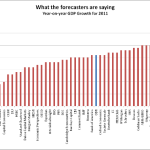
There are only so many Labour interviews a blog can take, so I'll skip over Yvette Cooper in the Guardian (sample: "I did think about standing, and Ed said he thought I should stand and if I wanted to stand he would not stand"). Instead, another catch-up on how the Office for Budget Responsibility's growth forecasts are shaping up against those made by other institutions. Since I last did this, two new documents have been processed into the public domain: the OBR's latest economic and fiscal outlook, of course, as well as the the Treasury's round-up of long-term independent forecasts.