Labour party

Brown struggles on beyond the crash

From our UK edition

Today's Guardian calls it his first interview since leaving office, although I think the Independent beat them to that one back in July. But, in any case, Gordon Brown's chat with Larry Elliot is another staging post on his slow path back to public life. Here's my quick summary: 1) Sniping from the moral high ground. A bit late now, but Brown is making a desperate scramble for the moral high ground. Not for him, he says, scurrilous memoirs that sift through the "arguments" of the past. No, he's got far more important things on his mind than muck-raking and innuendo, like the future of financial regulation across the world. Or has he? It's hard not to see barbs mixed in amongst it all. Take this line from the interview: "I am a full-time MP, not a businessman.

Alan Johnson’s degree in making life difficult for Ed Miliband

From our UK edition

There he goes again. Another Alan Johnson interview, another reiteration of his differences of opinion with his leader and another Tory press release claiming Ed Miliband’s writ doesn’t even run in his own shadow Cabinet. This time, Johnson has told Mary Riddell, “Well, I don’t think [a graduate tax] could [work]. Frankly, there’s a difference of view.” If this was not enough he continued to say, “I feel it’s going to be very difficult to make a graduate tax a workable proposition.” This must be so frustrating for Ed Miliband. First, it takes some of the heat off the Lib Dems who are all over the place this weekend on the whole university funding question.

Woolas loses his appeal

From our UK edition

Phil Woolas has lost his appeal against the election court declaring his victory in Oldham East and Saddleworth. As I understand it, Woolas has not exhausted his legal options and could take the whole matter to judicial review. Word is that no decision will be made on a by-election until it is known whether or not Woolas will appeal.   Interestingly, Woolas was accompanied to court today by John Healey, the shadow Health minister. Healey is extremely popular with his Labour colleagues, he came second in the shadow Cabinet elections, and his decision to stand by Woolas today is a sign of where the emotional energy in the Parliamentary Labour Party is on this issue.

Laws on the formation of the coalition: Labour were simply too divided

From our UK edition

David Laws has responded to Andrew Adonis’ partisan review (no link apparently) of 22 Days in May. Laws’ account of the formation of the coalition and its infancy in government. Laws denies Adonis’ charge that the Lib Dems had a ‘right-wing agenda’ and, to prove the point, drops a wonderful quotation from Peter Mandelson during a discussion on tax, saying: ‘Haven’t the rich suffered enough already.’ Rather, Laws’ argues that the coalition formed as it did because Labour were simply too divided to be credible. He writes: ‘Labour was too disorganised or divided even to table clear positions on tax, education spending, pensions or the deficit.

Uncharitable action

From our UK edition

After CoffeeHouse raised a virtual eyebrow and a few questions about the behaviour of War on Want and the Jubilee Debt Campaign, Tory MP Matthew Hancock has written to the Charity Commission asking for an investigation into their status: "Quite apart from the issue over whether a charity should support an organisation that seeks to disrupt the operations of UK companies, I also believe that the charities’ support of UK Uncut clearly appears to breach Charity Commission guidance on political activity." Let us see what Dame Suzie Leather, the Chairman of Charity Commission, thinks.

A grim turning point for Ed Miliband

From our UK edition

Yesterday's PMQs already feels like a turning point. It wasn't so much the nature of David Cameron's victory – comprehensive though it was – but rather the way  Labour MPs have reacted to Ed Miliband's defeat. Whatever doubts some of them held privately about their leader have suddenly spilled out, mercilessly, across the snow. In his Daily Mail sketch, Quentin Letts describes Miliband's excrutiating exit from the chamber yesterday; Guido and the Telegraph are carrying remarks from disgruntled Labour figures. The volume of hostile radio chatter has risen considerably over the past twenty-four hours. Of course, there are several caveats to be slapped across all this – not least that Labour are bobbing up above the Tories in the polls.

What the statist left thinks of the liberal right

From our UK edition

The Tories have the evil gene – that was the subtext to Ed Miliband’s jibes about the complacency of the children of Thatcher. Labour’s former General Secretary, Peter Watt, disagrees. In an important post for Labour Uncut, Watt observes: ‘But there is an arrogance at the heart of our politics that is going to make it difficult to really understand why we lost. It is an arrogance that says that we alone own morality and that we alone want the best for people. It says that our instincts and our motives alone are pure.  It’s an arrogance that belittles others’ fears and concerns as “isms” whilst raising ours as righteous.

Nothing Miliband says can rain on Mr Confident’s parade

From our UK edition

Back from Zurich, where he’s been helping FIFA determine the winner of the world’s greatest bribery festival, Cameron was in hearty form at PMQs today. He faced Ed Miliband who looks increasingly like the life and soul of the funeral. His party is riding high in the polls – but only when he’s away. As soon as he pops his head back around the door a groan of misery goes up and his rating collapses. Earlier this week the OBR gave an upbeat assessment of the economy so Ed sent his bad-news beavers to sift through it for signs of toxicity. They couldn’t find much. Jobless totals are to rise. But only a bit. The economy will grow reluctantly. But not that reluctantly. We’re faring worse than some of our rivals, and better than others.

PMQs live blog | 1 December 2010

From our UK edition

VERDICT: A freewheeling, swashbuckling sort of performance from Cameron today, that was encapsulated by a single line: "I'd rather be a Child of Thatcher than a Son of Brown". Sure, that may not go down too well with lefty Lib Dems nor, indeed, many Scottish voters. But, in the context of PMQs, it was a rapier response to Ed Miliband's sclerotic lines of questioning. Why the Labour leader chose to completely ignore today's Mervyn King quotes, and sift unpersuasively through the footnotes of the OBR report, I'm not sure. In any case, the plan didn't work at all. This was yet another PMQs which generated more heat than light, but Miliband was the only participant who got burnt.  1233: And that's it. My quick verdict shortly.

Poverty NGO or Labour stooge?

From our UK edition

While I worked at DfiD, officials were very keen to disabuse me of my suspicion that some NGOs are in fact not focused on a politically-neutral campaign to end worldwide poverty but are instead extensions of the Labour movement. They may be staffed by Labour supporters, run by ex-Labour advisers or just be used to working with a Labour government; but they were not corporately aligned in any way. Or so I was told. And I was happy to believe it. But what is this? War on Want and the Jubilee Debt Campaign - two supposedly internationally-focused NGOs - are said to have joined forces with the protest organisation UK Uncut to fight the Coalition Government's deficit reduction.

The money that didn’t swing the election

From our UK edition

Before the election, the Tories used to regularly, and with a certain justification, complain about how the vast majority of money that Peter Mandelson’s department was dishing out to businesses via the Strategic Investment Fund went to those based in Labour constituencies. Not a single Tory-held seat benefitted from this £601.5 million of spending. Indeed, 84 percent of the constituencies that benefitted from this money were Labour at the time. But new research on the election result shows that this money doesn’t seem to have made voters much more loyal to Labour. In the 25 seats that benefitted from the fund the swing against Labour was 12 percent. This is only marginally smaller than the 14 percent swing against Labour nationally.

Lansley gives us a nudge

From our UK edition

Andrew Lansley’s rhetoric is strident: ‘It’s time for politicians to stop telling people to make healthy choices. Rather than lecturing people about their habits we will give them the support they need... we will support leadership from within communities.’ One could be forgiven for thinking that the Health White Paper will inaugurate a completely new dawn. It doesn’t. Many of Lansley’s initiatives are resuscitated Labour policies: taxes on alcohol and tobacco and incentivising healthy living through choice are tried and tested formulas that have had limited past success in every field bar raising revenue. Lansley’s White Paper is not a testament of radicalism, but it is quietly revolutionary nonetheless.

Osborne airs the Tories’ election message

From our UK edition

George Osborne’s autumn statement previewed what I suspect will be the coalition, or at least the Conservatives, re-election message. ‘This government has taken Britain out of the financial danger zone and set our economy on the path to recovery.’   Today’s OBR forecast was a boon for the Chancellor. It suggests that there won’t be a double-dip recession, as his critics suggested there would be. The improved economic numbers allowed him to come to the House and declare that the deficit reduction ‘plan is working’, and that already the coalition has saved the country £19 billion in debt interest. Alan Johnson was his usual self in response.

Setting the scene for Osborne’s speech

From our UK edition

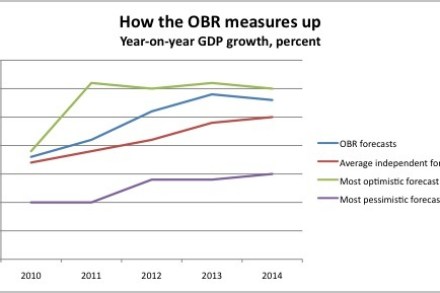
George Osborne will make a brief statement to the house this afternoon, responding to the Office for Budget Responsibility’s revised growth forecasts. Reuters reports: ‘As expected, the Office for Budget Responsibility raised its 2010 growth forecast to 1.8 percent from its 1.2 percent June forecast to factor in a surprisingly strong performance in the middle of the year.’ The upgrade fuels Osborne’s positive narrative: the coalition pulled Britain from the abyss and international confidence in Britain's economy is growing. These forecasts vindicate the government’s ‘cut with care’ strategy. Concrete savings are now being made and they enable the Chancellor to announce that public sector net borrowing will fall.

Some early statistical vindication for IDS

From our UK edition

The Observer has news that will warm the government’s hearts. Ernst and Young have conducted a report that suggests 100,000 public sector jobs will be saved thanks to the savings made by welfare reform. The report’s other finding, a crucial one, is that the Treasury will be raking in £11bn by 2014-15. So then, a statistical vindication for IDS’ reforms, the economic side of them at least. It also gives the government some defensive hardware ahead of tomorrow’s Chancellor’s autumn statement. Not that it really needs it. On the back of Britain’s strong economic performance in the third quarter, the Office for Budget Responsibility is expected to raise its 2010 growth forecast from 1.2 percent to 1.7 percent.

Too clever by half, Miliband pitches for the squeezed middle with the vacuous promise of change

From our UK edition

Ed Miliband has made an inauspicious start to his second political relaunch of the week. The Sun has dubbed him Buzz Lightweight, after he adopted the Pixar-inspired catchphrase ‘Beyond New Labour’ to describe his vision for the party. Miliband’s media presence is already wooden; migrating to plastic is hardly a promotion. Miliband and his elders have arrived at Labour’s national policy forum. In so far as it’s possible to determine what he stands for, Miliband is not aiming for the middle ground of British politics, as David Cameron and Tony Blair did. But he is courting the ‘squeezed middle’ with the promise of change. So far, that promise is more vacuous than profound – the new boss looks like the old boss.

The Big Squeeze

From our UK edition

The media pack is often blind to an impending political car-crash.  For instance, very few in Westminster, or the media, noticed the scrapping of the 10p tax band until the screech of twisting steel turned heads. The same is happening now in relation to living standards. The media and political establishment are yet to wake up to the fact that working families in Britain are about to become poorer (though hat-tip to Allister Heath for being quick off the mark on this front). The gathering wisdom is that, with the recession now behind us, household budgets will start to recover.  We have just published a new report – Squeezed Britain  – that paints a darker picture.

Solutions to the Mili-woe

From our UK edition

Ed Miliband’s day today rather sums up his problems. His morning media round has all been seen through a negative prism. Nick Robinson mocks the new leader’s attempt to talk about the squeezed middle by calling it the squeezed muddle. While Ed Miliband’s declaration that he is a socialist, something he has said many times before, is not being treated as a refreshing dose of intellectual honesty but as evidence that he’s just too left-wing. A lot of Ed Miliabnd’s problems come from the fact that the media is in hunting mode. The media, as a rule, don’t like being surprised and Ed Miliband’s victory was not what it expected. So in return the media are giving him a bit of a kicking. This is, of course, a simplification.