Labour party

How much are we still paying for Brown?

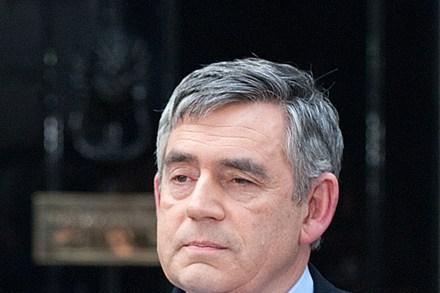
The story today of a pregnant woman being downgraded so Gordon Brown and his six aides could travel business class from Abu Dhabi to London may ring a bell with CoffeeHousers. We revealed last August that Brown has a taste for freebies, and that he was offering himself for $100,000 at speaking and award-giving engagements. For an extra $20,000 he would throw in his wife, Sarah. The Mail on Sunday reports that one of the pregnant woman’s co-passengers was “livid, asking why it was necessary for all of [Brown’s team] to be travelling business — and if it was being paid for by the taxpayer.” He raises an interesting point.

Ed Miliband is an Idiot

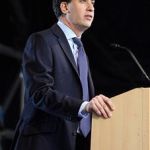
I don’t think there’s any point in pretending that Ed Miliband is not an idiot. All the evidence the prosecution needs comes from this typically self-aggrandising passage in his address to protestors in London this afternoon. We come in the tradition of those who have marched before us. The suffragettes who fought for votes for women and won. The civil rights movement in America who fought for equality and won. The anti-apartheid movement who fought the horror of that system and won. Our cause may be different but we come together today to realise our voice and we stand on their shoulders. We stand on the shoulders of those who

Miliband is marching to the wrong drum

Ed Miliband’s decision to address today’s anti-cuts march is a strategic mistake. It makes him look like the tribune of an interest group not a national leader. He’ll also be tarred by association, fairly or not, if these scuffles we’re seeing turn into anything more serious. In his speech, Miliband tried to place the march in the tradition of those for female emancipation, civil rights and against apartheid. But this rhetoric doesn’t work as, given Miliband’s commitment to the Darling plan, we are talking about relatively modest differences about the pace of cuts. One other thing that was striking about the speech is Miliband’s attempt to accuse Cameron of practicing

Marching with no alternative

Thousands have converged on London today, to march against the monolithic evil of ‘cuts’. They have not stated an alternative, a fact that led Phil Collins to write an eloquently savage critique in yesterday’s Times (£). That the protesters are incoherent beyond blanket opposition to the government is not really an issue: as this morning’s lead article in the Guardian argues, the Hyde Park rioters of 1866 weren’t brandishing drafts of the Second Reform Bill. But it’s intriguing that Ed Miliband has decided to address this rally, thereby endorsing it. The Labour party hierarchy recognises that it is taking an enormous and perhaps totally unnecessary risk. First, Ed Miliband’s oratory

Miliband’s two big risks

Who would have thought it? Miliband’s short speech in Nottingham today went largely unheralded, and doesn’t seem to be getting a whole lot of attention now — and yet it tells us more about his approach to Opposition than almost anything he has said previously. Fact is, the Labour leader is taking two risks that may be either bold or foolhardy, depending on your point of view. These risks could come to define his Labour party. The first is splashed right across the entire speech. Miliband dwells on three “challenges” that the country will face over the coming decade: the “cost of living crisis”; declining prospects for the next generation;

What Portugal means for the UK

Last night, Portugal’s parliament voted to reject its latest measures to deal with its deficit. It was the fourth time that the Portuguese parliament had been asked for more taxes and for more spending cuts. The result has been a further loss of confidence in Portugal’s ability to pay its debts. Market interest rates have risen to over 8 percent. European leaders are meeting this weekend to work out a path forward. The lessons for us here in the UK are starkly clear. First, it is better to set out all the difficult decisions needed to deal with the debt crisis, even if these take place over a number of

Balls replies with mischief

Ed Balls has just delivered Labour’s Budget briefing. His main point was that the Office of Budget Responsibility now forecasts higher levels of unemployment than it did last autumn. He claimed that this would lead to a £12.6bn increase in spending on unemployment benefit. He also argued that the decision to increase tax thresholds by CPI rather than RPI was an effective tax increase and that it will hit the middle hardest. In a classic piece of Ballsian mischief, he reveled in pointing out that the Office of Budget Responsibility says that it received news of the extra cut in corporation tax and the 1p cut in fuel duty too

PMQs live blog | 23 March 2011

1232: And that’s it. And here’s my quick verdict: a solid performance from Cameron is what was, on the whole, a sedate session. The Main Event starts now, follow our live blog here. 1228: More fire from Cameron on the NHS. “Do you want to save … lives,” he quivers,” or do you want to stick with the status quo.” The PM’s rhetorical confidence in this area is striking, particularly given that it is one of his most criticised policy areas. 1226: Matthew Hancock questions why the Labour government used PFI contracts to build hospitals, when there were better value alternatives. The Tories have spent the past few days emphasising

The state of public opinion ahead of the Budget

It’s a point that I’ve made before, but here it is again: Budgets don’t tend to shift opinion polls, at least not the headline numbers. But opinion polls can give some insight into how Budgetary decisions will go down with the public. So by way of a catch-up with some recent polls, and ahead of tomorrow’s Main Event, I thought CoffeeHousers might appreciate a quick overview of public opinion on matters fiscal. Here goes… 1) Who’s to blame? When it comes to the overall flow of British politics, the question of who’s to blame for the cuts carries clear — and dangerous — implications. This graph of YouGov findings suggests

Why Osborne is so interested in merging income tax and National Insurance

When trying to understand George Osborne Budgets, you need to bear in mind the mantra that he and his team live by: in opposition you move to the centre, in government you move the centre. It is this desire to move the centre ground that lies behind Osborne’s keenness to merge income tax and national insurance. As I say in the Mail on Sunday, the thinking behind it is that if people were more aware of how much tax they really paid, they’d be more inclined to vote for low-tax parties. At the moment, National Insurance is one of the taxes people are least aware of as it is simply

Actually, there’s some solace for Miliband in today’s poll

Much excitement, today, about the fact that Ed Miliband is just as unpopular as Nick Clegg. A pre-Budget package by Ispos-MORI contains the finding that both party leaders are actively disliked by 51 per cent of the public. It’s a striking result, particularly after the tuition fee furore — yet, sadly, it isn’t new. It actually comes from the political monitor that Ipsos MORI released in January. They didn’t ask the question for their March political monitor. So far as the Clegg-Miliband divide goes, the latest Ipsos MORI figures actually have this to offer us: net satisfaction with Miliband’s performance as party leader is at -5 per cent, whereas it’s

The grade inflation scam

Today’s OECD Economic Survey of the UK (download the complete pdf here ) contains some devastating passages about our education system. As it’s 148 pages in size, we thought CoffeeHousers might appreciate some highlights. Here’s your starter for ten: “Despite sharply rising school spending per pupil during the last ten years, improvements in schooling outcomes have been limited in the United Kingdom.” This is rather a staggering indictment of Tony Blair’s “education, education, education” policy. But what about the ever improving exam results that we hear about each summer? Again, the OECD:   “Official test scores and grades in England show systematically and significantly better performance than international and independent

Rattled Cameron battles through PMQs

A testy PMQs today with Miliband trying to pin Cameron down on the specific question of whether the NHS is now subject to EU competition law, and Cameron responding by dubbing Miliband ‘son of roadblock’. The exchange revealed that although Cameron is not a details man, something that will cause him problems in time, he still has enough presence in the chamber to withstand tricky moments. But I suspect that Labour will be happy if Miliband’s parting shot of ‘you can’t trust the Tories on the NHS’ makes it into the news bulletins this evening. There were, as there so often are these days, a couple of questions from Tories

PMQs live blog | 16 March 2011

VERDICT: A more evenly-matched PMQs that we have been used to, with both leaders parrying and thrusting to some effect. Miliband’s chosen topic — the NHS — was a surprise, particularly given today’s unemployment figures and the persistent flurry of bad news from abroad. Yet it did open up a clear divide between him and Cameron. On one side, the Labour leader claiming that the the coalition is taking undue risks with a beloved health system. On the other, the PM painting Miliband as Brown Mark II, a roadblock to reform and change. Neither side really won, or lost, the argument today, but you can expect them to return to

Labour divided on electoral reform

John Healey has become the most senior shadow cabinet minister to declare that he will be voting no to AV. In a pugnacious article for the Independent, the Shadow Health Secretary describes the proposed system as a ‘perverse’ leg-up to extremists and one that will make Nick Clegg a permanent kingmaker. He added that he had not been ‘persuaded that AV is an upgrade to the voting system’. This is a small but important intervention. Until now, Labour’s contribution to the no campaign had been a procession of ghosts from former regimes: messrs Reid, Blunkett and Prescott being the most prominent of these heavyweight has-beens. Healey is a popular figure

Livingstone: Londoners won’t know what I’m planning until after I’m elected

Ken Livingstone was out on the stump in Croydon yesterday. So far, Livingstone has not made any election pledges; his entire campaign has been founded on his past record as London Mayor. So, when can Londoners expect to hear what Red Ken plans to do, and how he intends to fund it? 6:30 into this interview with the Mayor Watch website, he said: “On the morning after the election, I’ll let you know.” Thirty seconds later, he repeated himself for clarity’s sake.

Are two Eds better than one?

This was the question raised by today’s joint Balls Miliband press conference. The two Eds are very different in both body language and temperament. Balls is the far more pugilistic politician, always looking to dispute the premises of a question and happy to use aggressive language. While Miliband is far more of a conciliator, looking to find consensus and using only gentle humour. They even stand at the lectern in different ways: Balls hunched over his, leaning into the fight. Miliband hanging back from his, and taking a gentle step towards it when answering a question. The danger for Miliband is that Balls appears to be the alpha male, the

Balls and Miliband fail the credibility test

Eds Miliband and Balls gathered the press corps together this morning to broadcast a straightforward message: oh yes, we do have an alternative. And the shape of that alternative? A repeat of the one-off tax on bankers’ bonuses that, Balls claimed, raised £3.5 billion last year. The money would be used for an entire buffet of economic delights, from the creation of new houses to the funding of job schemes for the young. The upshot, apparently, would be 110,000 new jobs. Nice work, as they say — if you can get it. But there are a couple of problems with all that, the first of which Labour has pre-empted. It

Clegg defines his liberalism

I do feel for Nick Clegg. He’s taken an oppositionalist party into government, and they hate it. He is politically and psychologically prepared for what goes with power; grassroots LibDems less so. And this brings problems. Yesterday, he was complaining that his party is “too male and too pale”; but his main problem is that there are too few of any. At the peak of Cleggmania, the Lib Dem had 30 per cent of the the vote. Now it’s 10 per cent in the polls. If things continue at this rate, he won’t need a ‘ring of steel’ for his next conference: a phone box will suffice. So, what can