Labour party

Ed Miliband by numbers, April edition

It’s just a single poll, sure — but Ipsos MORI’s latest is still fairly eye-catching stuff. And this is why: it has the Tories level with Labour for the first time since October. Anthony Wells serves up a pinch of salt over at UK Polling Report, saying that this “unusual” result is most likely down to the weightings that are used. But, technicalities aside, any poll that puts the Tories close to Labour, at this stage in the political cycle, is going to be greeted cheerily by Cameron & Co. – and less so by Team Miliband. It’s not all bad news for Ed Miliband, though. His personal ratings have

The Odd Couples

It must be Jack Lemmon and Walter Matthau season at the Commons’ film club. A string of odd political couples has stalked stages across the land this morning, supposedly pronouncing the merits or demerits of the alternative vote. David Cameron and John Reid were the oddest: the Prime Minister’s well-heeled insouciance contrasting with his lordship’s winking Glaswegian charm. It’s good fun, without being hugely constructive. Cameron and Reid joked that they agreed on nothing beyond FPTP, before embarking on a distended muse about party politics and that old canard ‘Britishness’. Things were little better for Ed Miliband, who spent a large portion of his conference listening to Vince Cable explain

How the coalition plans to recover

This morning’s battle of the political odd couples shows the dangerous direction in which the AV referendum is going for the coalition. The Yes campaign are becoming ever closer to making explicit the argument that a yes vote is the best way to keep the Tories out. For their part, the No side are continuing to hammer the compromises of coalition and the unfairness of the party in third place determining the result. In other words, no more Lib Dems in government. These campaign strategies mean that the result of the referendum will be seen as a decisive rejection of one side or other of the coalition. This is precisely

Muckle Eck’s Big Mo

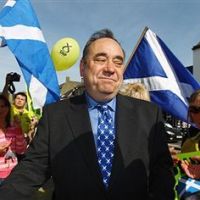
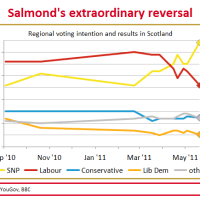
Scotland on Sunday publishes a thumper of a poll today that suggests the SNP is on course to defeat Labour and remain the largest party at Holyrood. In fact, John Curtice’s calculations have the Nats taking 55 seats to Labour’s 49. The Tories, meanwhile, slip to 14 while the Lib Dems suffer a catastrophe and would be left with just six MSPs, just ahead of the Greens with five seats. Should this poll be accurate and should the election – which is still 18 fun-stuffed days away – produce a result of this sort then happy days indeed. By which I mean, of course, not-as-desperate-as-they-might-have-been-days. Kenny Farquharson lays it on

Charting Labour’s future

The Labour Party is still ambling in the wilderness – sure of its destination, but uncertain of the route. Its response to last year’s general election defeat has been silence, publicly at least. In the privacy of debating chambers however, the party is charting its potential renewal. These circles murmur that ‘the state has reached its limits’; or, in other words, that Fabianism, the dominant force in the post-war Labour movement, has been tested to destruction. Philip Collins touches on this in his must-read column for the Times today (£): ‘Since the general election defeat, the only intellectual life in the party has come from blue Labour, an intriguing set

Cameron’s other speech

There is no rest for the Prime Minster. After delivering his speech on immigration in Romsey this morning, there was another to deliver, 62 miles away in Woking, this afternoon. This second CamSpeech of the day was billed as a scene-setter for the local elections — and so it proved. Rather than dwelling on a single policy area, the main purpose was to rattle through 101 reasons to vote Tory on 5 May. If there is anything to be taken from the text, it is just how upfront and unapologetic it is. There is little room for nuance, but plenty of room for sweeping, and forceful attacks, on Labour. This

Brown to the IMF? Not with CoffeeHousers’ blessings…

What to do when you’ve already saved the world? Save it all over again, judging by Gordon Brown’s latest reported manoeuvrings. Today’s Mail claims that our former PM is “clear favourite” to be succeed Dominique Strauss-Kahn as head of the International Monetary Fund. Although, as the paper says, it’s likely that the Coalition would operate against any such appointment. To remind the suits what they might be imposing on themselves, I thought I’d return to this post that we put up on Monday. It asked CoffeeHousers what Brown’s biggest mistake in government was. And we received more than enough responses to vote on a Top Ten, as below. We’ll keep

The Tories’ middle-class problem?

Back in July 2003, Bruce Anderson wrote a piece on David Cameron for The Spectator. Its tone was summed up by its headline — “My hero” — and that tone has suffused through much of Bruce’s writing about the Tory leader since. Which is why his piece for the FT today is striking by virtue of its differentness. Its headline is that, “Cameron is losing touch with core Tories.” Its argument is that the Tory party is ignoring the hopes, fears and aspirations of the white middle classes. Admittedly, Bruce doesn’t put all this down to Cameron. On his account, there are demographic factors at play — not least that

The battle over universal benefits continues on the local front

Here’s a question for you: should free school meals (FSM) be given to all pupils, regardless of their parents’ income? I ask because this is precisely what the Labour-led council of Southwark is proposing for its primary schools. As the Evening Standard reports, the councilmen’s thinking is that by giving “healthy” FSMs to every pupil, every day, they might help “reduce childhood obesity.” Oh, and the measure will cost some £4 million a year. Even if we put aside the question of whether the local praetorians should — or even could — tackle obesity on behalf of middle-class parents, this is still needling stuff. Southwark council has to find savings

Lansley and Cameron in the firing line

The coalition’s decision to ‘pause’ its NHS reforms has left an open goal for its opponents, and they’ve been busy tapping the ball into this empty net this morning. At its conference up in Liverpool, the Royal College of Nursing has, predictably but embarrassingly, declared that it has no confidence in the health secretary. Back in London, Ed Miliband has been making hay while the sun shines attacking both the bill and the pause. His refrain at his press conference this morning was ‘the answer to a bad bill is not to slow it down but to junk it.’ Miliband’s performance this morning was striking for him speaking at a

Why we should be concerned about debt interest

There’s an interesting post by Éoin Clarke on debt interest doing the rounds. It originally appeared on his blog, but was soon commandeered by LabourList — and little wonder why. Dr Clarke’s point is a perceptive and striking one. Debt interest, he says, is lower now than it was under John Major. The implication is that when George Osborne rattles on about the money blown on just “servicing our debt,” we should take it with an almighty heap of salt. It’s not, perhaps, as bad as all that. Or, rather, that’s one way of looking at it. There are other ways, which I would list thus:   1) Going beyond

Nick Clegg meets Gillian Duffy

There’s a new equation in British politics, and it’s one that Nick Clegg came up against this morning: Politician + Rochdale = Gillian Duffy. The Deputy Prime Minister was quizzed by Gordon Brown’s unassuming nemesis during his visit to the town earlier — and the results are in the video above. For what it’s worth, he did fairly well, emphasising the pressing need to tackle Labour’s poisonous fiscal legacy. But I suspect Mrs Duffy’s parting condolences will capture the headlines: “I’m sorry, Nick…”  

What was Brown’s biggest mistake?

“I have to accept my responsibility.” Who would have thought that Gordon Brown would ever breathe those words, let alone breathe them to a conference in America over the weekend? Our former PM has, it’s true, suggested that his regulatory system was inadequate to the financial crash before now. But here he was much more explicit: “We set up the Financial Services Authority believing the problem would come from the failure of an individual institution. That was the big mistake. We didn’t understand just how entangled things were.” And that’s event before he got onto the “responsibility” bit. I’ll repeat it, just in case it didn’t sink in the first

Beyond the frontline

Labour’s cartography department has been hard at work all weekend to produce this. It is, lest you haven’t heard Yvette Cooper today, an “interactive web-map” of the job losses announced by police forces so far, all across the country. You can interact with it in ways that include clicking to view a larger version. So far as web campaigning goes, this is probably fertile ground for the Opposition. No one likes the idea of more crime — and “more crime” is often conflated with “fewer bobbies” in the public debate. Yet Labour’s point is diluted, somewhat, by one simple fact: that their former Home Secretary refused to guarantee that police

Unite chief blames MI5 for protest violence

Sometimes, just when you think that the craziest left-wing ideologues have gone off to tend to their gardens, up one pops. Meet Len McCluskey, the head of Unite, who tells The Times’s Rachel Sylvester (£) that Fidel Castro has been a “heroic” leader of his people. That would be the same Cuban dictator who jails journalists and trade unionists. Odd choice of hero. But it gets better. McCluskey seems to think that MI5 encouraged violence at the last anti-cuts protest. I kid you not: “Mr McCluskey believes that the secret services, in particular MI5, may have been working under cover to encourage the violence as part of a conspiracy to

Dreadful MP of the Week: Glenda Jackson

I’m most grateful to Selena Gray for publicising Glenda Jackson’s response to the notion that volunteers might run a library that Brent council has threatened to close. I don’t think, however, Selena goes nearly far enough. Firstly, it cannot be pointed out too often that any library closures are the responsibility of councils, not central government. The latter may not send as much money to the former as it did in previous years but the decisions on what to spend the money councils do have are entirely a matter for the councils themselves. If your local library or swimming pool closes it’s because your local council has decided to spend

An obstacle to the Big Society

Toby Young’s piece in the latest issue of the Spectator magazine captures one of the problems facing the Big Society. It’s not that people don’t want to donate their time to fill in the cracks left by the cuts – it’s that they’re often blocked from doing so. Toby highlights the case of Kensal Rise Library, which a local group of volunteers had hoped to save from the axe. But local council chiefs have hardly greeted their plan for running the library with enthusiasm. As Toby puts it: “On Monday, the council produced its considered response in the form of a 178-page ‘supplement’ to … well, it doesn’t say. In

Labour fights back in Pickles’ war on propaganda sheets

Most councils publish a newspaper – usually delivered to your door and instantly discarded. The government has decided that these freesheets are both a waste of public money and detrimental to local newspapers competing in the open market; the accusation that they are predominantly used for propaganda purposes has also been made. Labour opposed the revisions to the Code of Recommended Practice on Local Authority Publicity, which might suggest that these publications are too valuable to their councils. However, some of the red camp’s objections were valid. Two weeks ago, Chris Williamson, Shadow Communities and Local Government Minister, said that the proposals were indicative of Whitehall’s continued interference in local

Winners and losers | 6 April 2011

The birds chirruping in the sunlight clearly didn’t get Ed Balls’s memo. Otherwise they’d know that today is “Black Wednesday,” the day when the coalition’s tax and benefit policies swoop in to leave the average household some £200 a year worse off. This is the message that the shadow chancellor is broadcasting this morning, be it on Radio 4 or in a post for Labour Uncut. His claim is that the coalition is — by going “too far, too fast” on the deficit — merely squeezing the “squeezed middle” even more. Only that’s not quite the full picture. The Treasury, for one, is pointing out that today’s measures will actually

Miliband may be punished for his contempt for Clegg

Ed Miliband’s hand of friendship has to be one of the shakiest body parts in British politics. Sometimes it’s extended to the Lib Dems, sometimes it’s not. Sometimes it’s extended to Nick Clegg, sometimes it’s not. Sure, the Labour leader does appear to have finally settled on a position: that he will only shake the hands of a Cleggless Liberal party. But that has come after constant wavering on his part, and could well be subject to change. I mention this now because of a claim in Rachel Sylvester’s column (£) today. I’m not sure whether it has been made before — but it neatly encapsulates how Miliband has lurched