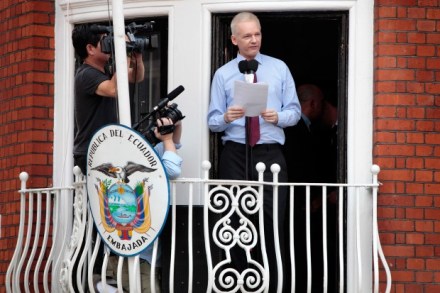
Julian assange

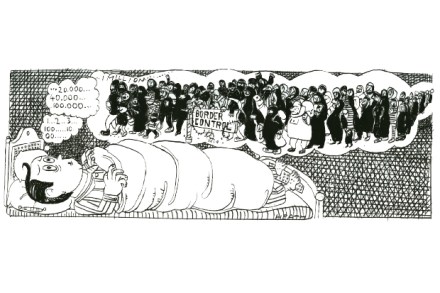
Portrait of the week: gambling politicians, gender rows and a free Julian Assange 

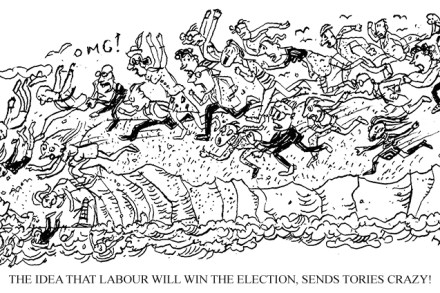
Home The Conservative party withdrew its support from two parliamentary candidates, Craig Williams (who was parliamentary private secretary to the Prime Minister) and Laura Saunders, both of whom the Gambling Commission had been investigating after allegations that bets had been placed on the date of the election. Two Conservative party workers and six policemen were also alleged to have been involved, one of the policemen being under criminal investigation. Others remained under investigation. Labour suspended a parliamentary candidate of its own, Kevin Craig, after being told the Gambling Commission was investigating him betting on failing to win the seat, which he now might. The candidates’ names would still appear on ballots as standing for their parties.
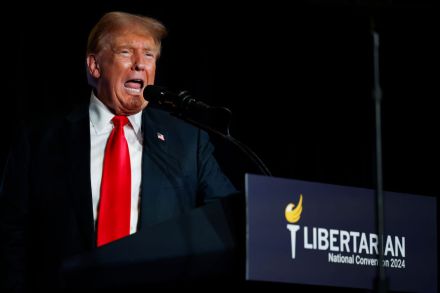
Should presidential candidates pledge to free Assange?

From our US edition

Washington, DC WikiLeaks founder Julian Assange is a hero to libertarians. As is Ross Ulbricht, the founder of now-defunct Silk Road, an internet marketplace where you could buy lots of shady things. Where some see traitors and criminals, many libertarians see truth-seeking rebels, courageously engaged in a war against Big Government, defying unjust mandates. This was particularly apparent at the 2024 Libertarian National Convention in Washington, DC, this weekend. In an email sent to press by organizers, “Free Ross Ulbricht” and “Free Julian Assange” were ranked the top topics for Donald Trump’s speech Saturday — over “End the Fed" and other popular slogans.

donald trump libertarian assange

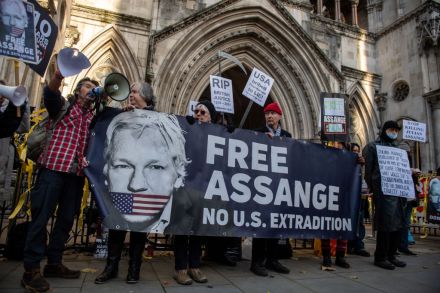
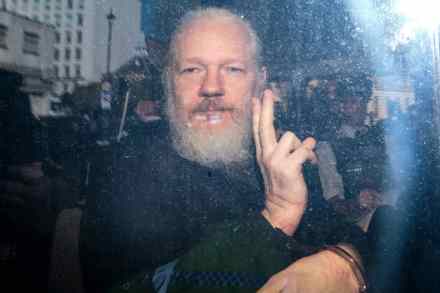
Should Julian Assange be extradited to America?

27 min listen

Freddy speaks to philosopher Slavoj Zizek ahead of what we understand will be Julian Assange's final court appeal against extradition back to the US. The WikiLeaks founder has been wanted by the US authorities after he leaked tens of thousands of highly sensitive documents. On the podcast they discuss the parallels between Assange and Navalny, whether the West is beginning to behave more like the Soviet Union than we ever have, and if WikiLeaks was behind the election of Donald Trump.

Why Julian Assange is hated

From our US edition

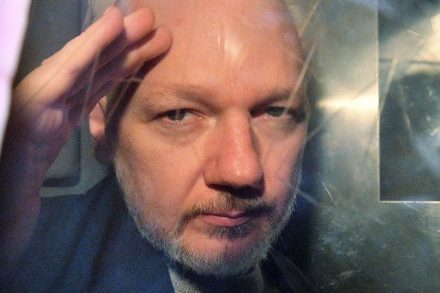
The British High Court ruled on Friday that Julian Assange can be extradited from the UK to the US. The US thus won its appeal against a January UK court ruling that he could not be extradited due to concerns over his mental health. This latest twist in the endless Assange saga is just the culmination of the long and slow well-orchestrated campaign of character assassination that reached the lowest level imaginable with unverified rumors that Ecuadorians in their London embassy wanted to get rid of him because of his bad smell and dirty clothes.

assange

Julian Assange and the deep flaw in our extradition laws

You could almost hear the rejoicing in Whitehall on Friday morning when the High Court cleared the way for Julian Assange to be extradited to the US, rejecting a plea that he was too mentally frail. The man has, after all, been a thorn in the administration’s side for 11 years: 18 months contesting his rendition to Sweden, followed by seven embarrassing years holed up in the Ecuadorian embassy, and then two-and-a-half years in Belmarsh fighting extradition to the US on espionage charges. But there is one disquieting feature. The offences he is charged with in the US are not ordinary charges of criminality, like the accusations he faced in Sweden, but are essentially state crimes: in this case espionage and the betrayal of US state secrets.

Will the right save Julian Assange?

From our US edition

In late 2018, Nils Melzer, the United Nations Special Rapporteur for Torture, was contacted by lawyers representing WikiLeaks publisher Julian Assange, asking him to intervene on their client’s behalf. ‘I was like, “No. Not this guy. Isn’t this the rapist hacker guy?”’ Melzer recalls. He ignored the email. Three months later, the lawyers contacted him again, this time warning that Assange’s extradition to the US — where he faces 17 counts of violating the Espionage Act for obtaining and publishing secret military and diplomatic documents — could be imminent.

assange

Trump might be Edward Snowden’s last chance at freedom

From our US edition

There was speculation that more pardons could be on the horizon after President Trump recently pardoned his former national security adviser Michael Flynn. Some members of Congress are encouraging Trump to grant the boldest clemency currently being discussed: NSA whistleblower Edward Snowden. Democratic congresswoman Tulsi Gabbard tweeted on November 27, one day after the Flynn announcement, '@realDonaldTrump Since you’re giving pardons to people, please consider pardoning those who, at great personal sacrifice, exposed the deception and criminality of those in the deep state.' Her tweet linked back to a post from October promoting her legislation that would drop US charges against both Snowden and Wikileaks’s Julian Assange.

snowden

The Russia probe was mishandled worse than anyone could have imagined

From our US edition

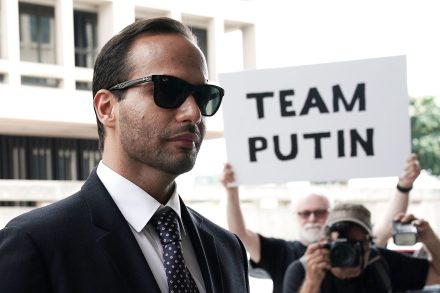
It’s been over three years since the FBI first launched its investigation into an alleged conspiracy between the 2016 Trump campaign and the Russian government, and yet we’re still learning just how badly our intelligence agencies bungled Crossfire Hurricane. The president and his allies have been arguing since the probe went public that it was all a ‘witch hunt’ designed to put a stop to or delegitimize his electoral victory. Subsequently released details about the investigation seemed to track with that theory: Inspector General Michael Horowitz, for example, chided the FBI in a December report for failing to fulfill its full obligations when seeking FISA warrants against former Trump campaign official Carter Page. Sens.

George Papadopoulos

Free Julian Assange — his fate is inextricably tied to our own

From our US edition

I visited Julian Assange in Belmarsh prison on November 21. One small detail, insignificant in itself, did strike me as emblematic of how prisons function with regards to welfare and human rights. All the guards were very kind and repeatedly emphasized that everything they do is for our own good. For example, Assange is in solitary confinement 23 hours per day. He has to eat all his meals alone in his cell, and when he is allowed out for an hour he can’t meet other prisoners. The communication with a guard who accompanies him is reduced to a minimum. Why such severe treatment since he is now just in protective custody? (He served his prison time and he is only there to prevent him escaping extradition.

julian assange

Who counts as a journalist, anyway?

From our US edition

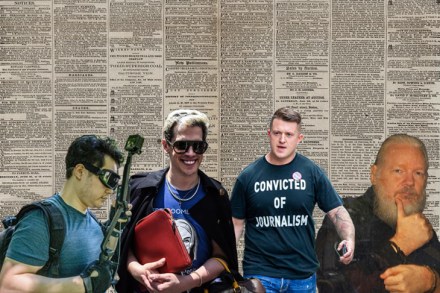
As a young journalist in the mid-2000s, there was the occasional circumstance where I was asked to ‘prove it’: upon showing up to a news event I was covering, whoever ran check-in insisted that I show some press credentials. You know, those badges you see on episodes of Law & Order to denote that someone’s a reporter. (More often than not, the guest star probably holds it up and indignantly yells ‘Press!’ in order to enter a crime scene.) Working for a digital-first outlet – CNET Networks, later acquired by CBS – I never had anything like it except maybe business cards. To me, it seemed like an antiquated request; to the people checking my legitimacy, it was an obvious question.

journalist

In defense of treason

From our US edition

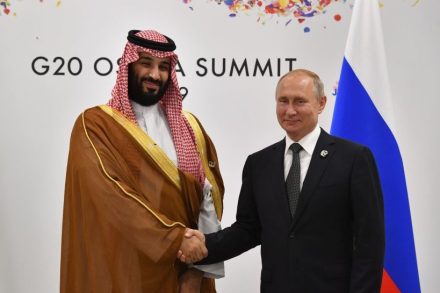
The recent G20 meeting in Osaka and its surrounding events provide a sad view of the emerging New World Order: Trump exchanging love messages with Kim Jong-un and inviting him to the White House, Putin jovially clapping hands with Prince Mohammed bin Salman, and so on, with Merkel and Tusk, the two voices of old European reason, marginalized and mostly ignored. This NWO is very tolerant: they all respect each other, no one is imposing on others imperialist Eurocentrist notions like women’s rights. This new spirit is best encapsulated by the interview Putin gave to the Financial Times on the eve of the Osaka summit, in which he, as expected, lambasted the ‘liberal idea’ claiming that it ‘outlived its purpose.

treason

Barometer | 17 April 2019

Embassy endurance Julian Assange was thrown out of the Ecuadorian embassy in London, seven years after seeking sanctuary from extradition proceedings. But there are people who have hidden longer in embassies: — Jozsef Mindszenty, a Hungarian cardinal, spent 15 years in asylum in the US embassy in Budapest. He had served eight years in jail for opposing the communist regime but was freed during the Hungarian uprising in 1956. In 1971, he was allowed to leave Hungary to live in exile in Austria. — Berhanu Bayeh, Ethiopian foreign minister between 1986 and 1989, has been sheltering in the Italian embassy in Addis Ababa since 1991, when his government was overthrown by the Ethiopian People’s Revolutionary Democratic Front.

Portrait of the Week – 17 April 2019

Home Although the latest date for Brexit had been postponed by the European Council until Halloween, 31 October, the government had to confront the prospect of holding elections to the European parliament on 23 May if parliament would not agree to Theresa May’s withdrawal agreement before then. Former Conservative leader Iain Duncan Smith said that May should go before those elections, which ‘would be a disaster for the country. What are you going to say on the doorstep — vote for me and I’ll be gone in three months?’. Nigel Farage launched his Brexit party. The House of Commons went into recess until 23 April, St George’s day.

The soiling of Julian Assange

From our US edition

Here’s an intense irony for you. The journalistic activity for which Julian Assange has been indicted in the Eastern District of Virginia led to the exposure of blatant American war crimes and official deceit in Iraq: the very war Donald J. Trump vociferously decried during his successful presidential campaign. Over and over again in 2016, Trump lamented ‘Iraqi kids blown to pieces’ and pilloried Hillary Clinton for backing the invasion. And yet now, by seeking the extradition and prosecution of Assange on charges that stem directly from the revelation of those crimes, Trump has chosen to shunt all this aside and do the bidding of his besmirched GOP predecessor, George W. Bush.

assange

The real wizard of Oz

What makes a barrister famous? At one time, many of the best advocates were also prominent politicians, whose day job was in court and who moonlighted in the Commons — think F.E. Smith. But it is impossible today to double up with any distinction. As long as capital punishment survived, public attention also attached to those great defenders who rescued their clients from the noose — think Edward Marshall Hall. But English judges no longer don the black cap to pronounce the sentence of death. Geoffrey Robertson, the author of this riveting memoir, ticks the boxes which guarantee the reputation of the modern celebrity silk: chiefly, a concentration on the fashion-able area of human rights, with a special interest in press freedom, making him a hero of the left-wing media.

Books Podcast: The secret lives of Julian Assange, Craig Wright and Ronald Pinn

In this week's podcast I'm talking to the novelist and journalist Andrew O'Hagan about lies, paranoia, and the way that nothing, online, is quite as it seems. His new book The Secret Life (Faber) tells, in the words of its subtitle, "three true stories": one about Andrew's utterly bizarre time as the prospective ghostwriter for Julian Assange; another about his association with the man who claimed to have invented the digital currency Bitcoin; and the third -- still darker and stranger -- about Andrew's own experiment in stealing a dead man's identity to become someone else online. They add up  to a funny, alarming and disturbing picture of what happens when digital fantasy meets analogue reality.

Vlad the corrupter and the crisis on the left

Julian Assange still has not found the courage to face the women who accuse him of sexual abuse. Rather than try to clear his name, he has sat in the basement of the Ecuadorian embassy in Knightsbridge for four years – a confinement long enough to drive most of us out of our minds. If Assange has lost his wits, however, there is a method to his madness, as there was long before he received what paltry hospitality the Ecuadorian diplomatic corps could offer him. Nothing he leaks has ever hurt Russia. He will denounce and expose human rights abusers, as we all should. But he will never allow his followers to learn of the suppression of democracy and human rights by Putin’s forces within and without Russia’s borders. Human rights in Assange’s mind are shape shifters.

Tangled web | 30 June 2016

Mike Bartlett’s curious blank-verse drama Charles III became an international hit. His new effort examines the cut-throat world of dark-web espionage. An American traitor named Andrew (Edward Snowden presumably) is hiding out in a Moscow hotel. Enter a flirty, giggling Irishwoman played by Caoilfhionn Dunne, who claims to be British and who teases Andrew over his betrayal of his homeland’s secrets. She evinces an interest in Oscar Wilde and the pair lock horns over footling minutiae. Andrew points out that Barbie dolls are called Sindy in the UK and this seems to demonstrate his familiarity with Britain. But he fails to spot the false cadences of her accent and he doesn’t query her use of the strange term ‘British Metropolitan Police’.

Inside the Ecuadorian embassy with Julian Assange: Risk reviewed

'This film would not have been possible without the following encryption tools,' is one of the least expected film credits I can think of. But then again, Laura Poitras’s Risk is not exactly your run-of-the-mill documentary. After her Oscar-winning Citizenfour, a gripping hour-by-hour account of Edward Snowden’s NSA surveillance disclosures from his Hong Kong hotel room, Poitras’s latest is an intimate portrait of WikiLeaks founder and editor-in-chief Julian Assange. Poitras started filming Assange at work in 2010 and her film follows the whistleblower’s mission and his various legal travails since then. As a result, Risk is far less dramatically sensational than Citizenfour, which unfolds over the course of several history-making days.

Portrait of the week | 11 February 2016

Home David Cameron, the Prime Minister, said that if Britain left the European Union, France could stop allowing British officials to make immigration checks on the French side of the border, and, his spokesman predicted: ‘You have potentially thousands of asylum seekers camped out in northern France who could be here almost overnight.’ Mr Cameron denounced the way prisons are being run by his administration: ‘Current levels of prison violence, drug-taking and self-harm should shame us all.’ Junior doctors went on strike again for 24 hours. Twelve men of Pakistani heritage were jailed for up to 20 years for the rape and sexual abuse of a girl when she was aged 13 and 14, over a period of two years, in Keighley, West Yorkshire.