Italy

Why does the media never call world leaders ‘far left’?

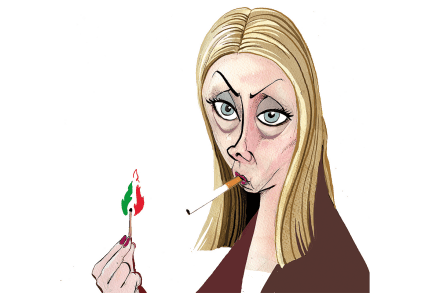
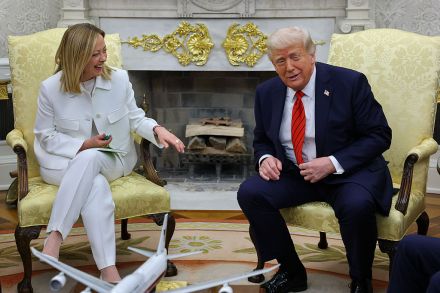
Italy is about to have its first female leader and the American left is furious. Giorgia Meloni grew up in a working-class neighborhood in Rome and was raised by a single mother, after her father, a communist, fled to the Canary Islands and was later convicted of drug trafficking in Mallorca. She wrote in her autobiography that her mother planned to have an abortion when she was pregnant with her but changed her mind at the last minute. Meloni worked as a nanny, a waitress, and a bartender before getting into politics, but she’s no AOC. Meloni, 45, is the leader of the right-wing populist Brothers of Italy party, which recently won Italy’s general election with 26 percent of the vote. She’s widely expected to be named Italy’s first female prime minister.

Giorgia Meloni and the reactionary axis that wasn’t

One is a blonde, photogenic woman who grew out of a youthful infatuation with Benito Mussolini to become the first female prime minister of Italy. The other is anything but photogenic, a grizzled veteran of more than three decades of political combat, who began his career as a student activist and became a respectable center-right statesman, only to reinvent himself as a populist firebrand. But if you were to judge Giorgia Meloni and Hungarian Prime Minister Viktor Orbán by the frequency with which they appear together in media coverage, usually with adjectives like “far-right” and “extreme” attached, you might assume that the two conservative heads-of-state are basically indistinguishable. The European Union and its assorted sympathizers certainly seem to think so.

giorgia meloni

Giorgia Meloni should inspire American conservatives

Giorgia Meloni and her Brothers of Italy party were swept into power in elections this weekend, a development that the media complex in America greeted with all the subtlety of a bird smacking into a sliding door. The New York Times managed to call her a “fascist” 28 times in a single article. Meloni stands to become Italy’s first female prime minister — but I suppose it’s only good for women to break glass ceilings if they’re the correct kind of women.

Giorgia Meloni is no springtime for Italian fascism

Is it springtime for fascism in Europe? First, it was Sweden. Now, it’s Italy. To judge by the reaction to Giorgia Meloni’s victory in the Italian elections on Sunday, the moment to say arrivederci to democracy has arrived. “Giorgia Meloni will be a minister-president whose political examples will be Viktor Orbàn and Donald Trump,” Katharina Barley, the vice-president of the European Parliament, declared. Maybe so, but will she actually be able to transform her country? Fratelli d’Italia, the Brothers of Italy, is a nationalist party that traces its roots back to Mussolini and is led by the charismatic Meloni. It's about to play a starring role in the Italian political firmament.

Dear America: moving to Europe won’t solve all your problems

“In Europe people wear breathable clothes made out of natural materials, in the USA people wear plastic.” “In Europe people sleep indoors, not in tents on the street like Los Angeles.” “Unfortunately people have a lot of reactions to gluten in the US and zero issues in Europe” “How can you avoid looking like an American tourist in France?” Scroll through your news feed and you’ll witness a lot of Americans, usually those who pride themselves on their progressive views, indiscriminately romanticizing “Europe.” In the wake of the endless Covid restrictions and after Roe v. Wade was overturned, there’s been endless social media chatter about how to move from the US to Europe.

europe

Nancy Pelosi’s Italian job

The price of gasoline in California is averaging at over $6 a gallon. Inflation is 8.6 percent. The nation is reeling after yet another mass shooting, and the Democratic base is furious at their party for being caught flat-footed by the Supreme Court on abortion. How are our nation’s leaders responding? Well, Nancy Pelosi and her ample bosom are taking a waterfront stroll at a private beach club in Italy. The Speaker of the House looked well below her eighty-two years as she showcased her tanned figure in a turquoise-patterned bathing suit. Pelosi and her beau Paul are taking a break from, respectively, suspect stock trading and drink driving at the highly exclusive Alpemare Beach Club near Florence, owned by Italian opera star Andrea Bocelli.

nancy pelosi breasts

Following the seam of the Iron Curtain

Just before the pandemic, I spent several months traveling through Europe, from the north of Norway to Istanbul and beyond to Azerbaijan. I saw unforgettable sights: the endless daylight of the Arctic summer; the vast Hammershus castle on the Danish island of Bornholm; Vienna’s ornate Prunksaal library; and the sandy beaches of Corfu. But the focus of my journey was precisely those things that most travelers to these places often ignore. I was following the route of the Iron Curtain. My aim was to visit every part of that old great divide, all the places where NATO once abutted the Warsaw Pact, where overwhelming military might stood constantly primed for apocalypse.

The last American tourist

I was driving along a curvy English road outside a village in Gloucestershire a few weeks ago when a sign loomed on our left. It said: CATS EYES REMOVED My first thought was: What a horrible way to make a living in this day and age, even out here in the countryside. So much for All Things Bright and Beautiful... Maybe those people who said that Brexit would turn the English into depraved monsters were right. I was jumping to conclusions. It hadn’t been put up by an entrepreneur or veterinarian but by the highway authority. Cat’s eyes are what the English call those super-reflective bumps embedded in the stripes on minor highways to keep drivers from drifting across lanes. The sign was a warning that this curvy road had recently become much more dangerous.

tourist
venice

The real food of Venice

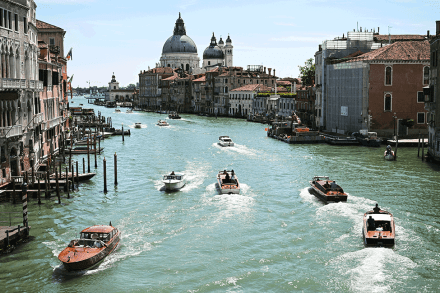
A few years ago, I moved to Newlyn, a fishing village in west Cornwall. I didn’t understand why I moved to Newlyn until I returned to Venice. I take almost all my holidays in Venice, and it is a cliché that Venice only slowly reveals her mysteries. You must fight your way past a mass of Renaissance portraiture and mirrored palaces but the mystery it showed me this time is this: like Newlyn, Venice is a fishing village. Venice got rich in the thirteenth century, monopolized the trade routes to the east for two centuries and covered itself in Istrian stone, which Newlyn didn’t. But it’s still a fishing village, founded by people running away from barbarians, into the mud flats of a lagoon to fish for crabs. It is easy to forget that — unless you look for Venetian cuisine.

Florence with Dante

The trouble with Florence, says Ricardo, a local journalist, is that we’re just living off our past glories. “Aren’t we all?” I reply. Florence could perhaps be forgiven when it has accumulated such vast cultural and physical capital, built up over centuries. Signs remind you that it’s 700 years since the death of its most famous son, Dante, father of the Italian language. I must admit I’ve always been too intimidated to read his epic, The Divine Comedy, which T.S. Eliot said was “as great as poetry ever gets.” To prepare for my assault on the summit, I have been reading about Dante himself. I hadn’t known he had no more than a passing acquaintance with his great love, Beatrice.

florence

The romantic return of Florence’s wine windows

Stroll around Florence and you’ll notice little ornate openings embedded in the walls of Renaissance palazzos. They look like doorways for tiny people, though they would have to be quite athletic tiny people, as the openings are three feet off the ground. But they’re not entrances for Tuscan pixies — they’re for selling wine. There are more than 150 buchette del vino dotted around the city and they date back to the 17th century. You’d knock on the door, hand over some money and a bottle, and the mysterious person behind the wall would fill it full of wine. It wouldn’t have been just any old plonk either; the great merchant houses of the city like Frescobaldi, Ricasoli and Antinori, who still make some of Tuscany’s best wines, would sell in this way.

Wine

Elena Ferrante’s Italian job

As there’s nothing more annoying than when someone tells you ‘I told you so’, I shall refrain from telling you so for as long as possible. But it will be hard. There I was, lying on the couch one afternoon at work and reading Twitter, when I noticed LitHub appearing in my feed. Now, I am usually as glad to see LitHub in my feed as a prize race horse is to see cat food in his. LitHub is one of those trendy, sort-of academic websites that talks about things like ‘digital humanities’ and does its earnest best to take the fun out of reading and the point out of book-reviewing when, as any-one knows, reading and writing book reviews is a waste of time unless there’s blood and feathers everywhere by the end of the first paragraph.

elena ferrante
Amanda Knox

School of hard Knox

Rudy Guede was released from prison this past December. If that name doesn’t ring a bell, it’s because for a long time, the brutal murder he was sentenced for was blamed on Amanda Knox. The 2007 burglary gone wrong made worldwide headlines for years. Knox, a photogenic American student studying abroad in Perugia, and her nerdy Italian boyfriend, Raffaele Sollecito, were found guilty, twice, of murdering Knox’s British roommate Meredith Kercher in what the Italian police called a ‘drug-fueled sex game gone awry’. Everyone, save Knox and those close to her, was shocked to learn four years later that there was no slasher sex game, and, more importantly, there was absolutely no DNA linking Knox and Sollecito to the crime scene that imprisoned them for years.

Pictures at an exhibition

Deeply learned and with a style all his own, Marco Grassi is as at home with Duccio as with Norton Simon; Bronzino as with Bernard Berenson; a painting on his desk as with a ‘Last Supper’ in Florence’s Basilica of Santa Croce. In the Kitchen of Art presents Grassi’s most memorable essays over a span of nearly 20 years. Beginning with a previously unpublished memoir of his Florentine upbringing, and continuing with in-depth critical discussions of the greats of Italian art along with recollections of the grandest collectors of the 20th century, this book shows the art world in the round.

grassi

A tinpot Caesar

In 1919, an obscure political agitator called Benito Mussolini assembled a ragbag of Blackshirt diehards in the Lombard capital of Milan and launched the movement that was to become, two years later, the National Fascist party. The party took its name from the classical Roman symbol of authority — an ax bound in rods, or fasces. Once in power, Mussolini introduced the stiff armed Roman salute after the handshake was deemed fey and unhygienic. At times he wore a richly tasseled fez and thrust out his chin pugnaciously for the cameras. For all his posturing and demagoguery, Mussolini was widely admired in pre-war Britain, where Lord Rothermere’s Daily Mail routinely carried flattering portraits of him.

mussolini

A leaf from Verdi’s book

Radicchio, radicchio, wherefore art thou radicchio? A red-leafed chicory by any other name would doubtless taste as bitter — but it certainly wouldn’t sound as pedigreed. Consider the following bit of dialogue: ‘Would you like a chicory salad?’ The natural response is a hasty, ‘Not just at the moment, thank you,’ the very name of chicory summoning up painful memories of undercooked chickpeas and bowls of foliage into which well-meaning persons have seemingly shaken the broken fragments at the bottom of the cereal box. Compare and contrast with the following overture: ‘Would you care for some grilled Chioggia radicchio embellished with small cubes of buffalo mozzarella and drizzled with a reduction of Balsamico di Modena?

radicchio

Happy hours

A family of peacocks is sunning itself in our villa garden. They all look extraordinarily happy and composed, especially the baby one for whom (like us, come to think of it) this is a whole new experience. But then, the 150 hens wandering in and out of their coops painted like beach huts don’t look exactly overburdened themselves. Nor do the sheep, pigs and cows in their 220 acres of lush Tuscan terrain near the Merse river.

tuscany

Will coronavirus kill the eurozone?

The familiar should be a consolation amid the terrible novelties of COVID-19, but the pandemic’s effects on the European Union threaten to turn familiar fiasco into dangerous novelty. As a weakened Angela Merkel faces Germany’s crisis of economic responsibility, and France floats the idea of issuing its own ‘corona bond’, the EU and its currency face what Emmanuel Macron would probably not want to call its Waterloo.Henry Kissinger’s remark — ‘Who do I call if I want to speak to Europe?’ — has never seemed more true. Britain is leaving.

eurozone

Italy gave China PPE to help with coronavirus — then China made them buy it back

China has tried to restore its image after lying to the world about the seriousness of its coronavirus outbreak, but its attempts at humanitarianism have turned out to be as slippery as its wet markets. After COVID-19 made its way to Italy, decimating the country's significant elderly population, China told the world it would donate Personal Protective Equipment (PPE) to help Italy stop its spread. Reports later indicated that China had actually sold, not donated, the PPE to Italy. A senior Trump administration official tells The Spectator that it is much worse than that: China forced Italy to buy back the PPE supply that it gave to China during the initial coronavirus outbreak.

Chinese President Xi Jinping

Palermo without borders

This article is in The Spectator’s February 2020 US edition. Subscribe here. On a wet November evening, Leoluca Orlando, the mayor of Palermo, sat in the front pew of a church on the city’s main thoroughfare. He, like the citizens proliferating behind him, was waiting for the concert to begin. The setting and the seating order had a provincial air, like something out of an Upamanyu Chatterjee novel. But Orlando, the man who squeezed the Sicilian mafia, has a cosmopolitan vision. Orlando has converted Palermo, a major gateway for the masses pouring out of Africa and the Middle East, into perhaps Europe’s least administratively hostile city to prospective settlers.

palermo