Italy

Sustainable splendor: skiing the Italian Alps

“Wow.” My younger brother stopped still on the runway as we disembarked our plane at Innsbruck. In every direction, snow-capped mountains shot up to the sky. I found myself rubbing my eyes like a cartoon character, while he picked his jaw up off the floor. Delivering us across the border to Brunico, our cab driver felt moved to score the scene. “All this untz, untz, untz music, I can’t do! Phil Collins OK?” The Alps looming majestically on both sides of the road, “In The Air Tonight” blasting comically loud, the journey fast became a core family memory. It felt stupendous, exciting; like your first time seeing Manhattan sparkle in the distance from JFK. “This is the Brenner Pass... and now, Italy. Welcome in Italy!

italian

Hotel hopping in Rome

Summer in Rome. Expectation: breathe the soul of the classics, soak up the history, feel the romance. Reality: breathe in the AC, soak in a pool of sweat, feel ever so slightly unhinged. My plans to indulge in Italy’s time-honored tradition of la passeggiata — strolling around looking stylish, gelato in hand — were quickly nixed by the Cerberus heatwave. Dreams of meandering around perhaps the world’s most famous open-air museum gave way to lying recumbent with a handheld fan. Jumping from the relative cool of a sleeper-train carriage onto the platform at Termini station felt akin to opening an oven door and climbing in. Red alert warnings were issued as the mercury soared toward 119°F.

Rome

The era of ideological, overreaching and omnipresent government

It was a law of classical political philosophy that democratic polities devolve inevitably into tyrannical ones. This law is being validated in the twenty-first century, as liberal democracy creates societies antithetical to both liberalism and democracy by shaping citizens of a character for which neither was designed nor developed. In a parallel development over the past decade or so in Europe and the United States, liberals and democrats view their response to the problem as “reaction,” pure and simple, against the sort of thing they have been fighting since 1789. Only it is not reaction; it is apparently something new in history.

government

Meloni and her lieutenants plan their takeover of Europe

Cosenza, Italy On a dreary afternoon in May, hundreds of well-dressed Italians crowded into a regal government building in Cosenza, aptly named The Provincial Palace of the Hall of Mirrors. It was a campaign event for Fratelli D’Italia, Italy’s ruling political party. The supporters listened attentively for more than two hours. The mood was triumphant and the politicians spoke as if victory was inevitable. They spoke about a plan for when, not if, the right assumed greater power in Europe.  “This confidence is due to the fact that we, as Italy, have acquired centrality in a very important way,” said Giovanni Donzelli, the party’s national organization manager.  “This centrality is all thanks to the great work done by our leader Giorgia Meloni.

Meloni

Bar-hopping, Venetian style

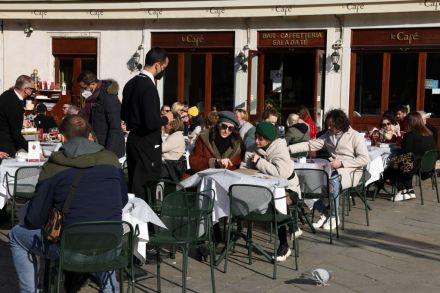
It’s a mist-steeped weekday morning in the Dorsoduro district. The kind when the rising lagoon licks at the old stones as if trying to devour the city, footsteps echo mournfully between peeling palazzi and even the marble statues seem to hang their heads. But not too early nor too dismal, it turns out, for wine. In Osteria Al Squero — named after Venice’s oldest boatyard, which it faces across the narrow canal — the lights are on. A huddle of Venetian men stands beneath the wooden beams with their grocery bags and small dogs, enjoying un’ombra. It means “shade” in Italian but also, here in the Veneto, a small glass of vino.

Venetian

Plogging: Europe’s bizarre eco-friendly fitness craze

The first finisher crossed the line sweaty, tired and almost black with dirt, his white Decathlon shirt turned gray and his standard-issue blue gloves transformed into a deep midnight. He dragged behind him a refrigerator-sized plywood box, piled high with swollen rubbish bags and secured with a hooked rubber bungee cable — where he grabbed that, nobody knew. Yet José Luis Sañudo Lamela’s smile was wide, and he laughed heartily when onlookers and fans expressed amazement at his feat. But despite Lamela’s assuredness that he would take home top billing in the annual World Plogging Championships, one man outdid him — if not in diversity of goods, in pure heft.

plogging

Eating my way through Sicily

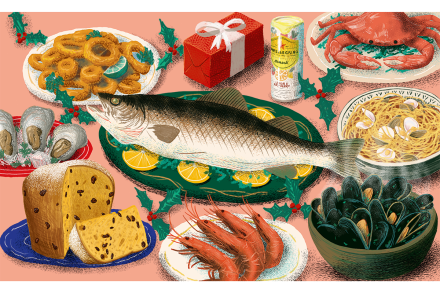
I arrived home six pounds heavier after three weeks in Sicily. That is the weight of a gallon of milk. Eight cans of beer. Or a small Yorkshire Terrier. I could try blaming the Cerebrus heatwave on my filthy granita habit and lack of almost any bodily movement (and it didn’t help) but the reality is this: Sicily is the fantastical realm they say it is and stupendously beautiful. And the food is even better.  Roman, Arab, French, Greek and North African influences spectacularize every meal. Almond milk granita is spooned into glistening brioche rolls before you can wipe the sleep from your eyes. Chocolate cannoli appear out of nowhere at breakfast. Arancini oozes globs of molten cheese in a manner that’s, quite frankly, sexy.

sicily

The marvelous Montalbano

I visited Sicily in May 2005, when the airlines were still requiring all checked luggage to be left unlocked. After the flight from Paris touched down at Palermo, my wife and I went to collect our luggage at an apparently quiet and unrushed airport to discover my suitcase opened partway and an expensive dressing gown missing. Eighteen years ago, il Commissario Salvatore Montalbano was quite unknown to me. Otherwise, I should have immediately thought of the Sinagra family at the eastern end of the island, though the word “mafia” did come to mind as I rezipped the bag.

Montalbano

Mount Etna and a museum with rooms

“There is too much Nutella in the cornetto.” Not the words you hope to hear while trudging up the craggy slope of the most active volcano in Europe, in the wrong footwear. Clouds of black dust kicked up into my nostrils. A white butterfly posed starkly against dried black lava.  “Come, ragas, I want to show you something. These are lava bombs. I am standing on thiiiiiiick liquid. The lava! It went splat-ta! Like pizza dough!” Our guide Vincenzio gesticulated at his bedraggled group, inwardly asking themselves why they’d volunteered to tackle Mount Etna in a heatwave. “A big mama. She-” A robotic siren interrupted Vincenzio mid-flow, screeching from a startled septuagenarian’s Nokia. A teenager patted down his jean pocket, confused.

mount etna

‘We must defend our territory’: on the frontline of Europe’s migrant woes

Lampedusa, Italy The motorcade carrying Italy’s prime minister is being held up by a wild-eyed pirate. With a bushy black beard, sun-blasted face, tattooed forearms and a single earring, he stands in front of the convoy of a dozen police cars, extending a flattened palm. Blue lights flash, engines idle and somewhere behind blacked-out windows sit Giorgia Meloni, the prime minister, and her important guest, Ursula von der Leyen, president of the European Commission. The pirate is Giacomo Sferlazzo, leader of the protests that began on the island of Lampedusa after around 100 small boats carrying migrants arrived there on a single day in September. Really he’s a local musician, professional puppeteer and, as he describes himself, a Marxist-Leninist follower of Antonio Gramsci.

lampedusa

Don’t cry from pleasure: chef Ciccio Sultano’s Sicily 

The Cerberus heatwave is as fierce as they said it would be. I feel like I’m being microwaved on a low heat, my phone hot to the touch inside my pocket. A friend and I heave suitcases into the imposing stone lobby of a.d. 1768, then slump on chairs, dizzy. A palatial, historic residence hidden in plain sight, I’m gratefully swallowed up by its high ceilings and cool shadows. We’ve navigated Italian roads (and road rage) from Catania to Ragusa Ibla in 107.6 degrees Fahrenheit to seek out one hotel, and one man: Ciccio Sultano.  Our month-long road trip through southern Italy is finishing in the late Baroque towns of UNESCO World Heritage Site Val di Noto, collectively rebuilt after a huge earthquake on January 11, 1693.

sicily

Inside the traditional art revolution

More and more often lately, people are rejecting tired modern art. They often find solace in the art of the past; online accounts admiring “traditional art” have amassed hundreds of thousands of followers, but they act as online repositories for a bittersweet recognition: what once was, no longer is. But the kind of art they seek, involving detail, meaning and skill, still exists, and it is growing. The cultural hegemony of contemporary, abstract art is slowly beginning to crack; through those cracks we can see new art surfacing. As I have become increasingly disillusioned with the state of politics, an observation from Ernst Jünger, the German philosopher and skeptic of the extreme politics of his day, rings true to me.

art revolution Milano Painting Academy

Handsiness or assault? Fondling in the post-#MeToo era

“If I wanted to, I could have had sex with people all the time,” said Kevin Spacey in court this week. Cockburn isn’t sure how the disgraced actor thought that would land during his cross examination for his London court case, where he pleaded not guilty to a dozen charges that include sexual and indecent assault counts and one count of causing a person to engage in penetrative sexual activity without consent. During his time in the witness box, the House of Cards actor had his final chance to convince jurors that he never assaulted anyone. The outcome of this case could affect whether he’s able to make a career comeback after sexual misconduct accusations. It isn’t exactly going swimmingly so far.

kevin spacey

The troubled relationship between Mussolini and his son-in-law

Like those of his wartime ally Joseph Goebbels, the diaries of the Italian fascist foreign minister Count Galeazzo Ciano (1903-44) have proved a mainstay of academic research into the frequently banal inner workings of the Axis dictatorships. Both men were entirely aware of their journals’ historical and commercial value. In 1937, Goebbels struck a lucrative deal with Max Amman, the Nazi Party publisher, for the release of his warped musings on race and politics twenty years after his death, which in the event came sooner than he might have imagined. Ciano in turn used his diaries to barter unsuccessfully for his life when arrested on charges of treason.

ciano

Italian cooking lessons in the home of a Venetian chef

My mother advised that I get a plain wedding ring. Diamonds, she said, interfere with a woman’s ability to knead dough. “But I don’t knead dough,” I protested. “You will when you’re married.” I guffawed. And yet there I was, four days into my marriage, in an Albanian chef’s Venetian home, being told in no uncertain terms that while my husband Nick could keep his ring on, mine would need to come off. We had arrived in Giudecca, an island in the Venetian lagoon, by water bus, having spent the day in Padova. There, we’d visited the Basilica di Sant’Antonio, home to first-class relics of the great saint — bones, lower jaw, incorrupt tongue and cartilage from his larynx.

Venetian

Umbria: Italy’s underrated gem

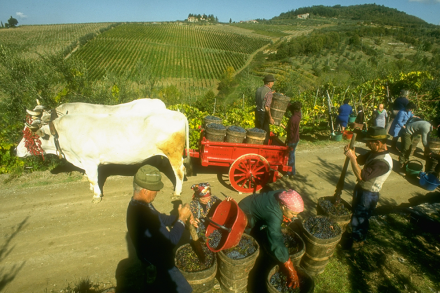
Nestled in the Apennine Mountains due east of Rome is the region of Umbria, a hidden gem at the heart of Italy. It's characterized by lush green countryside, rolling hills carpeted in olive groves and picturesque medieval hilltop towns. The region has the beauty of Tuscany but without the mobs of tourists. Its food is the best Italy has to offer — fresh, traditional, high-quality and spectacularly tasty. The senses, then, are satisfied — but Umbria also harbors a rich religious legacy. Home to some of Catholicism’s most titanic saints — Francis and Clare of Assisi and Benedict of Nursia — and dotted with ancient and medieval churches of great beauty, it's as much a pilgrim’s paradise as it is a tourist’s Italian dream.

umbria

On the hunt for my fiancé’s Christmas shotgun

A platitude oft repeated by left-wing activists is that its easier to buy a gun in the United States than it is to purchase medicine or vote. Feminists similarly like to say that American women have fewer rights than firearms. If anyone on the left would like to test these obviously absurd claims, I would challenge them to start by trying to buy a Benelli M2 Field Shotgun. I went down the Benelli rabbit hole a couple of months ago after my fiancé told me he wanted one for Christmas. When I discovered the hefty price tag on an M2, I somewhat jokingly protested à la A Christmas Story that he might shoot his eye out. Just like young Ralphie, my fiancé was undeterred.

benelli shotgun

Wining and walking in Turin and Genoa

Turin at the end of August is pleasingly melancholic. The city has emptied after the feast of Ferragosto on August 15 and won’t fill up again till September. Solid bourgeois streets, with eighteenth- and nineteenth-century buildings now housing banks, are deserted save for the occasional confused tourist. What brings others to Turin in August I cannot say. For me, it was a wedding in Milan at the end of the week and the prospect of a little vacation ahead of it. Turin was a whim. I was meant to meet a college friend in Genoa on Monday, but my Sunday-night redeye from New York was canceled. Saturday was the only option, and so I was left at a loose end. Options abounded: I could stay overnight in Milan and head to Genoa with my friend the next day.

turin

Remembering Mussolini’s March on Rome

Shortly after 11 on the unseasonably warm Monday morning of October 30, 1922, a 39-year-old, one-time schoolteacher-turned-political journalist — and former Socialist Party activist — named Benito Mussolini stepped down from a train arriving at Rome’s Termini station. He had traveled in overnight from his home in Milan, and before embarking he told the local station master, pausing to cast his black eyes up and down the empty platform, “I need to be punctual. From now on there must be no more delays.” This was the source of the sardonic joke that at least under Mussolini the trains always ran on time.

The prodigal daughter

In April 1930, the nineteen-year-old Edda Mussolini married Count Galeazzo Ciano, aged twenty-seven, after a brief courtship in which love appears to have played little part. Her father, Il Duce, wanted the magnificent occasion to be not merely the wedding of the century but a grand, almost royal, demonstration of fascist might and a celebration of fecundity. Edda, his beloved firstborn, was to stand for everything that was best about fascist womanhood, while the groom was to carve out the path of “the new Italian man.” These were the glory years, and thousands of schoolchildren sent poems and cards with angels in advance of the occasion, which the Papal Nuncio attended with a present from the Pope.

mussolini