Isis

Portrait of the week | 1 June 2017

From our UK edition

Home The Conservatives grew restive when polls, for what they were worth, indicated a closing gap between their support and Labour’s. In a generally uneventful 90 minutes of television, in which Theresa May, the leader of the Conservative party, and Jeremy Corbyn, the leader of the Labour party, were questioned, Jeremy Paxman said to Mrs May: ‘If I was sitting in Brussels and I was looking at you as the person I had to negotiate with, I’d think, she’s a blowhard who collapses at the first sign of gunfire.’ Mr Corbyn said in an earlier interview with Andrew Neil: ‘I never met the IRA,’ leaving viewers wondering in what sense this could be true.
A proper discussion about terrorism is the best way to honour Manchester’s dead

From our UK edition

Until last week, it was thought that the jihadi threat was subsiding and the security services were increasingly able to disrupt any serious plot. The recent attacks involved knives or rented cars – deadly in the wrong hands but a far cry from the 7/7 attacks, or the seven-aircraft Heathrow aircraft bomb plot thwarted in 2006. Yet now, for the second time in our history, a suicide bomb attack has been perpetrated against the public. And this might show that things are getting worse. That as Isis is forced into retreat in Iraq and Syria, the jihadists are preparing to return to Britain with deadlier skills and tactics. While al-Qaeda focused on military and economic targets, Isis considers young girls at a pop concert to be ‘crusaders’.

Portrait of the week | 25 May 2017

From our UK edition

Home  Twenty-two people were killed and 59 wounded by a man who blew himself up, with a bomb containing metal fragments, in the foyer of Manchester Arena as crowds were leaving a concert by the American singer Ariana Grande, aged 23, who has a strong following among young girls. Of the wounded, 12 were children. Police named the suspected murderer as Salman Ramadan Abedi, aged 22, a Mancunian whose family come from Libya, which he had recently visited. Isis said it was behind the attack. A 23-year-old man was arrested the next day. The official threat level was raised to ‘critical’, meaning that an attack was expected imminently. Soldiers were deployed in the streets to support armed police.

A war on joy

From our UK edition

When the pictures of the dead came in, it was hard to take, even from a distance. There was Georgina Callander, 18, a bespectacled Ariana Grande ‘superfan’ who had tweeted that she was ‘so excited’ to go to the concert in Manchester Arena. There was Saffie Roussos, aged 8 and still at primary school, who went with her mother and older sister. There was Olivia Campbell, aged 15. I looked at their bright faces and thought of all the love their families had carefully decanted into them over the years, their wealth of possibility. Then on Monday night a suicide bomber smashed up all their futures in an instant. What an act of vandalism against humanity. What grubby blasphemy.

The ruin of a ruin

From our UK edition

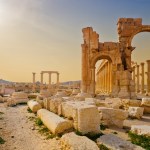
In the welter of Syrian bloodshed, why should we remember the death of a single man? Because he was the archaeologist Khaled al-Asaad, tortured and beheaded by Isis two years ago when they destroyed the remains of Palmyra, one of the world’s most important ancient cities. Their victim was its director of antiquities. In an icy fury, Paul Veyne, a French expert on Palmyra, has dedicated this comprehensive, passionate, but concise book to the memory of the murdered Syrian scholar. In it he relates thousands of years of Palmyra’s history, describing those who lived there and pausing only briefly to underline what monsters Isis were to smash the site.

Police force

From our UK edition

I’ve often thought that a good idea for an authentic TV cop show would be to portray the police as neither dazzlingly brilliant (the traditional approach) nor horrifically corrupt (the traditionally subversive one) — but just a bit hopeless at solving crimes. There is, though, one thing that prevents the idea from being as original as I’d like: this is how the police already come across in many true-life dramas. Take, for instance, the harrowing and — given its high-profile scheduling — extremely brave Three Girls (BBC1, Tuesday to Thursday), which provided an unsparing and wholly believable account of the Rochdale child-grooming scandal.

Was the Borussia Dortmund bus bombing motivated by greed?

From our UK edition

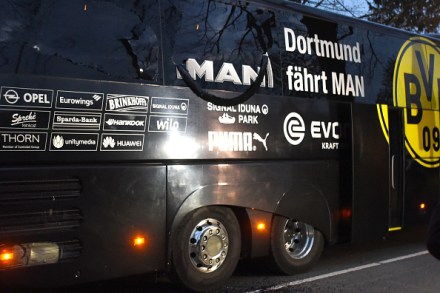
It seems the rush to blame the Borussia Dortmund bus bombing on Islamist extremists was wrong. German police have now arrested a 28 year-old man in connection with the incident; and despite initial assumptions that this assault was the work of Islamic terrorists, it appears this latest suspect has no connection with Islamic State. A week ago, it all seemed fairly straightforward: a letter had been found at the crime scene, claiming the attack had been carried out on behalf of Islamic State, and an Iraqi living in Germany had been detained by the police.

Real life | 20 April 2017

From our UK edition

Goodbye then, Bal-ham. You were my gateway to the south. I loved you for so many more reasons than that, but the fact that I could get away from you and go down the A3 to the verdant grasslands of Cob-ham was probably one of the biggest ones, if I’m honest, so by and large Peter Sellers was right. It was a love/hate relationship. The dynamic of our life together was forged by the state line that runs through you, which is every bit as drastic as the Mexican border. My flat was a few hundred yards from the boundary between Lambeth and Wandsworth, so I have spent the past 16 years within touching distance of a flagship Tory council while being dictated to by the loony left and their amusing ideas of how to best spend my money, for example on toilets for heroin users.

Islamic State claims responsibility for Paris terror attack

From our UK edition

Just days before the first round of voting in the French presidential election, there has been a terrorist attack on the Champs Elysees. A gunman opened fire on police officers, killing one and wounding two others. The terrorist was shot dead at the scene. Islamic State have claimed responsibility for the attack.The claim says that the attacker is Abu Yusuf-al-Belgiki. This is fast by the group's standards, suggesting some level of prior knowledge on their part. Candidates are already cancelling campaign rallies scheduled for tomorrow.

Can Iraq’s Christians ever recover from Isis?

From our UK edition

Since June 2014, when Islamic State attacked northern Iraq, the desks at Mar Ephrem seminary in Hamdaniya, a city 18 miles southeast of Mosul, have stood empty. Today, they are dusty and rooms once teeming with priests and nuns in training are dark; student ID cards, with titles such as 'Syrian Catholic: Parish of Bashiqa, Iraq', litter the floor and a statue of the Virgin Mary lies smashed. Now, Isis are gone. But in their wake an eerie quiet remains and the path of destruction is a visible reminder of their legacy, with thousands of houses destroyed in the fierce battle to retake the city last October.

War-war, not jaw-jaw

From our UK edition

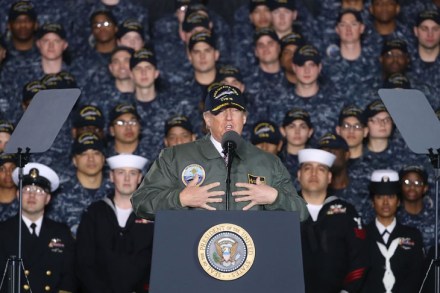
It’s often said that the Trump administration is ‘isolationist’. This is not true. In fact, we are now witnessing a dramatic escalation in the militarisation of US foreign policy in the Middle East, Africa and Afghanistan. This has not been announced but it is happening, and much of it without consultation with Nato or other key allies, or any debate in Congress or the media. A few weeks ago, US aircraft carried out over 30 air strikes against Islamic militants in Yemen — almost the same as the number carried out there all last year. In Iraq and Syria there have been many reports of civilian casualties in US raids. As many as 200 are thought to have been killed in air strikes on Mosul, although Iraqi authorities dispute that. Andrew J.

Kaiser Donald

From our UK edition

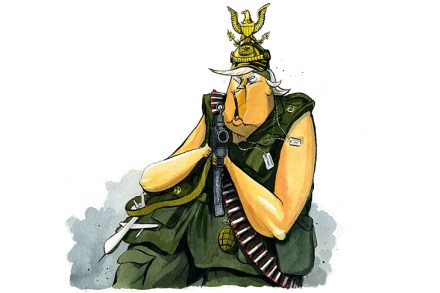
 Massachusetts All politicians wear masks. Donald Trump’s favourite is that of Maximum Leader. It was on display during this past week. ‘If China is not going to solve North Korea, we will,’ he said at the weekend, ahead of his meeting with Xi Jinping — a throwaway comment that could end up causing mayhem in the Far East. Next, his reaction to news of a chemical bombing in Syria. Trump blamed the atrocity on his predecessor’s ‘weakness and irresolution’, suggesting that he is keen to show the world what strength and resolve look like. The President, it seems, is not too dissimilar to the nightmare his political enemies warned us about: a nuclear-armed hothead itching to show the world how tough he is.

Our dangerous impulse to make sense of murder

From our UK edition

‘On Friday noon, July the 20th, 1714,’ begins the small, perfect 20th-century novel The Bridge of San Luis Rey, ‘the finest bridge in all Peru broke and precipitated five travellers into the gulf below.’ In the coincidence of crossing the bridge at the same time, explains the writer, Thornton Wilder, these five seemed to have been assembled by pure chance. Or had they? He entitles this first chapter ‘Perhaps An Accident’. He spends the rest of his book tracing the lives of each until the moment when, in a twang of rope, fate hurled all together into the abyss. Thus is the reader’s interest engaged for the human histories that unfold. But Wilder, an American Christian humanist, falters in his rationalism.

Isis claim responsibility for Westminster terror attack

From our UK edition

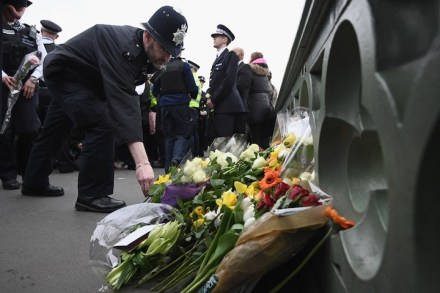
Islamic State has claimed responsibility for yesterday's deadly terror attack in Westminster. Isis described the man involved - a British-born jihadist who has been named by police as Khalid Masood - as a 'soldier of Islamic State'. The terror group released a short statement, saying: 'The attacker yesterday in front of the British Parliament in London was a solider of the Islamic State, executing the operation in response to calls to target citizens of coalition nations'. The statement from Isis was published by the Amaq News Agency, a propaganda outlet with links to the organisation. Despite claiming responsibility for the attack, however, Isis released no further details about the man involved.

Prophesying doom

From our UK edition

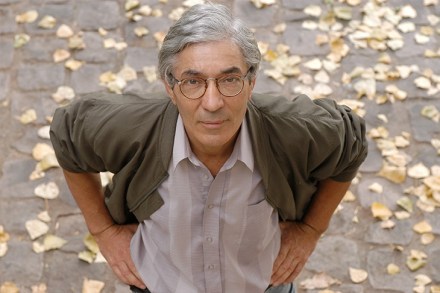
Boualem Sansal’s prophetic novel very clearly derives its lineage from George Orwell’s Nineteen Eighty-Four. A totalitarian surveillance state, a fundamentalist religious autocracy, is portrayed as being totally intolerant of free-thinkers. This is a powerful satire on an Islamist dictatorship. It is unsurprising that Sansal’s writings are censored in his native Algeria. The religious structure of the political state is familiar. The one true god is Yolah and his prophet or ‘Delegate’ is Abi. Abi’s book, the Gkabul, is the foundation of the religion; it is sacrosanct and immutable. Places of worship are mockbas and the nation is named Abistan after the true disciple. There are nine calls to prayer each day.

Israel Notebook | 16 March 2017

From our UK edition

On the Israeli side of the Syrian border, near al-Quneitra, you can watch the war. From my vantage point on the hill, I see a town held by Jabhat al-Nusra and another held by Nusra’s enemy, Bashar al-Assad’s regime. Behind a hill in the distance, I’m told by my Israeli guide, is an area controlled by Isis. Near a road blockade, a sign reads ‘Mortal Danger. Any person who passes endangers his life’ — a point reinforced by the rumble of mortars exploding and the screams that follow. I’ve never heard anything like it. The photographer I’m with is braver than me, or perhaps more foolish. He ventures past the sign for a better view. Almost instantly, a sniper in the distance starts firing in his direction. We both panic and leg it back to our bus.

Descent into hell

From our UK edition

In my work as a reviewer, a small, steady proportion of all the books publishers send me concern the Holocaust. With middle age has come a curious foreshortening of my perspective on modern history so that, paradoxically, the Nazis’ inhumanity has begun to seem less distant in time and, therefore, more horrible still. Fortunately I can reassure myself that, objectively, it happened long ago and that even the atrocities of eastern Europe and Rwanda are now a couple of decades safely in the past. Such consolations vanish when confronted by The Raqqa Diaries, which is shockingly of the present. It is a terrible reminder that we are unwise to impute any kind of teleology to history.

Portrait of the Week – 23 February 2017

From our UK edition

Home Theresa May, the Prime Minister, sat on the steps of the throne, as a privy counsellor, watching the Lords debate the European Union (Notification of Withdrawal) Bill. The Supreme Court upheld the rule that Britons must earn more than £18,600 before their husband or wife from outside the European Economic Area can settle in Britain. Rebecca Steinfeld and Charles Keidan failed (on the grounds that they are of different sexes) in their Court of Appeal application to be allowed to enter into a civil partnership. The BBC said that in 28 out of 44 areas in England subject to NHS ‘sustainability and transformation plans’, hospital services would be reduced. The BBC is to spend £30 million a year on a new channel in Scotland.

Syria is a world war without a solution

From our UK edition

The Afghans on the road in Serbia were wet from the rain. They were trying to hitch a ride into the border town of Presevo to make the way north to Hungary. Later I saw them sitting next to a train station drying their socks. Did they fear for the future? 'This is nothing, we came from Syria,' one of them said. That was in 2015 at the height of the refugee crisis as more than a million people sought refuge in the EU. Many of them had fled the conflict in Syria. But the traffic of people was not all in the same direction: Afghans, Lebanese, Tunisians, Uighurs from China, Hazaras from Pakistan, British, French, Germans and Chechens have all come to Syria in the last six years to fight in the war.

‘Isis? Bomb those suckers’

From our UK edition

These are the last days of the ‘caliphate’. The place Isis made their capital, Raqqa, in Syria, is encircled and cut off. They have already lost half of Mosul in Iraq, their largest city. Really, what did they expect? This was inevitable from the moment Isis declared war on everyone not in Isis. Defeat was even foreseen by one of the group’s leading thinkers, Abu al-Farouq al-Masri. ‘Announcing enmity to the world will strangle the caliphate in its cradle,’ he said last year. ‘This will bury our project alive.’ Al Masri (the ‘Egyptian’) is or was an elderly cleric and he was delivering a sermon in Raqqa meant as a warning to the leadership.