Iraq

John Bercow consistently voted for the Iraq war. He’s a colossal hypocrite, not a hero

From our UK edition

The Twitter-cheering for John Bercow, the transformation of him into a Love, Actually-style hero of British middle-class probity against a gruff, migrant-banning Yank, could be the most grotesque political spectacle of the year so far. Not because it’s virtue-signalling, as claimed by the handful of brave critics who’ve raised their heads above the online orgy of brown-nosing to wonder if Bercow is really promoting himself rather than parliamentary decency. No, it’s worse than that. It’s the lowest species of cant, hypocrisy of epic, eye-watering proportions, an effort to erase Bercow’s and Parliament’s own bloody responsibility for the calamities in the Middle East that Trump is now merely responding to, albeit very badly.

‘British values’ are a load of old codswallop

From our UK edition

Sometimes a combination of news stories crop up that so perfectly sum up the spirit of the age, its absurdities and hypocrisies, that there ought to be a name for it. This week, for instance, I learned that the Home Office had barred three Iraqi and Syrian bishops from entering the country, the same department that quite merrily welcomes some of the most unpleasant hate preachers from the Islamic world. Elsewhere, there was also a report about racial and religious segregation in schools and the need to teach something called 'British values' to children to help them integrate. And finally, the winner of the country's most prestigious art award was announced, beating competition from the other shortlisted works, which included a gigantic anus.

Soldiers of the Queen

From our UK edition

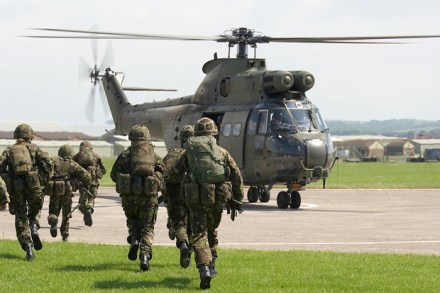
It’s not immediately obvious, but the silhouette on the dust jacket — soldiers advancing in single file, on foot (‘boots on the ground’) isn’t one squad, but five soldiers from different campaigns. From left to right, first comes the British infantryman of the second world war; next is a ‘jock’ from (I think) the Korean war; then a jungle fighter from the Malayan Emergency or the Borneo ‘Confrontation’; then, unmistakably, the long-suffering foot soldier of Operation Banner, the 38-year counter-insurgency (or police action, no one ever quite knew which) in Northern Ireland; and finally, the technology-festooned warrior of Iraq and Afghanistan.

A tale of two battles

From our UK edition

For the past few weeks, British news-papers have been informing their readers about two contrasting battles in the killing grounds of the Middle East. One is Mosul, in northern Iraq, where western reporters are accompanying an army of liberation as it frees a joyful population from terrorist control. The other concerns Aleppo, just a few hundred miles to the west. This, apparently, is the exact opposite. Here, a murderous dictator, hellbent on destruction, is waging war on his own people. Both these narratives contain strong elements of truth. There is no question that President Assad and his Russian allies have committed war crimes, and we can all agree that Mosul will be far better off without Isis. Nevertheless, the situations in Mosul and Aleppo are fundamentally identical.

We’re too busy vilifying Putin and Russia to notice our own misdeeds

From our UK edition

I have been wondering these last few weeks whether it would be cheaper to excavate a basement and buy a Geiger counter and iodine tablets, or emigrate to New Zealand. Call me frit, but I don’t like the way things are heading. Probably the second option is easier: Armageddon outta here, etc. I can re-enact Nevil Shute’s On the Beach from some rocky cove near Dunedin, waiting for the fallout to arrive. I was sentient only during the latter stages of the Cold War but from what I can remember, the two sides, them and us, behaved for the most part with a degree of rationality and common sense. (I like my politicians to be pragmatic rather than charismatic, which is why, if you were to ask who my favourite Soviet despot was, Brezhnev would always be the answer.

Stop the sabre-rattling

From our UK edition

I have been wondering these last few weeks whether it would be cheaper to excavate a basement and buy a Geiger counter and iodine tablets, or emigrate to New Zealand. Call me frit, but I don’t like the way things are heading. Probably the second option is easier: Armageddon outta here, etc. I can re-enact Nevil Shute’s On the Beach from some rocky cove near Dunedin, waiting for the fallout to arrive. I was sentient only during the latter stages of the Cold War but from what I can remember, the two sides, them and us, behaved for the most part with a degree of rationality and common sense. (I like my politicians to be pragmatic rather than charismatic, which is why, if you were to ask who my favourite Soviet despot was, Brezhnev would always be the answer.

The battle for Mosul could create another refugee exodus

From our UK edition

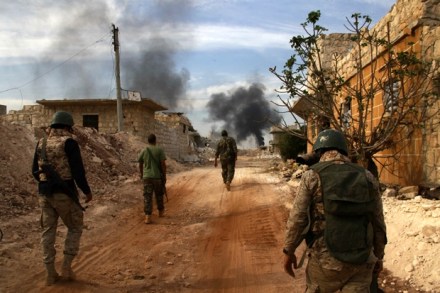
As the sun set over the frontline in northern Iraq on the first day of the long anticipated Mosul offensive, Kurdish peshmerga and Iraqi army soldiers began to celebrate the first victories over Islamic State. Almost a dozen villages had been taken yesterday, and more than 77 square miles liberated southeast of the Isis stronghold. The offensive to re-take Mosul, the last major city held by Isis in Iraq, has been more than a year in planning. It was long anticipated all along the hundreds of miles of frontline where the peshmerga and the Iraqi army have been fighting Isis. When I was in Tel Skuf in June last year, men would peer through their binoculars across the miles of flat, grassy, desiccated landscape and say 'we’ll go when the orders come'. Mosul was only 18 miles away.

Iraq’s endgame: The battle for Mosul

From our UK edition

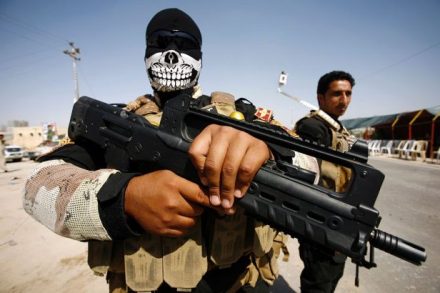
At night, the temperature around the Islamic State-held city of Mosul drops to around 80°F. At the Bashiqa front line, 15 miles northeast of the city, it would feel pleasant and almost calm, were it not for the steady sound of exploding shells. Most of life is tea and cigarettes. It’s like a quiet day on the Western Front, minus the mud. ‘It’s so peaceful you can’t imagine what’s happening — it’s surreal,’ says Allan Duncan, a former soldier with the Royal Irish Regiment who volunteered to join the Kurdish peshmerga here two years ago in order to fight Isis. ‘You almost forget that things are so close to the end.

The Spectator Podcast: Marriage for one | 27 August 2016

From our UK edition

An increasing number of women are entering into the institution of marriage with their dream partner: themselves. In her cover piece this week, Ariane Sherine investigates the women who have brought a new literalism to saying, 'I do'. But is this just a quirky fad? Or are we witnessing a profound social change? Lara Prendergast speaks to Ariane and Spectator editor Fraser Nelson on this week's Spectator podcast. Ariane tells Lara: 'There are an increasing number of women who have decided, because they don't have a man - or maybe some of them don't want a man - that if they can't find Mr Right, well, I'm going to embrace myself and marry myself and it's going to be a really positive and self-affirming ritual. I'm going to invite all my family and friends and have my big day, man or no man'.

The Spectator Podcast: Marriage for one

From our UK edition

An increasing number of women are entering into the institution of marriage with their dream partner: themselves. In her cover piece this week, Ariane Sherine investigates the women who have brought a new literalism to saying, 'I do'. But is this just a quirky fad? Or are we witnessing a profound social change? Lara Prendergast speaks to Ariane and Spectator editor Fraser Nelson on this week's Spectator podcast. Ariane tells Lara: 'There are an increasing number of women who have decided, because they don't have a man - or maybe some of them don't want a man - that if they can't find Mr Right, well, I'm going to embrace myself and marry myself and it's going to be a really positive and self-affirming ritual. I'm going to invite all my family and friends and have my big day, man or no man'.

Playing for high stakes

From our UK edition

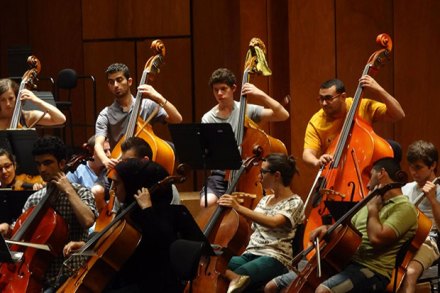
Now that even candidates for President of the United States can rise up from the undead dregs of reality television, it comes as no surprise to read that the National Youth Orchestra of Iraq owes its origins to a conclave of television execs. In 2008, Channel 4 and the independent production company Raw TV took upon themselves to campaign for a youth orchestra in Iraq, focusing their programme around the story of Zuhal Sultan, a 17-year-old Iraqi pianist. Later that same year, the Scottish conductor Paul MacAlindin was savouring a fish-and-chip supper in his favourite Edinburgh pub when his eye caught a headline in the Glasgow Herald about the same project — ‘Search for UK maestro to help create an orchestra in Iraq’ — and he thought: ‘I know how to do this.

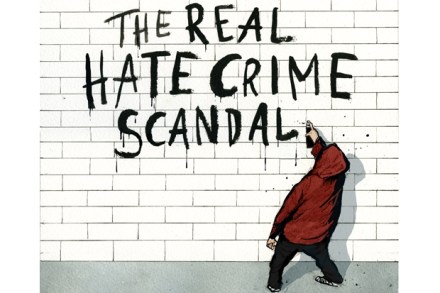
The Spectator podcast: The real hate crime scandal | 6 August 2016

From our UK edition

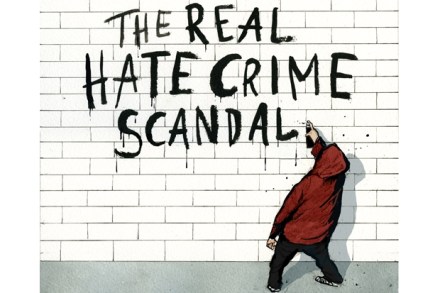
Since the vote for Brexit, the media has fallen over itself to cover the apparently large upswing in the number of ‘hate crimes’ being reported. One of the trends noted is a particularly high occurrence of such incidents in areas that voted 'Leave'. In his Spectator cover piece, Brendan O’Neill argues that there is an ‘unhinged subjectivity’ to hate crime reporting, which has skewed statistics in favour of self-critical moralisation. So, has there really been a post-Brexit surge in hostility towards minority groups or is our metric for recording these crimes simply off-kilter? Brendan O’Neill joins Kevin O’Sullivan, who was recently cleared after spending 20 months defending himself from a hate crime allegation, and Lara Prendergast to discuss.

The Spectator podcast: The real hate crime scandal

From our UK edition

Since the vote for Brexit, the media has fallen over itself to cover the apparently large upswing in the number of ‘hate crimes’ being reported. One of the trends noted is a particularly high occurrence of such incidents in areas that voted 'Leave'. In his Spectator cover piece, Brendan O’Neill argues that there is an ‘unhinged subjectivity’ to hate crime reporting, which has skewed statistics in favour of self-critical moralisation. So, has there really been a post-Brexit surge in hostility towards minority groups or is our metric for recording these crimes simply off-kilter? Brendan O’Neill joins Kevin O’Sullivan, who was recently cleared after spending 20 months defending himself from a hate crime allegation, and Lara Prendergast to discuss.

Syria’s foreign policy lessons are just as important as Iraq’s

From our UK edition

Before she was murdered, Jo Cox MP had written most of a report. She worked on it jointly it with the Conservative MP Tom Tugendhat for the Britain in the World project at the think-tank Policy Exchange. Its publication had been intended to coincide with that of the Chilcot report this week. Because of her shocking death, it is now delayed. But the project wants to continue her work, and the report’s bipartisanship. The essential point on which Mrs Cox (who opposed the Iraq war) and Mr Tugendhat (who served in it) agreed is that total non-intervention is not a foreign policy strategy. If Iraq shows the horrors of ill-planned intervention, Syria shows how non-intervention can cause worse suffering and instability.

The shame of Iraq

From our UK edition

‘If it falls apart, everything falls apart in the region’ — Note from Tony Blair to George W. Bush, 2 June 2003.   Instead of asking why we fought the war, we should ask why we lost The extraordinary length of time that we have had to wait for Sir John Chilcot’s report into the 2003 invasion of Iraq has not made the end result any more satisfying. For some, nothing less than the indictment of Tony Blair on war crime charges would have sufficed. As for Blair himself, and many of those who surrounded him when the decision was made to remove Saddam Hussein from power, they will go on believing until their dying day that not only was the war just, but there was nothing much wrong with the way in which it was sold to the public and to Parliament.

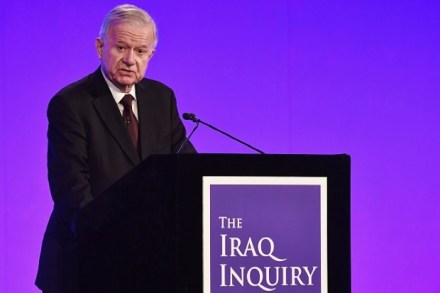
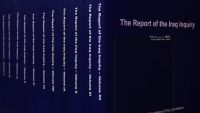
Sir John Chilcot’s full statement introducing the Iraq War inquiry report

From our UK edition

We were appointed to consider the UK’s policy on Iraq from 2001 to 2009, and to identify lessons for the future. Our Report will be published on the Inquiry’s website after I finish speaking. In 2003, for the first time since the Second World War, the United Kingdom took part in an invasion and full-scale occupation of a sovereign State. That was a decision of the utmost gravity. Saddam Hussein was undoubtedly a brutal dictator who had attacked Iraq’s neighbours, repressed and killed many of his own people, and was in violation of obligations imposed by the UN Security Council.

The Chilcot report has exposed Blair’s real crime: failure to prepare

From our UK edition

'If it falls apart, everything falls apart in the region' Note from Tony Blair to George W Bush, 2 June 2003. The extraordinary length of time that we have had to wait for Sir John Chilcot’s report into the 2003 invasion of Iraq has not made the end result any more satisfying. For some, nothing less than the indictment of Tony Blair on charges of war crimes would have sufficed. As for Blair himself, and many of those who surrounded him when the decision was made to remove Saddam from power, they will go on believing until their dying day that not only was the war just, but there was nothing much wrong with the way in which it was sold to the public and to Parliament.

‘I will be with you, whatever’: What Chilcot tells us about Tony Blair

From our UK edition

The Iraq Inquiry report is utterly scathing about Tony Blair. It paints a critical picture of his sofa government, in particular the way in which that government approached planning and preparation for Iraq without Saddam Hussein, and his ‘certainty that was not justified’ in presenting the severity of the threat posed by Iraq’s weapons of mass destruction to Parliament. The Prime Minister also appeared more concerned about the politics of the military action than its detail, and failed repeatedly to ensure that the relevant ministerial oversight and Whitehall resources were directed to the conflict. And he seemed unable to challenge or disagree with the US when necessary.

Iraq Inquiry: Key points from Sir John Chilcot’s statement

From our UK edition

Should the UK have gone to war in Iraq? Did it have the necessary legal basis and intelligence to do so? And did it mess up once involved militarily in the country? Sir John Chilcot’s Iraq Inquiry finally published its report this morning, and these are the key conclusions that he reached in his statement: While military action against Saddam Hussein ‘might have been necessary at some point’, in March 2003, he posed no imminent threat, the strategy of containment could have been continued for ‘some time’, and the majority of the Security Council supported continuing UN inspections and monitoring’. ‘Military action at that time was not a last resort,’ Sir John said in his statement.