Iran

Is the Iran ceasefire crumbling?

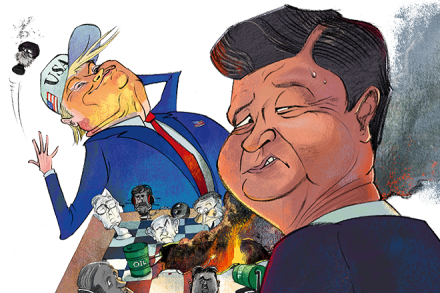
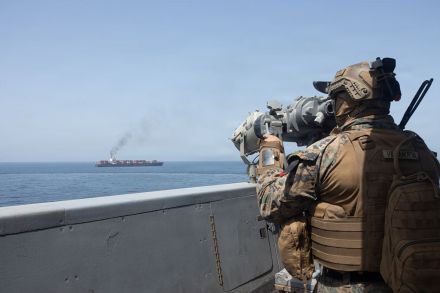
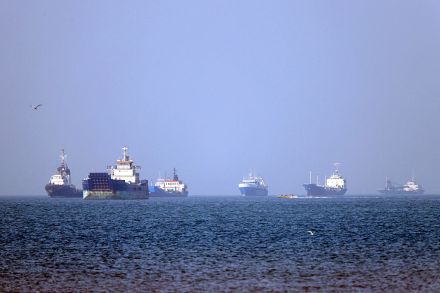
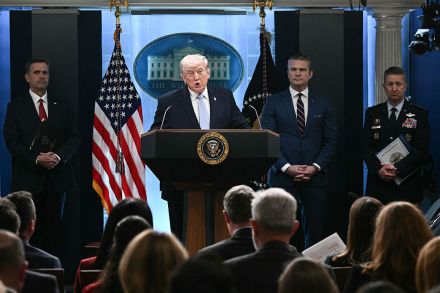
Is the fragile Iran war ceasefire over? It would appear so, with American and Iranian forces exchanging fire in the Strait of Hormuz. The renewed clashes follow President Trump’s launch of "Project Freedom," which aims to use the US military to escort stranded ships out of the critical waterway. Trump said American forces had hit seven Iranian small boats, with the US military claiming to have intercepted cruise missiles and drones launched by Tehran. Trump earlier warned that Iranian forces would be "blown off the face of the Earth" if they targeted US ships in the strait or the Persian Gulf. Tehran says it fired "warning shots" at US warships, and said it would attack any foreign force that tried to enter the strait.

iran ceasefire

For Trump, it’s lonely at the top

King Charles III and Queen Camilla were at their most emollient in Washington, where they exchanged a flurry of presents with Donald and Melania Trump. The King’s gifts to President Trump included a framed copy of the design plans for the Resolute Desk, which was originally given to President Rutherford B. Hayes by Queen Victoria in 1880. Trump appeared to shelve his hostility toward the United Kingdom for declining to participate in the Iran war, but he quickly made up for his forbearance by pummeling another NATO ally.

Trump

Does Trump have to ‘finish the job’ in Iran? 

The missiles and bombs may have stopped, at least for the moment, but the war between the US and Iran continues. The Strait of Hormuz remains closed, the US sanctions remain in place, and the fundamental issues separating the combatants remain unresolved. The bilateral negotiations have gone nowhere, and the two sides remain far apart. This stalemate has puzzled observers since it’s not hard to see the outlines of a deal. For Iran, the minimum acceptable goal is regime survival. For the US, it is the end of the Iranian nuclear program, which poses an existential threat to America’s regional partners and, eventually, to Europe and South Asia. Since the regime’s survival and the end of its nuclear program are compatible goals, a deal should be possible.

The contempt Trump feels for his NATO allies is mutual

The war in Iran has revealed plenty about America’s ability to inflict damage on its enemies, Tehran’s capacity to resist pressure and Washington’s broader tendency to get itself stuck in the Middle East – a region several US presidents planned to extricate from. The conflict has been paused since April 7 due to a ceasefire that Trump extended earlier in the week. But it is nonetheless revealing a gradual systemic shift in the so-called international order that has been bubbling beneath the surface for years. The movable object is none other than the transatlantic alliance which, through NATO, has bound the United States and most of Europe into a single security construct.

NATO

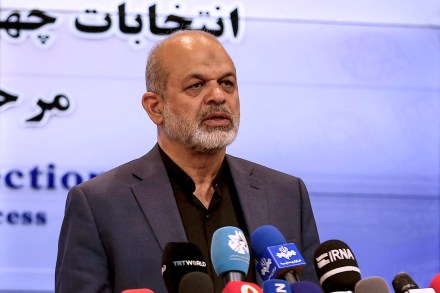
Who is really leading Iran?

In declaring an extension to the ceasefire in the Iran war, President Trump signaled clearly enough that he would prefer to strike a peace deal with Tehran. J.D. Vance, the Vice President, has been kicking his heels, waiting to return to the Pakistani capital Islamabad for another go at achieving a breakthrough. The Iranians keep blowing hot and cold on whether they are ready to play their part. Trump suggested in a social media post earlier this week that he believes this is because Iran’s government is "seriously fractured." His ceasefire extension is aimed at allowing the regime time to deliver a new proposal. Trump may want to hammer everything out in Islamabad, but he is not dealing with an ordinary government operating under a straightforward power structure.

iran
iran

Who is really leading Iran?

In declaring an extension to the ceasefire in the Iran war, President Trump signalled clearly enough that he would prefer to strike a peace deal with Tehran. J.D. Vance, the vice-president, has been kicking his heels, waiting to return to the Pakistani capital Islamabad for another go at achieving a breakthrough. The Iranians keep blowing hot and cold on whether they are ready to play their part. Trump suggested in a social media post earlier this week that he believes this is because Iran’s government is ‘seriously fractured’. His ceasefire extension is aimed at allowing the regime time to deliver a new proposal. Trump may want to hammer everything out in Islamabad, but he is not dealing with an ordinary government operating under a straightforward power structure.

Portrait of the week: Olly Robbins is sacked, inflation rises and the Strait of Hormuz is (briefly) opened 

From our UK edition

Home Sir Keir Starmer tried to explain himself to parliament after Sir Olly Robbins was sacked as permanent under-secretary of state at the Foreign Office, its chief civil servant. Sir Keir complained that as Prime Minister he had not been told that Lord Mandelson had failed to satisfy UK Security Vetting when he took up his post as ambassador to Washington. Sir Keir said that he had not been told before 14 April. In the Commons he said: ‘I did not mislead the House.’ Even before Lord Mandelson’s appointment, the Cabinet Office had compiled a due diligence report, given to the Prime Minister, which cited concerns about the peer’s ties to China and Russia. Zarah Sultana, the Your Party MP, had to leave the Commons chamber after saying: ‘The Prime Minister is a bare-faced liar.

Why Iran doesn’t want peace

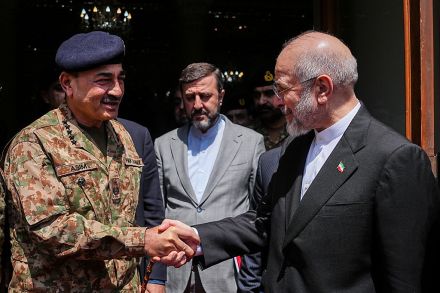
Perhaps we should be used to be this by now. Yet again, there have been a flurry of promises to rapidly achieve peace in Iran. Yet again, the American administration has threatened to destroy the nation’s infrastructure. J.D. Vance is again flying to Pakistan for more talks. And yet the conflict shows no sign of ending. We don’t know whether the Iranians will actually turn up. A foreign ministry spokesman said yesterday that Iran will not be joining the talks. The speaker of the parliament Mohammad Bagher Ghalibaf has also made clear that the regime won’t negotiate under threat of civilizational destruction. Why would they resist peace talks? There is both a diplomatic and domestic answer.

iran peace

Iran is winning the meme war

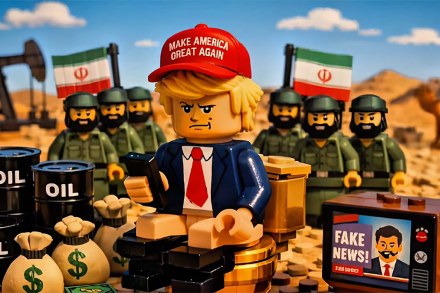
The opening strikes on Iran forced the country’s military to operate without a centralized command structure. Despite this enormous setback, something like a unified approach has emerged, and nowhere is that more evident than on social media.  Iran’s embassies have become meme factories, centers of information warfare churning out images and videos designed to do just one thing: mock the US and Israel and, in particular, Donald Trump. Courtesy of Iran’s overseas missions, we’ve now seen Donald Trump as a minion from Despicable Me; a Lego man fleeing a Lego Jeffrey Epstein; and a Pirate of the Caribbean trying, and failing, to hijack the Strait of Hormuz.

The only ‘civilization’ Trump will destroy is his own

If, as Donald Trump had threatened, “a whole civilization” had died earlier this month, the whole civilization concerned would have been that of the United States, not of Iran. If an American president had deliberately ordered the death of a civilization – whether or not such a thing is achievable – America’s claim to world leadership would have collapsed. Like, I suspect, many, however, I did not go to bed that night thinking that Trump would carry out his threat. I remember my parents telling me that, during the Cuban missile crisis, people truly believed there might be nuclear conflagration at any moment. It did not feel like that this time. It felt as if Trump had said something frightening and horrible to claim mastery over whatever was going to happen next.

civilization

Britain’s ‘drone gap’ makes it vulnerable

When John Healey was asked, onstage at the London Defence Conference, whether the armed forces were “ready” for war, the Defence Secretary replied: “Yes.” One of those present says: “That was greeted with near incredulity in the room.” Another attendee compared Healey’s plight to someone “playing French cricket,” with critics from all sides hurling balls at his ankles while he tried to bat them away. “You can’t score any runs in French cricket.” George Robertson, Healey’s most respected Labour predecessor and a former secretary general of NATO, was not present; he was in Scotland celebrating his 80th birthday. But he returned to give a withering interview to the FT and a speech.

britain drone

A change has come over Trump

Geostrategists used to fret over the “Eastern Question” or the Maginot Line or the Missile Gap. Today there is no doubt that the overriding geostrategic question of our day is whether the President of the United States is playing with a full deck. With the US-Israeli war on Iran failing, and depleting much of both countries’ non-nuclear defenses, with the Strait of Hormuz closed and western economies spiraling toward depression, Donald Trump greeted the world on Easter morning with a message to Iran’s leaders to “Open the Fuckin’ Strait, you crazy bastards,” then threatened the next day to wipe out Iranian civilization. He then denounced the Pope for having imparted Catholic teachings on just and unjust war.

How Trump loses friends and alienates people

It is a long haul until the midterm elections in November. Many threats and deadlines will have been issued to Iran in that time, many cycles of optimism and pessimism will have been completed. The war may be over, or Donald Trump may be bogged down in an intractable conflict which he privately wishes he had never started. Regardless, his administration must start preparing for what looks to be an increasing certainty: that the Republicans will suffer a heavy electoral reversal. That was looking likely even before Iran and its effect on oil prices. The President’s tariff wars have protected some, but the overall effect on blue- collar jobs has been negative. Moreover, at 3.3 percent, consumer inflation is back at the sort of levels which helped stop Kamala Harris from winning.

trump

Who’s actually winning the wars in the Middle East?

If you read the New York Times or watch the foreign policy establishment’s “best and brightest,” you will be told, with imperious certainty, that America is losing the war in Iran and was stupid to begin it. The conspiratorial wing on both the right and left add that it is all the Jews’ fault, although they usually remember to mutter they mean “Israel” instead of all Jews, a gossamer cloak over what they really mean. If, on the other hand, you watch Fox News or read blogs by conservatives or military analysts, you will be told with equal certainty that America and its ally, Israel, are actually winning – and winning decisively.  So, who is right? The answer, of course, is Carl von Clausewitz. What that old Prussian says goes to the heart of the issue.

middle east
fighting spirit

What happened to Britain’s fighting spirit?

When war is in the air, young men traditionally sign up – and they traditionally sign up, disproportionately, from the northeast of England, where I grew up. The country must be prepared for war, says Air Chief Marshal Sir Richard Knighton, head of our armed forces. But what use is all this puffed-up talk of a battle-ready Britain if we have no soldiers? In the northeast, the supply of soldiers has slowed not just to a trickle but to a drip. Sunderland, for instance, home to nearly 11,000 veterans, sent just ten men into the army in 2025. A reporter called Fred Sculthorp went to Sunderland for Dispatch magazine last month, to work out what had happened to the northeast’s fighting spirit, but all Fred found was apathy: why sign up when you can sign on?

Flat out: the property squeeze crushing the young

From our UK edition

Last month, a new account called London Price Drop appeared on X. It has already gained more than 14,000 followers simply by posting screenshots from Rightmove, which illustrate how properties in the capital are falling sharply in value. One of these is a leasehold flat in Shepherd’s Bush purchased for £425,000 in 2017, before being re-listed for £395,000 in May 2024, and eventually sold for £325,000 last August. Adjusted for inflation, that represents a real terms loss of close to £250,000. The London Price Drop account is so popular because it contradicts an assumption that many in Britain hold dear. Young or old, owner or renter, almost all of us believe that buying property is the route to wealth, and that house prices, in the long run, always go up.

Trump’s goals in Iran have always been clear

The bombing of the Revolutionary government in Iran is drawing comparisons with the war in Iraq. But the comparisons are with the wrong war. In 1981 there was an attack on Iraq which much more closely resembles what Donald Trump is trying to achieve in Iran. The story goes back to 1976, when the government of Jacques Chirac in France sold a nuclear reactor to the Iraqis – a deal for which the French have always managed to avoid much criticism. The French charged the Iraqi government twice the going rate. But as one of the Iraqi nuclear team later recalled: ‘We were happy to pay. After all, who else was going to sell us a nuclear reactor?’ Who indeed.

Sorry, but America still holds all the cards

“Negotiations.” Are you heartened or dismayed by that word? Those who remember or who have read up on the seemingly interminable Paris Peace Talks designed to bring an end to the Vietnam War have reason to be dubious. A negotiation, if it is to be successful, requires that both sides be candid and in earnest. The Vietnamese were not candid participants. They stalled. They prevaricated. They acted out. It seems that the Iranians are hoping to reprise that melodrama. They will be profoundly disappointed. On the second weekend in April, Vice President J.D. Vance, Steve Witkoff and Jared Kushner met some 70 Iranian representatives in Islamabad to hammer out a peace deal.

Iran negotiations

What’s Britain’s place in the post-Iran world order?

From our UK edition

Midway through James Joyce’s Ulysses, the character J.J. O’Molloytips his hat to ‘Our watchful friend, the Skibbereen Eagle’, a playful reference to an obscure provincial newspaper in the west of Ireland. Under an ambitious new editor, the Skibbereen Eagle had risen fleetingly to prominence in 1898 for its robust response to Tsar Nicholas II’s attempts to gain a warm-water port for the Russian navy by encroaching on China’s Yellow Sea. As its editorial warned in a chiding tone, the Eagle would ‘keep its eye on the Emperor of Russia and all such despotic enemies – whether at home or abroad – of human progression and man’s natural rights’.

If Trump hates the Wall Street Journal, why is its editorial board dictating Iran policy?

For the better part of a decade, Donald Trump has been an avid, if irascible, reader of the Wall Street Journal – particularly the columns overseen by its long-time editor Paul Gigot. Because the Journal is among the few American conservative outlets willing to criticize Trump – on everything from tariffs to temperament – he has developed a habit of denouncing it in public while devouring it in private. The Journal, Trump recently declared on Truth Social, is "one of the worst and most inaccurate editorial boards in the world." The ritual extends to annotated hard copies – margins filled with indignant scrawl – before the offending pages are FedExed back to News Corp headquarters in Midtown Manhattan.

wall street journal