Iran

Alan Duncan’s resignation just adds to the chaos in the Foreign Office

From our UK edition

Sir Alan Duncan's resignation will only leave a hole in the Foreign Office for a couple of days before the new prime minister replaces him. But he's not the only missing minister in that department: Mark Field is suspended while the incident at Mansion House is investigated. Duncan had been covering some of Field's responsibilities over the past few weeks, and now he is off too, just as the crisis in relations with Iran deepens. Jeremy Hunt, meanwhile, has been busy conducting a leadership campaign, all of which gives the Foreign Office, normally the most composed and regal part of Whitehall, a slightly chaotic, neglected feel.

On Iran and oil tankers

From our UK edition

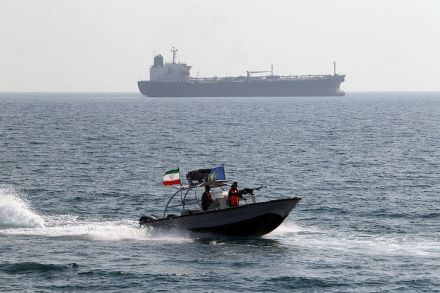
I’m glad the Foreign Secretary thinks it ‘unacceptable’ of Iran to have seized a British-flagged oil tanker in the Straits of Hormuz. But wouldn’t it have been a decent idea to give any British-flagged ships sailing through that tiny strait a naval escort? The risk was always there, ever since we seized an Iranian tanker at Gibraltar. Was the possibility of escorting tankers considered by the government?

Can Trump break the cycle of mistrust with Iran?

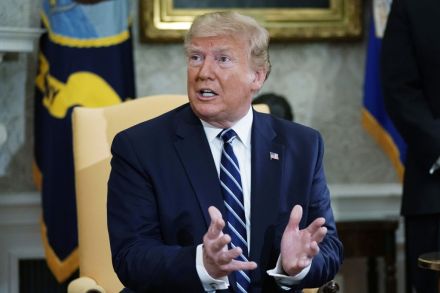
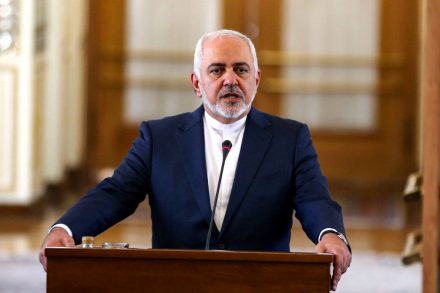
Might Donald Trump going to visit Tehran and crack a deal with Iran? It might seem improbable. But then again, there isn’t much with Trump that doesn’t. This is the fellow who ended up at the border with North Korea, playing kissy-face with Kim Jong-un after having breathed voluminous amounts of fire and fury. When I raised this question of a fresh Trump volte-face yesterday in New York at the ambassador’s palatial residence on Fifth Avenue with Iran’s foreign minister Javad Zarif in an interview for the National Interest, he thus didn’t bat an eye. 'There are prudent ways out,' of his current situation, he indicated. Indeed there are. Iran is floating the idea of beefed-up inspections in return for a permanent lifting of sanctions.

iran

Ignoring Iran

From our UK edition

Crises in the Gulf and Conservative leadership elections come around with unnerving regularity. It is not unknown for both to coincide — that happened in 1990, when Margaret Thatcher was overthrown in the lead-up to the first Gulf War. On that occasion, drama on the domestic front did not smother Britain’s response to the international crisis — unlike now. It is bizarre to have a US president threatening to ‘obliterate’ Iran while our Foreign Secretary hardly bothers to respond, preferring to pose with fish and chips and Irn Bru on the campaign trail.

Pompeo summons up fresh Iran sanctions from the Gulf

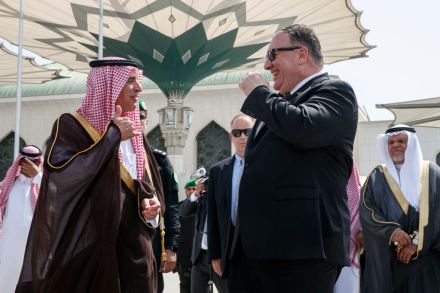
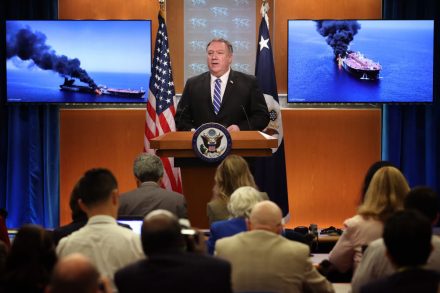
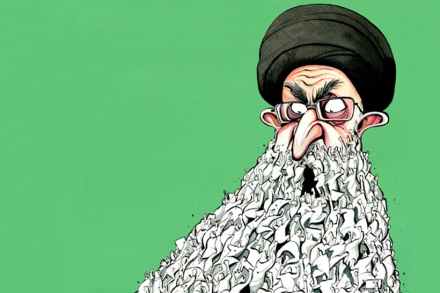
'First, I think it’s really important to understand that the Iranians are sowing disinformation,' Mike Pompeo told reporters Sunday en route to the Kingdom of Saudi Arabia and the United Arab Emirates  ('two great allies in the challenge that Iran presents.')'You’ll see too,' the secretary of state continued, 'that our campaign that began when President Trump took office will continue. On Monday, there’ll be a significant set of new sanctions.' Sure enough, this afternoon Trump announced intensified sanctions on Iran’s Supreme Leader.With that, the secretary was off, jetting from Joint Base Andrews to Riyadh and Abu Dhabi.

iran sanctions
donald trump iran

Trump is trapped in an Iran cul-de-sac

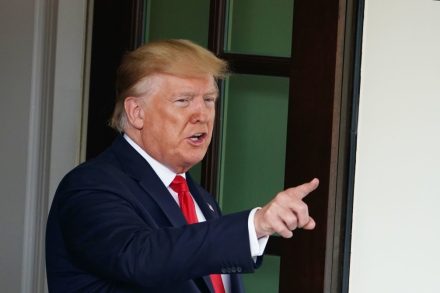
Donald Trump says he’s open to talks with Iran. He says that his policy of avoiding war is 'common sense.' And he says that he is upping sanctions on the regime today (which Russia is condemning as 'illegal').Iran’s response? Rear Adm. Hossein Khanzadi announced on Monday that Tehran can mete out a 'crushing response … and the enemy knows it.'Here are the fruits of Trump’s Iran policy. Far from undermining the regime, Trump has strengthened and emboldened it. Tehran is on a roll. It has shot down an American drone and interfered with shipping the Persian Gulf with no real consequences.

bad wars

After 30 years of bad wars, who thinks one with Iran will be good?

Don’t believe the hawks who tell you they don’t want a war with Iran. Instead, ask them if they’d go to war to stop Iran from getting nuclear weapons, or if they’d prefer war to peace if peace meant the mullahs’ regime could cling to power. War is a means to an end, and the hawks believe the ends of regime change and nuclear nonproliferation justify war, if it comes to that. Peace too is only a means to an end, and war is what happens when the means of peace are deemed insufficient.President Trump has a cooler head than most of his critics when it comes to nuclear weapons, as he’s proved so far with his North Korea policy. And North Korea actually has the bomb, which Iran is some distance from possessing.

Trump’s Iran gamble

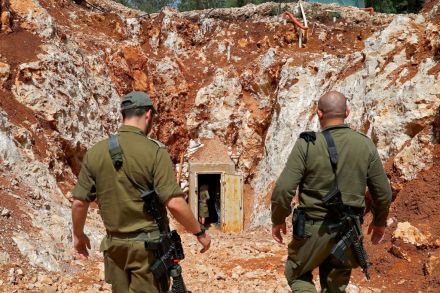
Beirut It seems that American planes were actually on their way to bomb Iranian targets last night when they were called back. That’s what the New York Times was told by a senior official in the administration, speaking anonymously of course. ‘Planes were in the air and ships were in position, but no missiles had been fired when word came to stand down.’ Was this President Trump or the Pentagon? It’s possible that the US military suddenly learned of a vulnerability in some part of their forces spread around the Middle East, in Bahrain, in Iraq, or in Syria, but then again, they’ve had time to prepare. More likely, this was Trump.

iran israel lebanon
John Bolton

The untenability of President Bolton

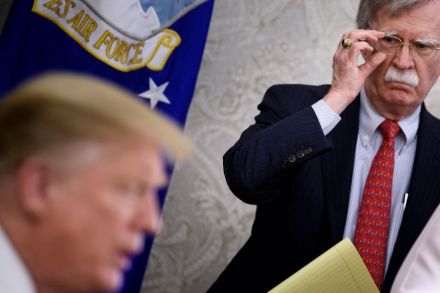
The president of the United States weighed retaliatory airstrikes on the Islamic Republic of Iran before pulling back at the eleventh hour, he confirmed Friday morning. 'We were cocked & loaded to retaliate last night on 3 different sights when I asked, how many will die. 150 people, sir, was the answer from a General. 10 minutes before the strike I stopped it,' Donald Trump tweeted. He said the planned response was not 'proportionate to shooting down an unmanned drone,' referring to the recent malign activity from the regime. 'I am in no hurry,' he caveated. 'He just tweeted it out,' Alex Ward, defense reporter at Vox, joked. Ward refers to a swirl of chatter that engulfed Washington Thursday night.

Iran calls Trump’s bluff

This time Donald Trump is unlikely to storm out of the room in a huff. He’s invited the top congressional leadership from both parties to a meeting at the White House this afternoon to discuss Iran. Now that Iran has shot down a US naval surveillance drone, Trump is in a bind. Instead of looking like Mr Big, he’s starting to resemble a paper tiger. At first Trump tweeted, 'Iran made a very big mistake!' which made it sound like he was going to take military action against the mullahs. But then a more emollient Trump appeared, telling reporters, 'I have a feeling…that it was a mistake made by somebody' who was freelancing rather than acting on orders from on high. Not likely. The truth is that Iran is calling Trump’s bluff.

donald trump
tucker carlson

Give Tucker Carlson a Nobel prize! 

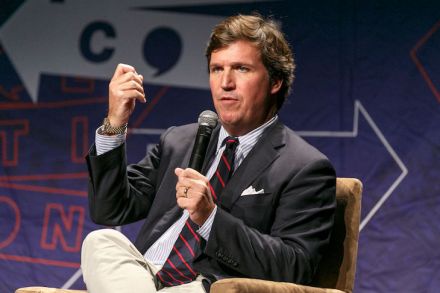
The strong favorite for the Nobel Peace Prize this year is Greta Thunberg, a girl who lectures grownups about climate change. In a sane world, the award would go to somebody who stops wars. In 2019, that somebody should be Tucker Swanson McNear Carlson. Carlson is a Fox News host, which means the smart people who give out awards will never take him seriously. In the last few weeks, however, he may have done more to advance the cause of peace than any other human on the planet. Anyone with half a brain can tell that some of President Trump’s cabinet and his advisers are itching to bomb, bomb, bomb, bomb, bomb Iran — as the late, hawk Saint John McCain so delicately put it, to the tune of the Beach Boys’ Barbara Ann.

Jeremy Corbyn is right about Iran and the tanker attacks

From our UK edition

Jeremy Corbyn’s right about Iran, isn’t he? On the attacks on ships in the Strait of Hormuz on Thursday, he tweeted (and don’t you just wish politicians could use a more considered medium?): 'Britain should act to ease tensions in the Gulf, not fuel a military escalation that began with US withdrawal from the Iran nuclear agreement. Without credible evidence about the tanker attacks, the government’s rhetoric will only increase the threat of war.' What, precisely, is wrong about that? What exactly about it caused the Foreign Secretary, Jeremy Hunt, to call him 'pathetic' and 'predictable'? Hunt himself didn’t exactly follow the US party line in announcing Iran was to blame for the attacks initially.

America has a credibility problem on Iran

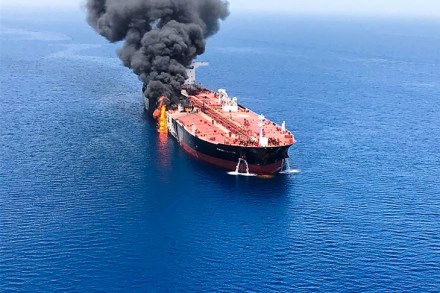
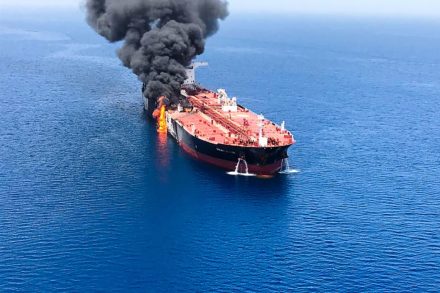
The Trump administration’s Iran policy is regime change in all but name. Rudy Giuliani, the president’s former attorney, once told me that while the administration emphasizes 'change in behavior', the Islamic Republic is so flawed that its regime is probably beyond reform. On this week’s Washington Shots podcast, pundit Tom Rogan told me that the list of demands Mike Pompeo laid out last year is so compendious as to demand the collapse of the Islamic Republic. Rogan, an Iran hawk, thinks the secretary of state has gone too far. So too does Trump — or so he did until the Thursday's flare-up, the apparent Iranian bombing of an oil tanker in the Gulf of Oman.

credibility pompeo iran
oil iran

Iran trumps Trump

It’s not every day that global diplomat and ex-Swedish prime minister Carl Bildt makes a fool of himself on Twitter. On some days, Carl’s too busy to tweet. But on Friday, the Stockholm speculator went full wag-the-dog. https://twitter.com/carlbildt/status/1139117308838891520 ‘Are there state or non-state actors that have an interest in provoking a conflict between Tehran and the US? It is difficult to see any other motive behind the tanker attack.

Is Matt Gaetz the future of Trump foreign policy?

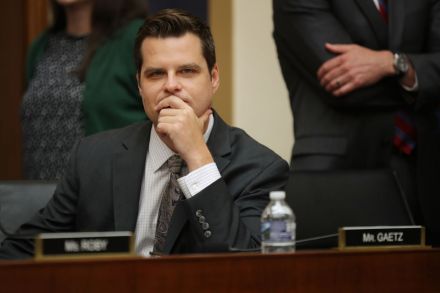
Rep. Matt Gaetz of Florida, a Trump favorite and Fox News star, may have just fired the first loud shot of a new ideological war that may be heard around the world. 'The "fog of war" is no fog to me, or any of the 700,000 people I serve,' Gaetz clarified to a surprised Washington crowd of lefties and libertarians last month. 'It is not hazy,’ said Gaetz, whose North Florida district has the highest concentration of active-duty military in America. 'We see the impact of war every day among the people we love who shape our lives. It is a stark reminder that the unmatched freedoms we enjoy are not free — they are bought with the blood of American patriots.

matt gaetz

What would peace with Iran look like?

Heiko Maas, the German foreign minister, was in Tehran on Monday. The ‘Iran conflict’, Maas said, is ‘one of the biggest conflicts of our time’. No one wants war with Iran. But what would peace with Iran look like — and what exactly needs to be pacified? The degree to which Maas’s statement was at once accurate and not accurate suggests the tricky nature of the ‘Iran conflict’. Iran’s forces are minimally engaged in conflict, but Iran’s proxies, Hezbollah especially, are everywhere engaged: in Lebanon, in Syria, in Yemen, and across Europe. On Sunday, news from London showed how the Iranian regime uses its proxies to play a double game with the West.

peace iran

Trump climbs down on Iran

The dogs of war are barking a little less loudly. While the risk of miscalculation remains, it is increasingly clear that neither the US nor Iran really wants a war in the Persian Gulf. After weeks of threats, incidents, and saber rattling, both President Trump and Iran’s leaders are slowly de-escalating. President Trump, for all his digital eruptions, clearly does not want to fight. On his trip to Japan last week Trump explicitly disavowed regime change. Last Monday, he said that Iran has ‘a chance to be a great country with the same leadership’. Trump also suggested that Japan could serve as a mediator between the US and Iran, a role that Japanese Prime Minister Shinzo Abe appeared to embrace. (Iraq has also offered to mediate).

iran

Iran alone

From our UK edition

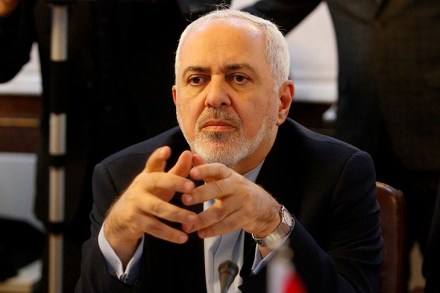
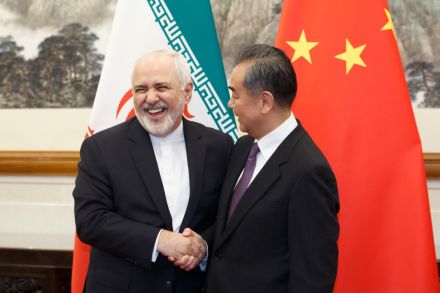
On 20 May, Iran’s foreign minister, Mohammad Javad Zarif, predicted that Donald Trump would fail to subdue Iran just as Alexander the Great and Genghis Khan had failed before him. That Alexander burned Persepolis to the ground and Genghis and his descendants wrought devastation before colonising the Persian plateau doesn’t connote defeat in the Iranian long view; neither the Macedonians nor the Mongols were able to extinguish Iran’s vigour and creativity, which reasserted themselves as soon as the invaders had moved on or been assimilated by the superior civilisation around them. ‘Iranians have stood tall for millennia while aggressors all gone (sic),’ was how Zarif concluded his aspersion on American staying power.

How would America really ‘end’ Iran?

Donald Trump says that America could ‘end’ Iran, and no doubt we could. The US could launch an air campaign that would destroy the Islamic Republic’s most important military assets. But it’s hard to see exactly how. With a diminishing number of useful allies, not to mention a military exhausted from 18 years of war on terror, America is not in the position it once was to exert great force in the Middle East. Ever since the push to invade Iraq, the US has been shedding allies. We have become increasingly dependent for help on an unimpressive handful of wannabes. Turkey sat out the Iraq War: so did France, Germany and Canada, three of our most potent military supporters.

iran bark bite

Russia and China are watching Iran, and waiting

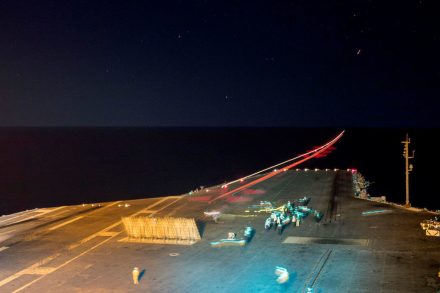
As US-Iran tensions rise, America’s sway over its allies is falling. Last week, Major General Christopher Ghika, the British officer second in command of anti ISIS forces in Iraq and Syria, publicly contradicted the rationale behind American troop build-ups in the region. US Central Command was quick to rebuff Ghika, but Britain’s Ministry of Defence supported him. Other NATO allies, too, are balking at confrontation with Iran. Spain has withdrawn a frigate from the American-led, Gulf-bound carrier group. Federica Mogherini, the EU’s High Representative for Foreign Affairs, has called for ‘maximum restraint’. If there is to be a third Gulf War, the US might find itself with fewer friends than in the last.

iran